
Irtah (Sha’ar Efrayim)
THE DAY BY DAY NORMALIZATION AND DEEPENING OF THE OCCUPATION:
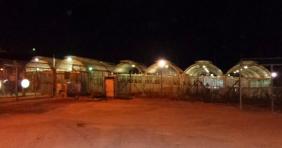
the development at the Irtah-Terminal by the almost finished
construction of new additions.
4.40 we arrived a bit early as we wanted to see if indeed the
Terminal opens at 4.45 which it did.
The literary "glowing"-new entrance at the Palestinian side
seems to work well: this Friday at dawn we see no pushing or
climbing and no shouting is heard near the fence where we are
standing. The workers come almost one by one through the
first turnstiles and enter the Terminal more organised via the
magnometers – of which there are now two .
What happens, though, at the far end of the entrance we can
not see and we wonder how the situation is there, especially
on the crowded Sundays.
4.50 While we walk to the side where the laborers exit the
Terminal, we see that after 5 minutes the first workers
already exited.
There seem to be less women this morning and almost all of them
greet us with a smile and "sabakh-a-chir" (good morning)
Those workers we talk to tell us the general situation has
improved.
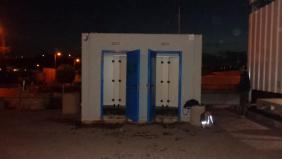
Coming closer to have a look at the new waiting area we are
met by the stench of the only two toilets(for AT LEAST 4000
workers!)
At the exit we see more booths are open than the usual 4 or 5
on Fridays : it seems 8 or 9. People come out in a steady
flow.
We leave at around 5.30.
Irtah (Sha'ar Efrayim)
See all reports for this place-
The checkpoint is for Palestinians only. It is the main barrier to the passage of workers from the northern West Bank to Israel. Workers with a permit to work in Israel and also for trade (with appropriate permissions), medicine, and visiting prisoners. One can cross the checkpoint only on foot. The checkpoint is located north of Road 557 and south of Tulkarm. Operated by a civil security company, opening hours: between 4:00 and 19:00 on weekdays. As members of Machsom Watch, we began our shifts to this location in 2007. We arrived before it opened at 4 in the morning and report since, on the harsh conditions and the long and crowded queues of workers. The workers who pass by continue their journey by transportation to work throughout Israel. In the first period of its activity, about 3,000 and then 5,000 people passed through this checkpoint every day. Due to the small number of checking points and arbitrary delays for long periods of time in the "rooms", workers feared losing their transportation. Hence workers leave their homes at 2:30 at night to be among the first. Today, 15,000 pass and the transition is faster. Workers are still leaving their homes very early to get past the checkpoint at 7 p.m. In an adjacent compound, there is a terminal for the transfer of goods on a commercial scale, using the back-to-back method.
-
