
Irtah (Sha’ar Efrayim)
At 4:50 a.m. people are already exiting the compound.
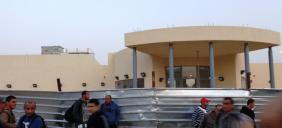
We walk towards the area from where the Palestinian construction workers and fruit and vegetable pickers enter Israel for work for the Israeli economy. People arrive and enter the compound immediately.
However, the sheds outside and the entry paths that have been added and channel the people do not 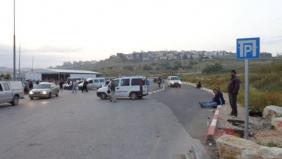 save time nor shorten their process inside the building and the ‘rooms’. We timed how long it took a man to go from the path behind the entrance sheds to the exit from the turnstile leading outside the building – 20 minutes, similar to that time it took before all these ‘improvements’ were made.
And people do complain of the pressure and the inspections. The random and arbitrariness experienced by individuals add up to a collective experience of the occupation. One of the men coming out tells us that inside someone had felt sickly as a result of the crowing and suffocated, and had to be taken to hospital.
A few days ago, the current Minister of the Interior Ardan declared he would promote the mandatory implementation of the biometric database. If we wanted to know about the precision of biometric identification, today we learned that a worker holding all the necessary permits was not allowed through because his finger print was not identified. And this has not been a singular case.
6:15 a.m. – we left.
Irtah (Sha'ar Efrayim)
See all reports for this place-
The checkpoint is for Palestinians only. It is the main barrier to the passage of workers from the northern West Bank to Israel. Workers with a permit to work in Israel and also for trade (with appropriate permissions), medicine, and visiting prisoners. One can cross the checkpoint only on foot. The checkpoint is located north of Road 557 and south of Tulkarm. Operated by a civil security company, opening hours: between 4:00 and 19:00 on weekdays. As members of Machsom Watch, we began our shifts to this location in 2007. We arrived before it opened at 4 in the morning and report since, on the harsh conditions and the long and crowded queues of workers. The workers who pass by continue their journey by transportation to work throughout Israel. In the first period of its activity, about 3,000 and then 5,000 people passed through this checkpoint every day. Due to the small number of checking points and arbitrary delays for long periods of time in the "rooms", workers feared losing their transportation. Hence workers leave their homes at 2:30 at night to be among the first. Today, 15,000 pass and the transition is faster. Workers are still leaving their homes very early to get past the checkpoint at 7 p.m. In an adjacent compound, there is a terminal for the transfer of goods on a commercial scale, using the back-to-back method.
-
