
Irtah (Sha'ar Efrayim)
On arrival we saw that the parking lot had new lines and arrows painted on it. Most of the vans for transporting workers were lined up neatly, totally ignoring the new markings.
The big trash dumpster has moved from the parking lot to behind the toilets.
On our way to the security barrier we found a new gate, locked, blocking the way to our usual lookout spot.
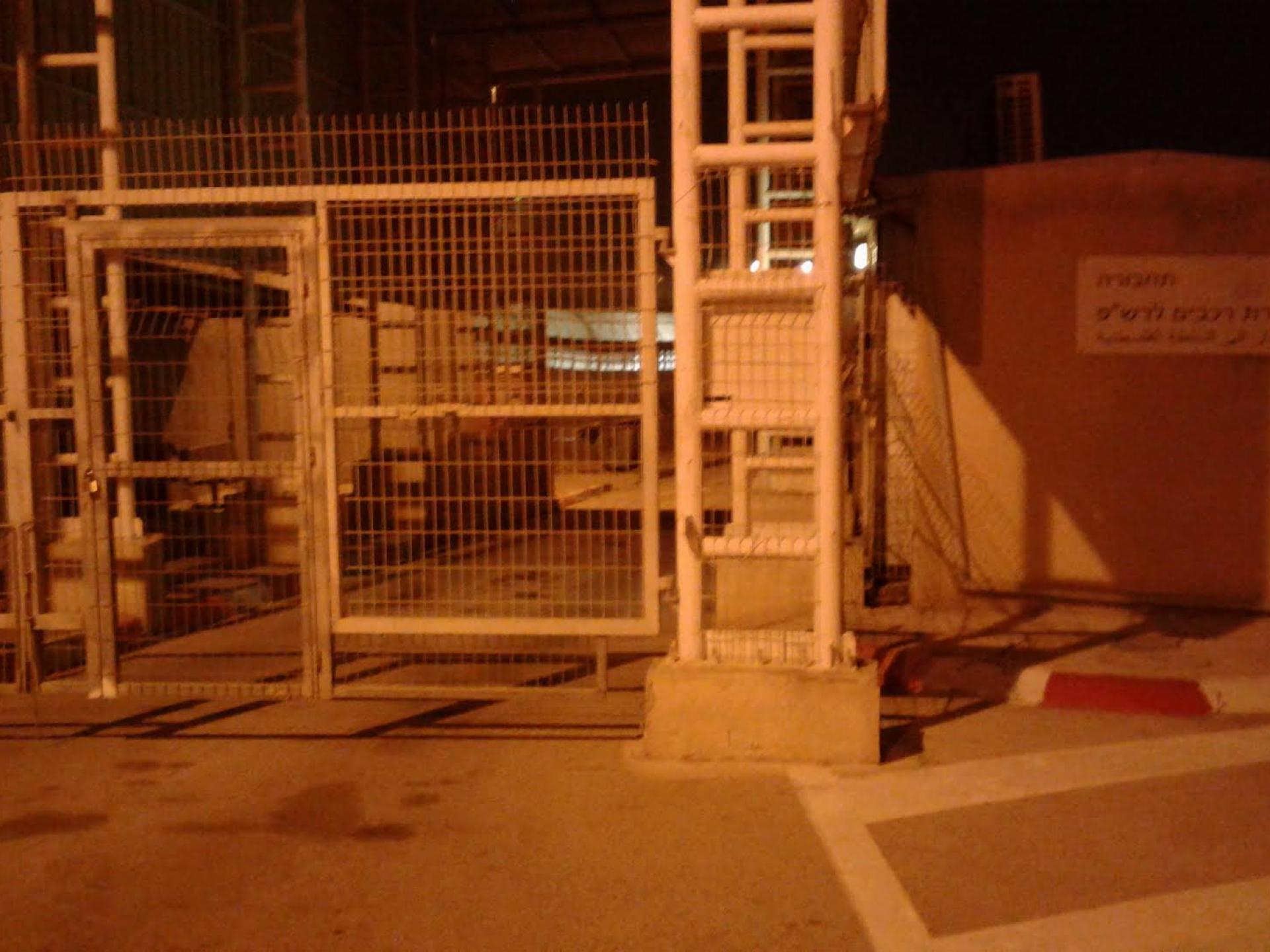
A guard told us not to proceed until he went down to the fence and locked another gate across the army access road. We had to stand ten or twenty meters from where the Palestinians enter the checkpoint. It is no longer possible for us to call to the people passing back and forth, to ask them what’s happening. It looks like they are creating a situation like at Eyal, where there is no possibility for contact across the security barrier, and we can only see the people who have been permitted to come into Israel.
The gates opened a few minutes late, but all the time we were there we saw no pressure. People walked into the checkpoint freely as soon as they arrived, and got through in five to ten minutes. One man told us he was pleased (mabsoot).
A large crowd got backed up on the narrow path leading out to the parking lot, and the guard on duty there unlocked the vehicle gate to relieve the pressure. When we left, at 5:00, the vehicle gate was still open.
Irtah (Sha'ar Efrayim)
See all reports for this place-
The checkpoint is for Palestinians only. It is the main barrier to the passage of workers from the northern West Bank to Israel. Workers with a permit to work in Israel and also for trade (with appropriate permissions), medicine, and visiting prisoners. One can cross the checkpoint only on foot. The checkpoint is located north of Road 557 and south of Tulkarm. Operated by a civil security company, opening hours: between 4:00 and 19:00 on weekdays. As members of Machsom Watch, we began our shifts to this location in 2007. We arrived before it opened at 4 in the morning and report since, on the harsh conditions and the long and crowded queues of workers. The workers who pass by continue their journey by transportation to work throughout Israel. In the first period of its activity, about 3,000 and then 5,000 people passed through this checkpoint every day. Due to the small number of checking points and arbitrary delays for long periods of time in the "rooms", workers feared losing their transportation. Hence workers leave their homes at 2:30 at night to be among the first. Today, 15,000 pass and the transition is faster. Workers are still leaving their homes very early to get past the checkpoint at 7 p.m. In an adjacent compound, there is a terminal for the transfer of goods on a commercial scale, using the back-to-back method.
-
