
Jaba (Lil)
A detained Palestinian stood behind a police armored vehicle at the Jaba checkpoint.
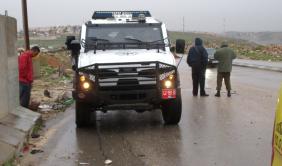
In the morning a group of young men and women left Ramallah for Ein Farah in Wadi Qelt for a day of rock climbing. On their way back policemen stopped their minivan and the commander, an officer, asked all of them for their IDs. Only then did the man (in a red sweatshirt) realize he’d forgot it at home. The officer took all of their IDS, removed from the vehicle the man who’d forgotten his and stood him by himself in the rain and cold. Until…?
The officer ordered the others to remain in the vehicle.
Time passed, the young people in the transit wanted to propose to the officer they’d bring the missing ID from his home in Ramallah, but there was no one to talk to. Because the officer doesn’t speak to Palestinians, nor with a Jewish woman. And he also forbade, loudly and threateningly, his two subordinates, a policeman and a soldier providing security, to talk to the woman asking questions.
Meanwhile the subordinates stopped, on the officer’s orders, more minivans (and only minivans), moved them to the roadside, the officer took the IDs of all the passengers, most of whom are poor, to be checked on the computer in the armored police vehicle.
And this is how they worked simultaneously: stopping, checking, detaining, shouting – the officer – and in silence – the other policeman and the soldier.
In the absence of dialogue it is only possible to base conclusions on what we see and what we hypothesize.
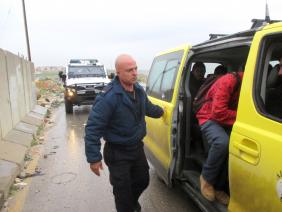
Our hypothesis, based on what we saw there, is that even if they categorically ignored us, by order, they definitely didn’t ignore the camera and it’s likely that the officer who looked ready to incriminate the criminal with the crime of leaving home without an ID was deterred by the documentation.
More time passed, the IDs were returned to their owners and the detainee was returned to his friends and their vehicle continued to Ramallah and the sovereign’s force turned to deal with other passengers in other minivans coming up the road.
Jaba' (Lil)
See all reports for this place-
Jaba' (Lil) In fact, the Jaba checkpoint is east of the Qalandiya checkpoint. Its declared purpose is the prevention of Israeli citizens from entering Area A. A road checkpoint for vehicles, located on Road 65, borders the southern fence of Kfar Jaba, about three kilometers east of the Qalandiya checkpoint, on the road leading to the settlement of Adam on Road 60. Archaeological excavations within the village found the remains of a cloth house from the First Temple period. The events that led to the construction of the checkpoint are precisely here: on the day of the abduction of Gilad Shalit and before the outbreak of the Second Lebanon War, a 17-year-old man from one of the settlements was abducted by a Palestinian cell. His body was found several days later at the entrances to Ramallah. A military investigation revealed that his abductors had taken him along this route. The checkpoint was set up to prevent future kidnappings and to warn settlers from traveling to Ramallah and entering Area A (which is forbidden for Israelis). The checkpoint that operates around the clock. Usually only vehicles traveling in the direction of Ramallah are inspected. (November 2016): Every morning, when the settlers en masse travel to Jerusalem on Route 60 and every afternoon they return from Jerusalem on Route 60, the army initiates a traffic jam at the entrance to the Jaba checkpoint and stops the movement of Palestinians traveling toward Route 60. (February 2020): In the last two years the checkpoint has not always been manned. Sometimes the soldiers come and just stand, sometimes they come and stop and check those who enter the village, sometimes they patrol the alleys of the village, sometimes they fire stun grenades and gas and sometimes they invade houses and stop young people, say those passing through the Hazma checkpoint. (Updated February 2020)
-
