
Jaba (Lil), Qalandiya, Sun 27.3.11, Afternoon
Translation: Ruth Fleishman
Qalandiya checkpoint:
On the other side of the checkpoint, next to the refugee camp, an ambulance from Jenin was parked. In it was a young man who had one of his feet in a plaster cast, a pair of crutches were next to him and inside the bundle of documents he carried was an invitation to Makassed hospital: "He has a problem in with his bones", said the ambulance driver and added: "all the co-ordinations were preformed correctly, that's what they said at the Red Crescent. It was only when we got here, an hour and a half ago, that suddenly something was wrong with the co-ordinations…" The young man, Yusuf, added: "I had been at Makassed three times already, during my last visit there, on the eleventh month, I was told that if I won't arrive for treatment (surgery), they would have to amputate my leg…". Whether it was a coincidence or it had something to do with the phone call that was made from our cell to the Line for Health Permits, Yusuf had miraculously ceased to pose a threat, the co-ordinations were "valid" once again, and the Red Crescent ambulance headed on, for the second time that day, transferring the patient to his destination.
Yusuf called us from the hospital to say that he would go through surgery on Wednesday.
At the entrance to the checkpoint was an infant, he was about three years old, he grabbed the train of his mother's clothes while in her hands she held his two younger brothers. He was probably bewitched by the shiny metal of the turnstile, so he slipped away from his mother and held on to the turnstile's bar which was turning in his hand. The child moved along with the turnstile hinge, completing half a circle, he then found himself entrapped behind the bars, only a few centimeters away from his mother, who could do nothing to release him.
The mother and the people that stood near her started to panic. They waved their hands and tried to get the soldier that was in charge of the release button to take notice, but she just sat in her post, chewing her gum, idly staring at what was going on, doubtfully seeing the shadows of the people in front of her. After several minutes, which seemed like eternity, when the yelling grew louder and penetrated her fortified room, the soldier put her hands to action and the infant returned to his mother.
Jaba checkpoint:
"The Nahal went out to the fields…" (taken from an Isreali song)
The transcript of Roni's conversation with the checkpoint commander:
– "Why is the young man sitting here in handcuffs?"
– "He is a suspect."
– "What is he suspected of?"
– "I'll send him off in a moment".
– "So he isn't a suspected anymore?"
– "No, he is a suspect!"
– "Then how do you know that he isn't suspected of anything anymore?"
– "I get my orders from above".
– "Did you send his ID number to some sort of an institution for examination?"
– "No. I'll send him off home in a moment…"
Sitting near the checkpoint was a man, he was leaning against the wall, his eyes were covered by cloth and his hands were pulled back, strapped tightly in plastic handcuffs.
From the evidence we gathered it seems that the arrest of this person was a local initiative and not an order from above. There was no "bingo" and we also didn't hear the most common alibi, which can never be confirmed: "The suspect is requested for interrogation by the GSS". The evidence to the fact that the soldier didn't really have a reason to keep this person at the checkpoint is that the young man's ID wasn't there and his personal background wasn't checked. It was probably an incidental arrest, the victim was taken from his home that afternoon by the Nahal soldiers who man the checkpoint. What for, and why?- Was it just for their plain amusement? – For the sake of the actual abuse? Or perhaps, they did it out of boredom, of which the soldiers at the checkpoints regularly complain?
It was clear from the persons pose that he was in agony. He stood with his back arched in an attempt to ease the pressure. The overly tight plastic handcuffs cut into his flesh, causing a swelling that made it hard to release him. The soldiers tried to insert a knife between the cuffs and his flesh for over ten minutes, but there wasn't a crack to be found, it was as if they were of one flesh.
The soldiers wanted the man to be quiet, and quiet he was. He just stomped his feet as the pain from the insertion of the knife became hard to bear. When he was finally released and sent off, he was told not to speak to us. The young man exposed his hands before our cameras, mumbled a couple of words and ran away down the hill towards the village.
Because of two Jewish women who had arrived there by chance at the right time, the man had been released on this occasion. Who will protect him and the many others like him on other occasions, other days, and who will be there at the dead of night?
Jaba' (Lil)
See all reports for this place-
Jaba' (Lil) In fact, the Jaba checkpoint is east of the Qalandiya checkpoint. Its declared purpose is the prevention of Israeli citizens from entering Area A. A road checkpoint for vehicles, located on Road 65, borders the southern fence of Kfar Jaba, about three kilometers east of the Qalandiya checkpoint, on the road leading to the settlement of Adam on Road 60. Archaeological excavations within the village found the remains of a cloth house from the First Temple period. The events that led to the construction of the checkpoint are precisely here: on the day of the abduction of Gilad Shalit and before the outbreak of the Second Lebanon War, a 17-year-old man from one of the settlements was abducted by a Palestinian cell. His body was found several days later at the entrances to Ramallah. A military investigation revealed that his abductors had taken him along this route. The checkpoint was set up to prevent future kidnappings and to warn settlers from traveling to Ramallah and entering Area A (which is forbidden for Israelis). The checkpoint that operates around the clock. Usually only vehicles traveling in the direction of Ramallah are inspected. (November 2016): Every morning, when the settlers en masse travel to Jerusalem on Route 60 and every afternoon they return from Jerusalem on Route 60, the army initiates a traffic jam at the entrance to the Jaba checkpoint and stops the movement of Palestinians traveling toward Route 60. (February 2020): In the last two years the checkpoint has not always been manned. Sometimes the soldiers come and just stand, sometimes they come and stop and check those who enter the village, sometimes they patrol the alleys of the village, sometimes they fire stun grenades and gas and sometimes they invade houses and stop young people, say those passing through the Hazma checkpoint. (Updated February 2020)
-
Qalandiya Checkpoint / Atarot Pass (Jerusalem)
See all reports for this place-
Click here to watch a video from Qalandiya checkpoint up to mid 2019 Three kilometers south of Ramallah, in the heart of Palestinian population. Integrates into "Jerusalem Envelope" as part of Wall that separates between northern suburbs that were annexed to Jerusalem in 1967: Kafr Aqab, Semiramis and Qalandiya, and the villages of Ar-Ram and Bir Nabala, also north of Jerusalem, and the city itself. Some residents of Kafr Aqab, Semiramis and Qalandiya have Jerusalem ID cards. A terminal operated by Israel Police has functioned since early 2006. As of August 2006, northbound pedestrians are not checked. Southbound Palestinians must carry Jerusalem IDs; holders of Palestinian Authority IDs cannot pass without special permits. Vehicular traffic from Ramallah to other West Bank areas runs to the north of Qalandiya. In February 2019, the new facility of the checkpoint was inaugurated aiming to make it like a "border crossing". The bars and barbed wire fences were replaced with walls of perforated metal panels. The check is now performed at multiple stations for face recognition and the transfer of an e-card. The rate of passage has improved and its density has generally decreased, but lack of manpower and malfunctions cause periods of stress. The development and paving of the roads has not yet been completed, the traffic of cars and pedestrians is dangerous, and t the entire vicinity of the checkpoint is filthy. In 2020 a huge pedestrian bridge was built over the vehicle crossing with severe mobility restrictions (steep stairs, long and winding route). The pedestrian access from public transport to the checkpoint from the north (Ramallah direction) is unclear, and there have been cases of people, especially people with disabilities, who accidentally reached the vehicle crossing and were shot by the soldiers at the checkpoint. In the summer of 2021, work began on a new, sunken entrance road from Qalandiya that will lead directly to Road 443 towards Jerusalem and Tel Aviv. At the same time, the runways of the old Atarot airport were demolished and infrastructure was prepared for a large bus terminal. (updated October 2021)
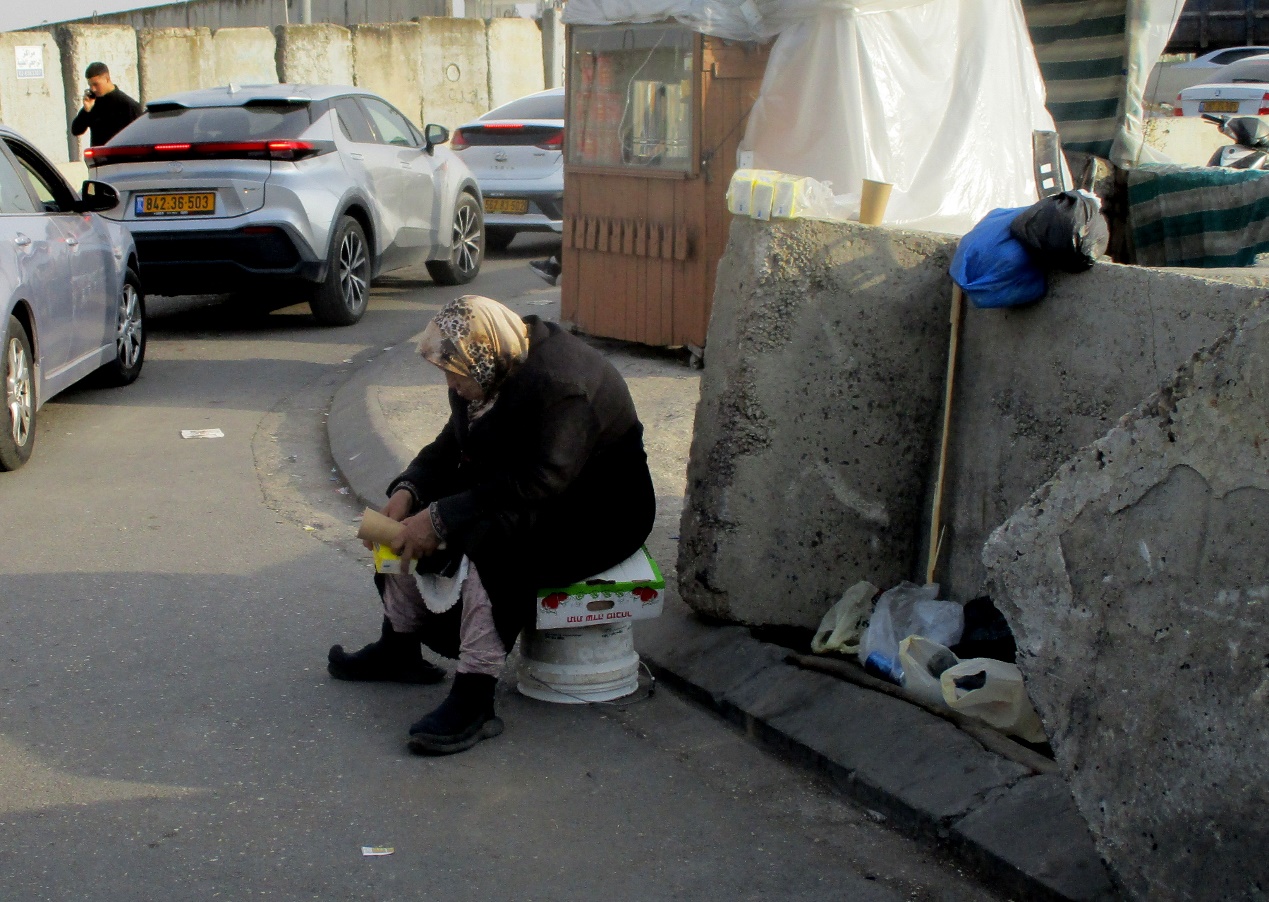 Tamar FleishmanOct-11-2026Qalandiya. Female Beggar
-
