
Jama’in, Jurish, Za’tara (Tapuah)
13:45 We depart from the train station at Rosh Ha'Ayin.
There is a new traffic light before the entrance to Sha'ar Shomron, another investment of State money in the West Bank. Each investment, whether it is in a new road, a new suburb, as well as the improvement of the checkpoints is a declaration: "we came to stay": an expression of the occupiers' belief in the endlessness of the occupation.
At the entrance to Jamma'in there is an armored military vehicle parked at the side, and a group of soldiers stopping a Palestinian car. Another armored car drives in the direction of Sha'ar Shomron. The Tapuah junction is almost entirely empty. In its center there are two soldiers roaming around and another soldier is to be seen in the watch tower.
At the entrance to the village of Kussra there is a row of young olive trees that have been planted some time ago. An appropriate Palestinian reaction to the hundreds of olive trees that were felled by the occupiers: "We are here to stay!".
14:30 Ju'rish. As in other villages in the West Bank, here to the school vacation is felt. Many boys and girls can be seen on the streets. Some are playing, others carry bundles of twigs for heating.
A short time after we arrive at the club, the girl pupils come. The first lesson if Yoga, directed by Sarah, and the second is English. There the verb to have in different persons, in regular or question sentences, is excercised, with Naomi in the lead.
And here is a request: We met today with a woman who was selling her handicraft. During the meeting of the MW members with the women of the village she begs to inform two MW members who ordered her products and paid her, that the items were ready and that she would be happy to send them to the buyers.
17:00 Departure from Ju'rish. It is freezing cold. Darkness falls. The children who ran around the streets, are already safely in their homes. There is very little vehicular traffic on the road, till the Tapuah junction. There a long motorcade moves slowly in both directions, to Nablus and to Ramallah. Now there are also only very few soldiers are seen at the junction. Not far from there a yellow barrier closes the entrance to Jamma'in which was still open a few hours before. An armoured car is parked near the entrance. At the entrance to Marda too there is a military vehicle parked, but the entrance to the village is open.
17:45 Return to Rosh Ha'Ayin.
Jamma'in*
See all reports for this place-
Jamma'in*
Jamma'in is a small town, with some of the best quarries in the area. The stone is sold all over Palestine and Israel and even outside the country. The city also has an industrial area. Although they are close to the Ariel and Tapuach settlements, Jama'in farmers have no daily problems with settlers. Harassment occurs mainly during the October harvest season - the settlers sometimes try to drive the farmers out of their plots. Jama'in has its own info-icon water reservoir tower. The water is obtained from sources and paid for by the Palestinian Authority. The city has one clinic that opens only 2-3 days a week. The biggest problem is that there is only one hospital in Nablus in an area of about 10,000 residents. This hospital is too small, does not have enough equipment, and not enough doctors.
Zeita / jama'in is a village of about 3000 inhabitants near Jama'in and Ariel. In the 1980s, land was taken from the village and transferred to settlements. Farmers in the village have lost some of their income. The settlements are located on the ridges, further away from Zeita, which is in the valley. The village does not often suffer from harassment.
The water sources for Zeita and Jama'in that have supplied water to the villages for centuries have been confiscated by the Mekorot company and the water is flowed to Ariel. Without a reasonable info-icon water supply the villages cannot develop agriculture or any industry.
The electricity comes from the Israeli Electric Company through Ariel and Jama'in.
The IDF oversees the main roads and entrances to the villages. -
Jama'in is a small town, with some of the best quarries in the area. The stone is sold all over Palestine and Israel and even outside the country. The city also has an industrial area. Although they are close to the Ariel and Tapuach settlements, Jama'in farmers have no daily problems with settlers. Harassment occurs mainly during the October harvest season - the settlers sometimes try to drive the farmers out of their plots. Jama'in has its own info-icon water reservoir tower. The water is obtained from sources and paid for by the Palestinian Authority. The city has one clinic that opens only 2-3 days a week. The biggest problem is that there is only one hospital in Nablus in an area of about 10,000 residents. This hospital is too small, does not have enough equipment, and not enough doctors. Zeita is a village of about 3000 inhabitants near Jama'in and Ariel. In the 1980s, land was taken from the village and transferred to settlements. Farmers in the village have lost some of their income. The settlements are located on the ridges, further away from Zeita, which is in the valley. The village does not often suffer from harassment. The water sources for Zeita and Jama'in that have supplied water to the villages for centuries have been confiscated by the Mekorot company and the water is flowed to Ariel. Without a reasonable info-icon water supply the villages cannot develop agriculture or any industry. The electricity comes from the Israeli Electric Company through Ariel and Jama'in. The IDF oversees the main roads and entrances to the villages.
-
Jurish
See all reports for this place-
Jurish
An ancient village, of which 62% of the lands were defined after the 1995 agreements as Area B, while the remaining 38% Area C. Israel confiscated 17 dunams of the village's land for the construction of the Israeli Migdalim settlement, in addition to expropriating land for Road 505. In mid-2016, a road was blocked by the IDF (partly paved by the Palestinian Authority) that connected Jurish to Road 505. This is the shortest way to get to Jurish from the main road, without bypassing another 6.5 km through Qusra.
From 2014 to mid-2016, volunteers from the Watch checkpoint in the village held English, yoga and Hebrew classes for girls.
-
Za'tara (Tapuah)
See all reports for this place-
Za'tara (Tapuah) Za'tara is an internal checkpoint in the heart of the West Bank, at the intersection of Road 60 and Road 505 (Trans-Samaria), east of the Tapuah settlement. This checkpoint is the "border" marked by the IDF between the north and south of the West Bank, in accordance with the policy of separation between the two parts of the West Bank that has been in place since December 2005. At the Za'tara checkpoint, there are separate routes for Israelis and Palestinians. In the route for Israelis, there are no inspections and the route for Palestinians inspects. The queue lengthens and shortens suits. The checkpoint is open 24 hours a day. The checkpoint is partially staffed and the people who pass through it are checked at random.
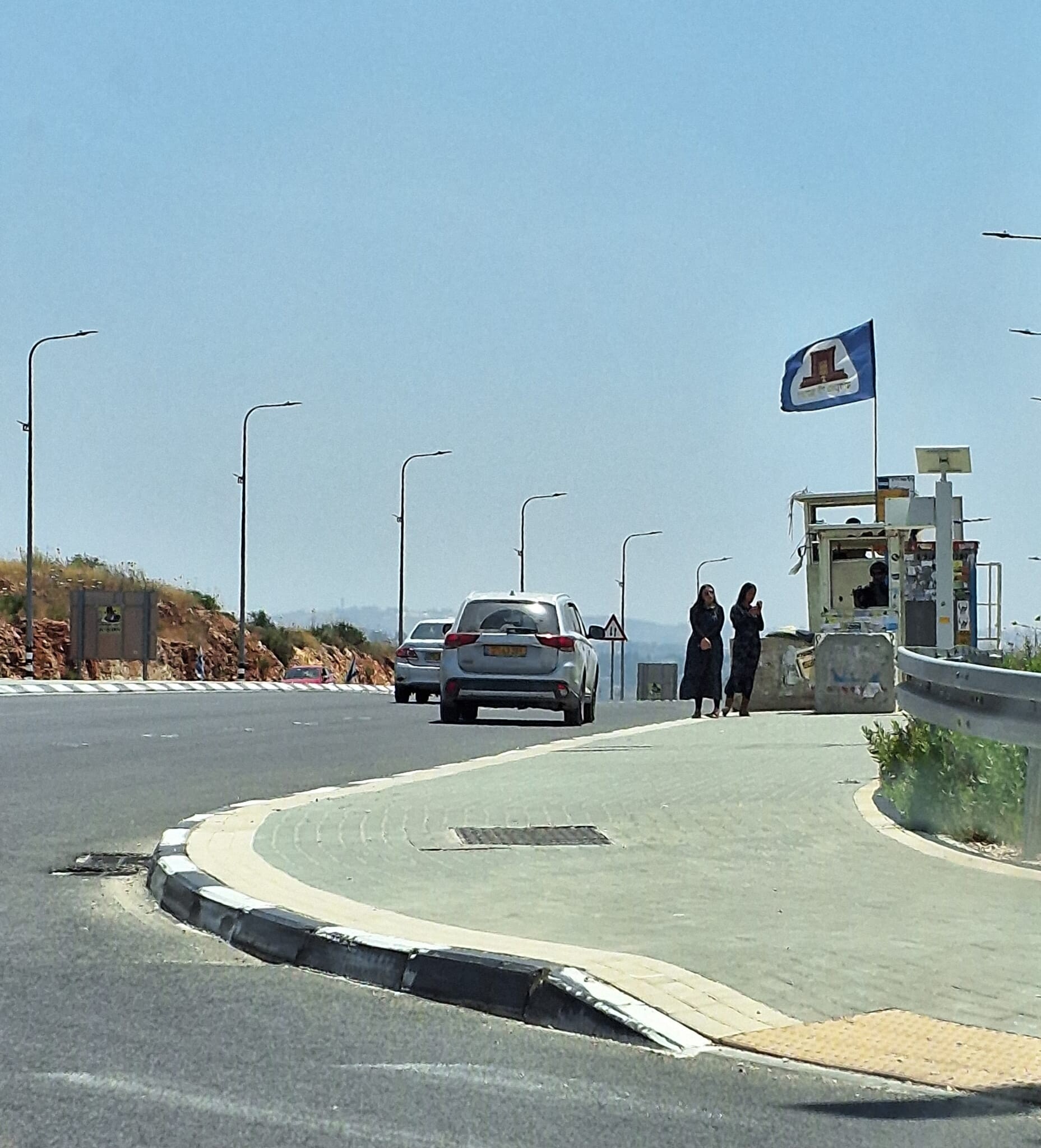 Ronit Dahan-RamatiJun-9-2026Za'atara (Tapuach Junction). The Temple Flag Above a Station
-
