
Jama’in, Za’tara (Tapuah), Zeta
Serious complaints by Zeita inhabitants and a-Sawiya people about closures and/or delays in Za’tara Junction. Zeita people who used togo to Shechem (Nablus) via Huwarra in 15 minutes are today forced to take a circuitous
route which means that the trip takes them now more than 1 hour.
The situation is especially serious in the morning and afternoon hours when more settlers use the Huwarra-Shechem road. Moreover the road is now being repaired, and the Army does not allow the Palestinians to use it. On days of terrorist attacks there is an additional hardship: at the Za’tara Junction Palestinian vehicles undergo very long searches.
10.20.ZA’TARA JUNCTION (Tapuach).
The place is quiet. Soldiers on duty in the observation tower. At the hitchiker station ( the trempiada)some settlers await transport and soldiers guard them with drawn weapons.
10.30 a-SAWIYA. Following an information which our acquaintance S.gave Aliyah, we planned to meet him and hear about problems at the Za’tara Junction. But S. was away from the village and the secretary of the Council whom we had planned to visit was already on his way out when we arrived. In a telephone conversation with Aliyah today, S. explained that the repairs in the Huwarra-Shechem road are seriously hampering Palestinians travelling between their villages. During the peak hours 7—9 am and during the afternoon hours, the Army closes the road, as A. puts it “for the settlers’ benefit and the Palestinians’ loss.” During those hours they are forced to make a big detour and to wait for a long time at the Za’tara Junction.
The headmistress of the kindergarten, which is located in front of the building of Zeita Council, invited us to visit. It has 3 classes and a playroom for the small children. In two of the rooms the older ones learn a bit of English and their abc’s. A talented young girl from the village has painted lovely scenes on the class walls.
The kindergarten headmistress, proud to show us the classes, told us that they receive donations from different organisations, including World Vision—as a sign near the awning over the playgroun proclaims. We noticed our hostess’ disappointment when we explained that we are not a philanthropic organisation.
Tsippi interviewed the headmistress. She will send her story separately to our site.
11.45 am. al-LUBBAN-a-SHARQIYAH. We hoped that this time the building of the madjeles (the council of a small village) would be open, but as has happened duringthe past year, the door was closed and there was no sign of any activity. What was very noticeable this time was the pervading prayer at the mosque broadcast by a loudspeaker throughout the village.
12.00 ZA’TARA. The Tapuach Junction was almost empty, no soldiers were to be seen.
12.15 pm. ZEITA. Some of our haverot know the viillage well from three years of joint activities with the women there. This time we wanted to meet A., a member of the Council.
The Council building is now used as a Clinic, and the office of the Council has been moved to an adjoining building, a kind of tunnel, which was redesignedand adapted to new needs. A., like the other women there, was very pleased to meet us.
She was very busy taking care of village affairs, but in spite of that she found time to sit and talk to us.
Together with two more women, she is a member of the Council: altogether three women and four men. She works hard and without pay. Joking with Nadim, she says: “the women in the Council work as is expected from the men, and the opposite is also true…” Between sentences to us, she quickly gave some instructions, and attended to several people who needed her help—all that during our meeting.
The serious problem which disturbs the villagers most is the closure of the roads they used to take, andwhich shortened the time to reach Shechem. According to A., till now the way from Zeita through Huwarra to Shechem took 15 minutes. Now it takes more than 1 hour, and sometimes even longer. On their way home from Shechem, they are forbidden to pass through Huwarra, and instead are forced to go through Awarta, and Beita to Road 60 in the direction of Za’tara Junction.
On days of terrorist attacks, very thorough inspections are carried out at Za’tara Junction, causing either closures lasting hours or else very long waits.
We asked her to update us about the usual issues. The Army passes from time to time through the village, putting up sudden closures on the road between Zeita, Qira and Deir Istiyah. But in general, it now enters the village less often.
The Shabach (Israel Security Service) also comes to the village less frequently. There are also less attempts to mobilise youngsters as collaborators. But from time to time there are arrests of wanted men.
There are no settlers in the area.
Nevertheless, there is anxiety about the future of lands which are near Deir Istiyah. Most of the village’s lands are close to Zeita and nothing prevents farmers from working on them. However, some families also possess lands near Deir Istiyah. Those are the lands they are afraid they might lose, because of the general situation of the territories in the neighbourhood of Deir Istiyah.
Jamma'in*
See all reports for this place-
Jamma'in*
Jamma'in is a small town, with some of the best quarries in the area. The stone is sold all over Palestine and Israel and even outside the country. The city also has an industrial area. Although they are close to the Ariel and Tapuach settlements, Jama'in farmers have no daily problems with settlers. Harassment occurs mainly during the October harvest season - the settlers sometimes try to drive the farmers out of their plots. Jama'in has its own info-icon water reservoir tower. The water is obtained from sources and paid for by the Palestinian Authority. The city has one clinic that opens only 2-3 days a week. The biggest problem is that there is only one hospital in Nablus in an area of about 10,000 residents. This hospital is too small, does not have enough equipment, and not enough doctors.
Zeita / jama'in is a village of about 3000 inhabitants near Jama'in and Ariel. In the 1980s, land was taken from the village and transferred to settlements. Farmers in the village have lost some of their income. The settlements are located on the ridges, further away from Zeita, which is in the valley. The village does not often suffer from harassment.
The water sources for Zeita and Jama'in that have supplied water to the villages for centuries have been confiscated by the Mekorot company and the water is flowed to Ariel. Without a reasonable info-icon water supply the villages cannot develop agriculture or any industry.
The electricity comes from the Israeli Electric Company through Ariel and Jama'in.
The IDF oversees the main roads and entrances to the villages. -
Jama'in is a small town, with some of the best quarries in the area. The stone is sold all over Palestine and Israel and even outside the country. The city also has an industrial area. Although they are close to the Ariel and Tapuach settlements, Jama'in farmers have no daily problems with settlers. Harassment occurs mainly during the October harvest season - the settlers sometimes try to drive the farmers out of their plots. Jama'in has its own info-icon water reservoir tower. The water is obtained from sources and paid for by the Palestinian Authority. The city has one clinic that opens only 2-3 days a week. The biggest problem is that there is only one hospital in Nablus in an area of about 10,000 residents. This hospital is too small, does not have enough equipment, and not enough doctors. Zeita is a village of about 3000 inhabitants near Jama'in and Ariel. In the 1980s, land was taken from the village and transferred to settlements. Farmers in the village have lost some of their income. The settlements are located on the ridges, further away from Zeita, which is in the valley. The village does not often suffer from harassment. The water sources for Zeita and Jama'in that have supplied water to the villages for centuries have been confiscated by the Mekorot company and the water is flowed to Ariel. Without a reasonable info-icon water supply the villages cannot develop agriculture or any industry. The electricity comes from the Israeli Electric Company through Ariel and Jama'in. The IDF oversees the main roads and entrances to the villages.
-
Za'tara (Tapuah)
See all reports for this place-
Za'tara (Tapuah) Za'tara is an internal checkpoint in the heart of the West Bank, at the intersection of Road 60 and Road 505 (Trans-Samaria), east of the Tapuah settlement. This checkpoint is the "border" marked by the IDF between the north and south of the West Bank, in accordance with the policy of separation between the two parts of the West Bank that has been in place since December 2005. At the Za'tara checkpoint, there are separate routes for Israelis and Palestinians. In the route for Israelis, there are no inspections and the route for Palestinians inspects. The queue lengthens and shortens suits. The checkpoint is open 24 hours a day. The checkpoint is partially staffed and the people who pass through it are checked at random.
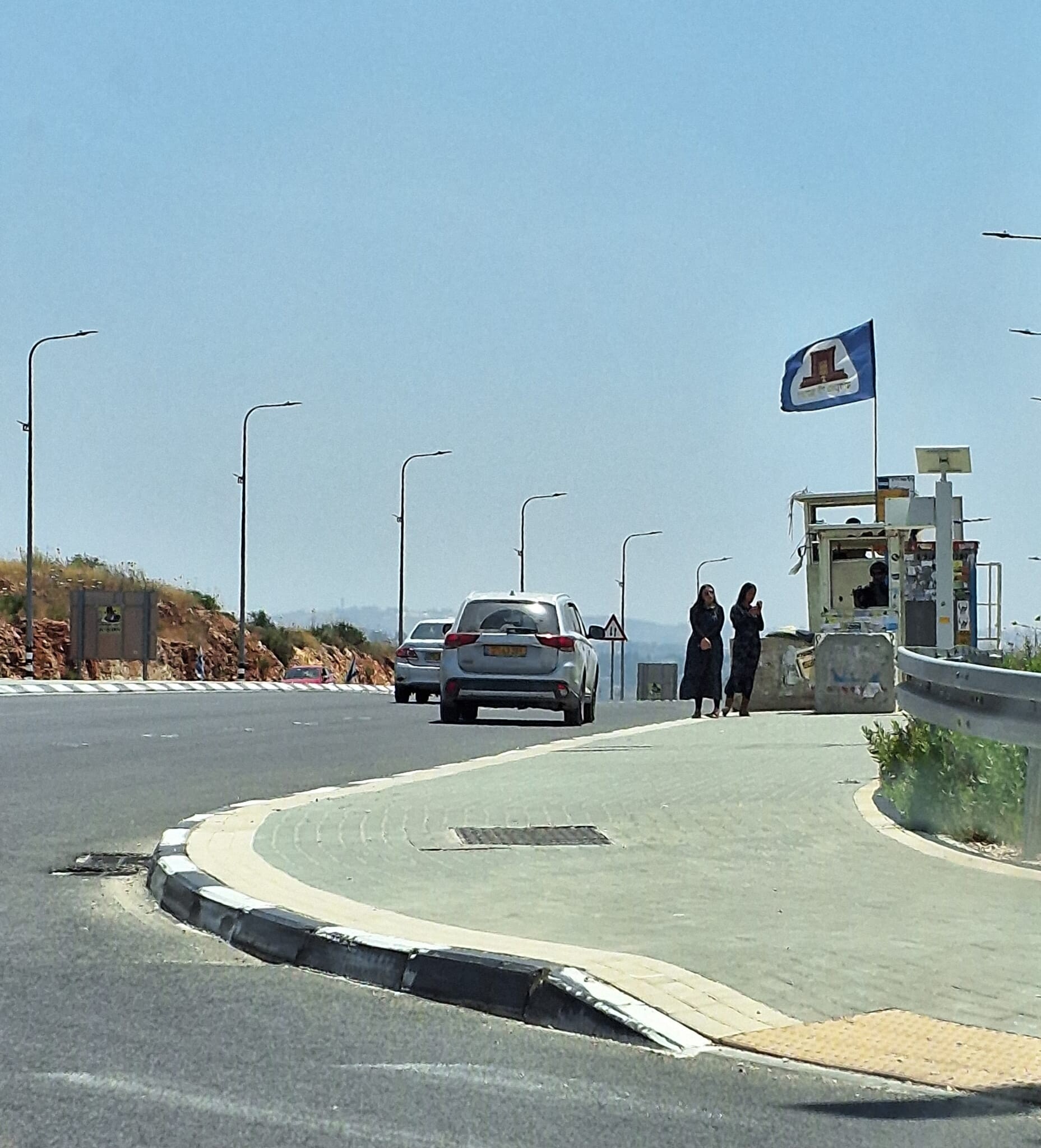 Ronit Dahan-RamatiJun-9-2026Za'atara (Tapuach Junction). The Temple Flag Above a Station
-
Zeta South (564)
See all reports for this place-
Zeta South (564) Agricultural checkpoint. Allows passage to farmers whose lands have been imprisoned beyond the Separation Barrier. The crossing is allowed for special permit holders, for three days a week: noon and afternoon for 15 minutes at a time. The Palestinians who need to pass are complaining about the short times and the few days they can work on their land.
-
