
Jebel Jalis – a very violent attack by the settlers of Givat Gal
Following a video that reached Mira from Hamed Qawasma which recorded a violent riot in the village of Jabel Jalis. The violence was by settlers from the Givat Gal neighborhood, which belongs to Kiryat Arba. We decided to look for the place and get to it.
At the Meitar crossing the parking lot was full. In a position near the fence on the Israeli side, a soldier is standing and looking through binoculars on the Palestinian side. The work of uprooting the trees along the fence continues and the roadside, which was always full of cars, is now empty. Gate 11, the pedestrian illegal pass, is completely blocked.
Further down the road the plowing is at its peak. The Palestinians plow every piece of land, even the smallest, so that the Israeli authorities don’t say that the land has not been cultivated for several years and will become “state land”. Donkeys are also recruited for this purpose.
In Eshtamoa’, four new caravans glisten in the sunlight.
Works at the Dura-Al Fawwar intersection, and the person who supervises the works and the army that guards the workers is a soldier from the Ben Gvir army.
We entered Kiryat Arba through the industrial area, from where the road leads to Jabel Jalis, the village where settler violence was reported from the Givat Gal neighborhood. Muhammad managed to find out where the video was taken and we arrived at the place.
The village is between Givat Gal and a military camp which is only tens of meters away from the village houses. We have been here before, when the Jewish settlement on this hill was just beginning. The new settlers have taken much of the Tamimi family’s agricultural lands.
Since then, the Jewish neighborhood in Givat Gal has grown wonderfully that is the word.
Abu-Rami, the mayor of the village, came out to us and began to tell in Amos Oz’s style in Hebrew, what the lives of the villagers are like. The rampage of the settlers described in the video sent by Hamed began after a British TV crew came to do a report on the conflict. To show what the life of the Palestinians is like next to violent settlers and the army which does nothing to protect the Palestinians.
The event began in the afternoon, when settlers from Givat Gal entered the village, and began rioting and destroying indiscriminately. One of the villagers was injured, and sought medical aid. It seems the TV crew didn’t need more than that. However, the event continued into the evening.
In the evening, around 9 o’clock, about 50 settlers from Givat Gal arrived again, about ten of them were in uniform, and the whole area was full of settlers and the soldiers guarding them. The rioters also entered the houses and the courtyards of the houses as shown. This is the place where the riot described in the video took place, near Abu Rami’s house
A heroic settler woman came with an ax and smashed the windows of one of the family’s vehicles, hit the roof of the car with the ax, and another settler came with a knife and slashed the tires. They also entered yards and houses, all under the watchful eye of the army. Not one of the rioters was arrested. On the other hand, complaints were filed against Abu Rami and two of his sons. One of them is a doctor who works in Bethlehem and was at the time still in the clinic and the other is the son whose car was destroyed.
For two days, Abu-Rami tried to file a complaint at the police station in Givat Avot — the station (which is near the residence of Knesset member Ben-Gavir), has a separation between the residents who turn: one side goes to Givat Avot, and another side, goes to Hebron, Palestine. From there, the Palestinian residents file complaints and settle their affairs. Abu-Rami was not received at the police station, and he gave up trying. He says that after a few days the police called to find out the satisfaction with the police treatment and rate it between 1-10. There is humor in the police.
Additional events:
– A few days ago, his 75-year-old brother went out to pasture. Settlers from Givat Gal beat him, wounded the sheep, threw large stones at him. He was wounded in the chest, hand and leg and needed medical attention. He told about poisoned figs that were scattered on the road leading to his house. The sheep ate from the figs and some of them died, and the members of the household who drank the milk from the sheep, were taken to the hospital in Hebron for medical treatment
Abu-Rami planted a plot of vegetables not far from the house. In the morning when he went down to the plot he saw that someone had visited the plot during the night, uprooted some of the vegetables, and also sabotaged the irrigation pipes. He filed a complaint against an unknown person.
The next day, he decided to ambush the vandal and went out to the plot, and indeed the settler returned to the scene of the crime.
– Abu-Rami planted a plot of vegetables not far from the house. In the morning when he went down to the plot he saw that someone had visited the plot during the night, uprooted some of the vegetables, and also sabotaged the irrigation pipes. He filed a complaint against an unknown person.
The next day, he decided to ambush the vandal and went out to the plot, and indeed the settler returned to the scene of the crime. He captured him and took him to the military base, telling them that this is the perpetrator. They freed him telling Abu Rami that it is forbidden to arrest Jews on a Saturday, the reason being that it is impossibe to take them by car to the police station on Shabbat. But to damage and destroy on Shabbat is allowed and cancels the Sabbath. The complaint still exists. What remains is that Abu rami has only told us the tip of the iceberg.
The event began in the afternoon, when settlers from Givat Gal entered the village, and began rioting and destroying indiscriminately. One of the villagers was injured, and sought medical aid. It seems the TV crew didn’t need more than that. However, the event continued into the evening.
In the evening, around 9 o’clock, about 50 settlers from Givat Gal arrived again, about ten of them were in uniform, and the whole area was full of settlers and the soldiers guarding them. The rioters also entered the houses and the courtyards of the houses. This is the place where the riot described in the video took place, near Abu Rami’s house.
A heroic settler woman came with an ax and smashed the windows of one of the family’s vehicles, hit the roof of the car with the ax, and another settler came with a knife and slashed the tires. They also entered yards and houses, all under the watchful eye of the army. Not one of the rioters was arrested. On the other hand, complaints were filed against Abu Rami and two of his sons. One of them is a doctor who works in Bethlehem and was at the time still in the clinic and the other is the son whose car was destroyed.
For two days, Abu-Rami tried to file a complaint at the police station in Givat HaAvot – the station (which is near the residence of Knesset member Ben-Gvir), has a separation between the residents who turn: one side goes to Givat Avot, and another side, goes to Hebron, Palestine. From there, the Palestinian residents file complaints and settle their affairs. Abu-Rami was not received at the police station, and he gave up trying. He says that after a few days the police called to find out the satisfaction with the police treatment and rate it between 1-10. There is humor in the police.
As always I get interested in the water system. The water here arrives in a pipeline from the Hebron municipality and is stored under the house in a cistern. Water in pumped to containers which are on the roof and then reach the house.
Abu Rami wants to publicize his tale and asks for our help/
Dura Al-Fawwar Junction
See all reports for this place-
Junction on Route 60: west - the town of El Dura, east - the Al Fawwar refugee camp. There is a manned pillbox at the junction. From time to time the army sets up flying checkpoints at the entrance to El Fawwar and Al Dura. Al-Fawwar is a large refugee camp (7,000 inhabitants in 2007) established in 1949 to accommodate Palestinian refugees from Be'er Sheva and Beit Jubrin and environs. There are many incidents of stone-throwing. In the vicinity of the pillbox there are excellent agricultural areas, Farmers set up stalls adjacent to the plots close to the road. In recent months the civil administration has set up dirt embankments thereby blocking access to the stalls, and making it impossible for the farmers to sell their vegetables. Updated April 2021, Michal T.
-
Hebron
See all reports for this place-
According to Wye Plantation Accords (1997), Hebron is divided in two: H1 is under Palestinian Authority control, H2 is under Israeli control. In Hebron there are 170,000 Palestinian citizens, 60,000 of them in H2. Between the two areas are permanent checkpoints, manned at all hours, preventing Palestinian movement between them and controlling passage of permit holders such as teachers and schoolchildren. Some 800 Jews live in Avraham Avinu Quarter and Tel Rumeida, on Givat HaAvot and in the wholesale market.
Checkpoints observed in H2:
- Bet Hameriva CP- manned with a pillbox
- Kapisha quarter CP (the northern side of Zion axis) - manned with a pillbox
- The 160 turn CP (the southern side of Zion axis) - manned with a pillbox
- Avraham Avinu quarter - watch station
- The pharmacy CP - checking inside a caravan with a magnometer
- Tarpat (1929) CP - checking inside a caravan with a magnometer
- Tel Rumeida CP - guarding station
- Beit Hadassah CP - guarding station
Three checkpoints around the Tomb of the Patriarchs
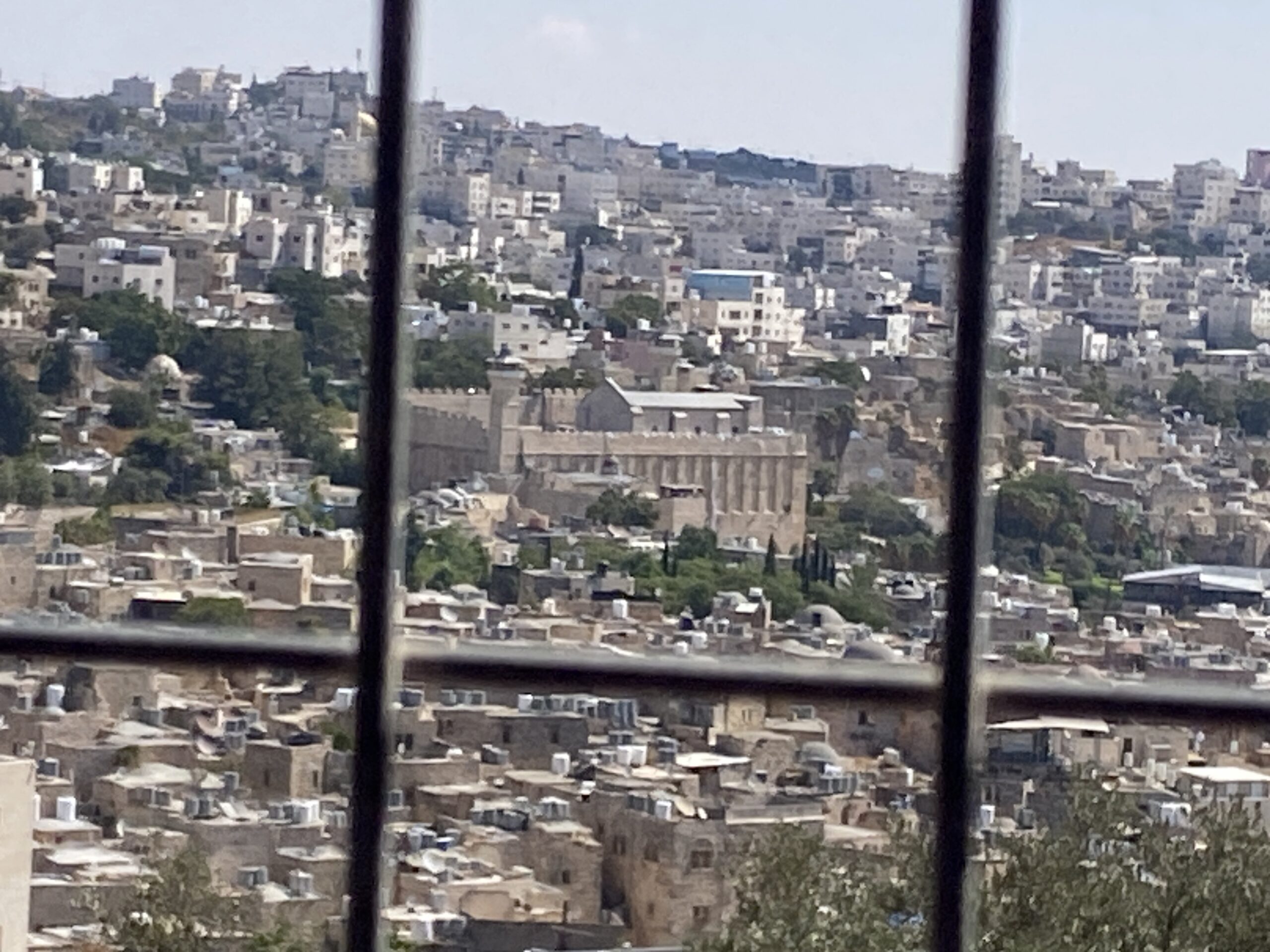 Yael ZoranSep-24-2026Hebron and the Cave of the Patriarchs from Beit Hashalom
-
Meitar checkpoint / Sansana
See all reports for this place-
Meitar Checkpoint / Sansana The checkpoint is located on the Green Line and serves as a border crossing between Israel and the West Bank. It is managed by the Border Crossing Authority of the Defense Ministry. It is comprised of sections for the transfer of goods as well as a vehicle checkpoint (intended for holders of blue identity cards, foreign nationals or diplomats and international organizations). Passing of Palestinians is prohibited, except for those with entry permits to Israel. Palestinians are permitted to cross on foot only. The crossing has a DCO / DCL / DCL / DCL (District Coordination Office), a customs unit, supervision, and a police unit. In the last year, a breach has been opened in the fence, not far from the crossing. This breach is known to all, including the army. There does not appear to be any interest in blocking it, probably as it permits needed Palestinian workers without the bureaucratic permits to get to work in Israel. Food stalls and a parking area economy have been created, but incidents of violent abuse by border police have also been recorded. Updated April 2022
-
South Hebron Hills
See all reports for this place-
South Hebron Hills
South Hebron Hills is a large area in the West Bank's southern part.
Yatta is a major city in this area: right in the border zone between the fertile region of Hebron and its surroundings and the desert of the Hebron Hills. Yatta has about 64,000 inhabitants.
The surrounding villages are called Masafer Yatta (Yatta's daughter villages). Their inhabitants subsist on livestock and agriculture. Agriculture is possible only in small plots, especially near streams. Most of the area consists of rocky terraces.Since the beginning of the 1980s, many settlements have been established on the agricultural land cultivated by the Palestinians in the South Hebron Hills region: Carmel, Maon, Susia, Masadot Yehuda, Othniel, and more. Since the settlements were established and Palestinians cultivation areas have been reduced; the residents of the South Hebron Hills have been suffering from harassment by the settlers. Attempts to evict and demolish houses have continued, along with withholding water and electricity. The military and police usually refrain from intervening in violent incidents between settlers and Palestinians do not enforce the law when it comes to the investigation of extensive violent Jewish settlers. The harassment in the South Hebron Hills includes attacking and attempting to burn residential tents, harassing dogs, harming herds, and preventing access to pastures.
There are several checkpoints in the South Hebron Hills, on Routes 317 and 60. In most of them, no military presence is apparent, but rather an array of pillboxes monitor the villages. Roadblocks are frequently set up according to the settlers and the army's needs. These are located at the Zif Junction, the Dura-al Fawwar crossing, and the Sheep Junction at the southern entrance to Hebron.
Updated April 2022
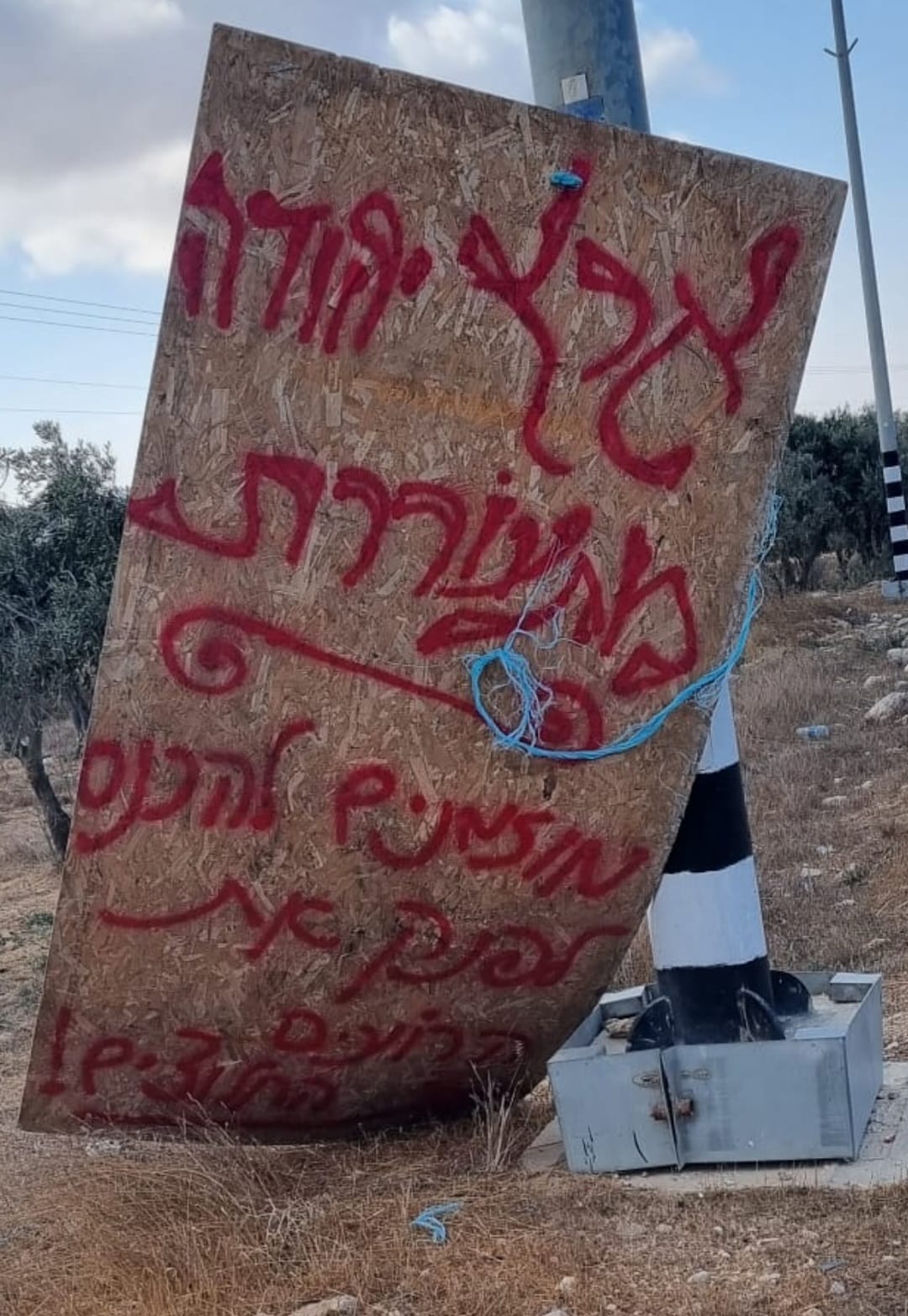 Smadar BeckerOct-17-2026A sign placed by those who call themselves the Pioneer Shepherds, at the outpost adjacent to Qawawis
-
