
Jit Junction, Deir Sharaf, Beit Iba,Shave Shomron
Jit Junction, Deir Sharaf, Beit Iba,Shave Shomron Sunday 30.07.06 PM Observers: Alex W, Susan L (reporting)Guests: Monica P., Stuart W. Summary We associate the eagle with (American) patriotism, with the military, and with pride so maybe it was not surprising that we saw one — if it indeed was an eagle — soaring over the parched, dry fields just beyond Fonduk not far from the settlement of Qedumim. A bird with a huge wing span, soft beige coloring and a white head. Beautiful. One could forget its power as it wheeled in circles high above. But we couldn’t help but wonder what it might make of the supreme dominion exercised over Palestinians everywhere, but observed today particularly at Jit Junction, just beyond the next set of hills and at Ar-Ras (see separate report) where behaviors inappropriate to a soldier — indeed any decent human being — made a mockery of “pride” in all its several meanings. And what of pride that “goeth before a fall?” The Book of Proverbs surely had it right that a people with such overconfidence and arrogance are likely to fail in the long run. 13:15 On the way from Qalqiliya: At Azzun, the young men gathered round the forty day old concrete blocks barring the way in and out of the village and also barring human beings from earning a livelihood, are in an expansive and jovial mood, willing to josh with us while also lamenting the state of affairs that they – and we – find ourselves in. An eagle, soaring high above the parched fields beyond Fonduk, before Qedumim – an omen, a warning? Certainly a symbol….13:35 Jit JunctionThe long line of vehicles snaking its way down the hill westwards, towards the junction to Beit Iba, tells us that there’s a rolling, almost permanent checkpoint, here. Hardly any traffic at all from the Za’atra side. The road is narrow, the summer sun beats down on everybody. The soldiers, three of them at the concrete barriers, tin roof overhead, make sure to tell us that each of one of them is in charge. No one is willing to talk in a civil manner, certainly not to Palestinians, and to us the excuse is that “surely you know what went on this morning at Beit Iba.” 13:50 A yellow taxi, full to the brim with passengers, stands way outside the long line of waiting vehicles, and the Hebrew speaking driver and soldiers exchange words. The driver points to a sick toddler in the back, resting on his mother’s lap. The soldier is adamant, that the taxi go back to the end of the line, probably to wait an hour before being checked. The driver now says they’re on their way to chemotherapy for the child, in Qalqiliya. The soldiers are adamant, the taxi driver refuses to give way, places the taxi on the side of the road, all passengers still in it. The driver, of course, must be punished by the soldiers – for behaving as a “Mensch,” for standing up to the arrogance and cruelty of these young soldiers, and is led to the other side of the junction, told to wait, and wait and wait, leaning against the roadway’s guard rail. As phone calls are being placed to Dalia Bassa, a UN ambulance, sporting the light blue UN flag, miraculously appears. We plead with the ambulance driver, the health worker riding next to him promptly gets out of the ambulance, goes over to the taxi, and mother and child plus two other female relatives walk haltingly over to the ambulance. As they do so, they ask whether they should hand the taxi fare to the soldiers; we advise, no, that we will hand the shekels over to the punished taxi driver. Tears come to our eyes: the goodness of humans on the one hand, the thoughtfulness and looking out for the other, as opposed to the supreme dominion and inhumanity of the soldiers. The UN ambulance wends its way towards getting help for the child, there’s another chemotherapy patient already inside, and we deal with the taxi driver, who accepts his fares stoically, not surprised in the least. The soldier from the eastern side of the junction comes over and boasts how wonderful it was that the ambulance came by when it did, and how good it was that he had managed to get mother and child into it! We can see plainly how the story would play from the IDF Spokesman’s Office…. 14:05 Meanwhile, the three other women who were in the taxi are let through the checkpoint and wait just beyond it for the young men. One is soon called, but the other is made to wait as a car, a truck a semi-trailer, whatever vehicles have already stood in line are beckoned to the checkpoint. A pedestrian, a doctor, on his way to renew his permit at Qedumim DCO, is made to wait, but is let through before the last remaining passenger from the taxi. He’s a pharmacy student at An-Narjah University in Nablus, hasn’t made it to the university at all today, as Beit Iba was closed. He was there already at 06:30 in the morning. Only now is he making his painful way home…14:30 Shavei ShomronNot a soul in sight, but from out of the window of the new military lookout tower, a hand, with those inimitable army gestures, indicates we’re not welcome. We’ve no desire to stay in any case, wave and turn around, making our way to: 14:35 Deir SharafFrom Jamal, the minimarket owner, we learn that “they say” there was a bomb. In any case, “they” exploded something near by, already at around 05:00, and the checkpoint was closed after that until midday. So, that’s one explanation for the thousands of people that were milling around in the area in the morning hours. Also an explanation for the fact that the Huwwash Bros. carpentry shop was closed (which it never is) since they couldn’t get through from Nablus. Also an explanation for the fact that there are fewer people than usual at Beit Iba. Beit Iba14:55 There was “lots of pressure,” laments the commander at the checkpoint, “earlier in the day,” but he leaves the story at that. There are, in fact, two vehicle lines open, from Nablus, but the line in the opposite direction is empty. There’s no taking turns, no order to what’s going on. Everybody is subject to the beck and call of the soldiers. When one vehicle moves forward, the soldier calls, “I said, no,” and the car or truck or bus has to back up. The vehicle line trying to get out of Nablus is long, the drivers tense, with good reason, and a white Mercedes’ driver shows his lack of patience as the soldiers call a bus (which is empty) before him. A lot of people, including the guard from the quarry near by, get involved, and the bus backs into the car, which is barely scratched. The driver of the fancy car continues to argue even after he’s allowed to drive on. Behind him, the wait time increases. More practically empty buses (after all nobody could get into Nablus in the morning, so there’s nobody to come out). The commander wanders over from the pedestrian checking point, murmurs to the soldiers, but little changes with his intervention. At one point, a Passat driver is told to turn back to Nablus, and the soldier, in perfect English, mutters, “I don’t give a fuck.” And what he says, in whatever language, however ugly, goes. Young boys are having a field day, weaving supermarket carts or other push carts through the checkpoint as “porters.” Their measly piles of goods are checked cursorily, but several times one teenager comes with another two, who are promptly sent back by the soldiers to go through the proper way. 15:55 At the pedestrian checking area, there is only one detainee throughout our shift. A young man who had been “uppity,” whom the commander has decided to “punish.” He stretches out on the wooden benches, seemingly relaxed. There is crowding at the turnstiles, nothing untoward, the checking of bags is less than usual, but young women’s names are also checked against the long list of ID numbers carried by each solider. Overall, less people than usual. 16:15 At the kiosk at Beit Iba, for once, there’s no good pop music playing. Instead, and not surprisingly, based on what the IAF wrought on Lebanon earlier in the day, martial sounding music and speeches. On the way to AnabtaWe see proof of what we hear from the men at Beit Iba: that the Shavei Shomron checkpoint, now fully guarded with brand new military watchtower and prettily decorated wall (for the benefit of the settlers) is completely closed even to ambulances and certainly to the inhabitants of Sebastia, visible just beyond the checkpoint. No wonder we see the minibuses making their tortuous way across fields, assuming that they can still find a way through the trenches and mounds created continuously anew by the army.
Beit Iba
See all reports for this place-
A perimeter checkpoint west of the city of Nablus. Operated from 2001 to 2009 as one of the four permanent checkpoints closing on Nablus: Beit Furik and Awarta to the east and Hawara to the south. A pedestrian-only checkpoint, where MachsomWatch volunteers were present daily for several hours in the morning and afternoon to document the thousands of Palestinians waiting for hours in long queues with no shelter in the heat or rain, to leave the district city for anywhere else in the West Bank. From March 2009, as part of the easing of the Palestinian movement in the West Bank, it was abolished, without a trace, and without any adverse change in the security situation.
 Jun-4-2014Beit-Iba checkpoint 22.04.04
-
Jit Junction
See all reports for this place-
The checkpoint is located on Route 60 near at the junction with Route 55, near the village of Jit. There was a checkpoint for vehicles passing between the north and south of the West Bank, which was abolished towards 2010. Since then, surprise checkpoints have been set up there from time to time with a police or Border Police vehicle, and vehicles and their passengers are inspected.
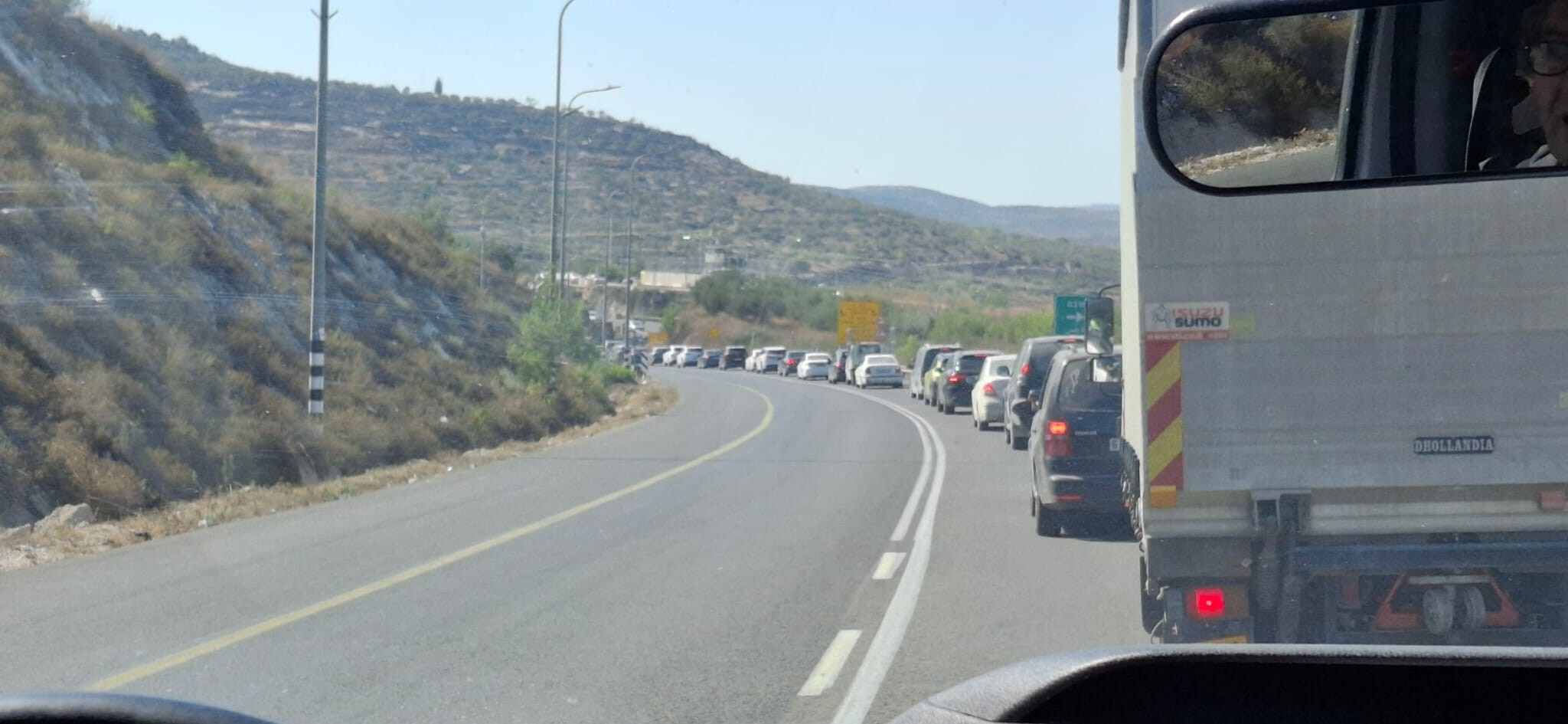 Anat PolakJul-17-2025Yitzhar Road, Jit Junction: traffic jam
-
