
Jordan Valley Checkpoints
Jordan Valley Checkpoints, Thursday, 27.7.06 AMObservers and reporters: Yael N, Chana BGuest: Journalist Amira HassDriver: Maha (with daughter Maram) General: the Jordan Valley is a 15 kilometer wide, 120 kilometer long strip, stretching from Ein Gedi in the south to the Green Line south of Beisan (where there is a new checkpoint on the valley road – Bezek Checkpoint). Fifty thousand Palestinians live in the area, 20,000 of those as residents of Jericho. Despite incentives offered by the state, the total of Jewish residents in 26 settlements is around 7,000. All governments of Israel have viewed the Jordan Rift Valley as the eastern frontier of the state and a security asset. Israel’s plan to erect a fence along the valley was shelved because of international criticism. And so Israel closed the valley to Palestinians who are not residents of the area (the above data were published in Peace Now’s magazine Achbar Hahitnachluyot, October 2005). We encounter problems deriving from this quarantine at the many checkpoints across the West Bank, where residents of the West Bank who seek to travel to the Jordan Valley are compelled to retrace their steps. For example, residents of Tubas are prohibited from visiting their relatives or working their fields in the Jordan Valley.Residents of the Rift Valley have a few central problems:• Most of the residents of the area are farmers who sell the bulk of their produce to Israel, and only very little to the West Bank.• Bezek Checkpoint is located on the Rift Valley road, at a point where the road crosses the Green Line, coming into the Beisan Valley. Sophisticated installations have been erected for “back-to-back” produce. The place has stood deserted since the construction was finished in October 2005. Alongside it, on Route 90, a road block has been erected to stop cars for inspection and filter the Palestinian farmers who used to transfer through here there produce for the markets of Israel and the West Bank. No longer… The Jewish farmers in the valley have no such restriction.• Attempts to make a living from roadside fruit and vegetable stands on Route 90 have been stymied by the Civil Administration, which destroys the stands and confiscates the produce, serves the traders with a warning order for “trespassing,” and a “seizure of movable property” form. This procedure is on the face of it patently illegal.07:00 – 08:30 Tayasir CheckpointTwo cars are waiting at the checkpoint, one coming from Tubas, and the other going to Tubas. Four soldiers are sitting at the checkpoint – and not processing the cars. We go over to clarify why the passage of cars is being delayed, and the response from one of the soldiers is: “I’m not entitled to eat in peace?” We explain that the force can be divided, some eating while others check, but to no avail. A phone call to the DCO and to the battalion commander causes movement and the cars are through.We hear from the DCO that there was an order to make thorough inspections, but in places where few cars pass even that can be done relatively quickly. According to what we see, the cars aren’t checked at all, and the DCO’s tale of warnings is refuted. We talk to the drivers who confirm to us what we have elicited from the many phone calls from this checkpoint – that the process here is generally slow and the attitude is for the most part hostile.We leave at 08:30 by which time no more than ten cars have come to the checkpoint. All pass after an unnecessary delay.The checkpoint is supposed to open at 05:00, but the soldiers’ clock is “flexible.” We are told that on July 26 (for example) the checkpoint opened at 06:30. There was a long line on both sides and people waited hours to pass. For the soldiers “local time” doesn’t count.The checkpoint closes at 21:00 after which no one can come or go. We are told that on 19.7 a Palestinian family with small children arrived at 20:30. They were forced to wait, according to the practice of this checkpoint… At 21:00 the soldiers informed them that this is it, the checkpoint is closed, they can go back to Tubas. An argument ensued: the family explained to the soldiers that they do not have a home in Tubas. After contacts with the Humanitarian Centre, they were allowed to pass to go home at 23:30 – which all goes to prove that torture can be inflicted without the use of weapons.10:40 – 11:15 Hamra CheckpointCheckpoint almost empty in both directions. Five soldiers are manning the place and the pace of transit is reasonable. A car of a Christian aid organization, with Israeli number plates, passes quickly on its way to Jenin. A tender loaded with produce arrives from Ein el-Bida in the north of the valley, on its way to Tubas which is also north of here. We ask why he didn’t go through Tayasir, and he answers that they won’t let his produce through. At Hamra he crosses with no difficulty and without inspection of the load. After a while two of the soldiers come over to us for a “political” conversation: there is no doubt that we did not convince them that the land is “occupied.” They have never heard of the Green Line, and are convinced that they are defending the State of Israel and us.Ein el-Bida (a Palestinian village close to Mehola Junction): we visit the home of M., a farmer, who tells us the following things. In place of traveling the short route by way of the Rift Valley Road (Route 90 and Bezek Checkpoint), they have to go today through Tayasir Checkpoint, Tubas, towards Zebabida, Jenin up to Jalame Checkpoint. There the produce is moved to trucks of Israeli Arabs in a back-to-back process. Because of the huge number of checkpoints, there is a great delay in transferring the produce which cannot be sold on the day of starting the transport. Sometimes the process consumes two days, the fruit and vegetables deteriorate and the cost of transportation considerably reduces the income.Produce destined for marketing in the West Bank is transported to the wholesale market in Beita (by Tapuach Junction). The route: departing from the north of the valley at 01:00, in order to reach Beita before the market closes at 08:00. Southward on the Valley Road to Uja (near Jericho), some 50 kilometres. From there westward and back to the north to Rimonim Junction. From there to Tapuach Junction and Beita Market. This winding route is at least another 50 kilometres.During the agricultural season, the army appears in the dead of night, and searches for agricultural laborers from the West Bank who don’t return home at the end of the day’s work. Because of the quarantine of the Jordan Rift Valley from the rest of the West Bank, workers from the West Bank are considered “illegals.” The nearest hospital is in Jericho or Jenin. Primary school classes are in the villages, but continuing studies are in the schools in the big Palestinian cities.11:45 Gitit Maale Ephraim JunctionSix cars. Soldiers from Orthodox (Haredi) Nahal. We don’t stop.Meeting with Ami ShoshaniAmi is a member of Kibbutz Ashdot Yaacov, manager of a quarry on the Allon Road. His workers are Palestinians from the area, and he tries to help them and others to navigate through the tormenting bureaucratic system of the Civil Administration and the army. He encounters injustice and arbitrariness, and is slowly becoming a one man “MachsomWatch.”We get important information from him in various areas. We again hear about payment of employers’ tax for workers from the Territories, working with licenses, to the tune of 600 shekels a month per worker.. It must be noted that, unlike other employers, he pays the tax for his workers and doesn’t recoup from their pay packets. The sum that he mentions is smaller by 300 shekels than the one we heard from workers employed in the settlements.,br>He also complains about the closing of Bezek Checkpoint to Palestinians and, like us, he feels that the motive is deliberate politically. He tells us that Israeli Arabs who try to pass at Bezek with personal purchases (two plant pots, or maybe a single chair) are detained on the contention that they are not “merchants.” The selection (of people) is by accent.From him we hear about a checkpoint at the exit from Kfar Majdal Benei Fadel (Migdalim Checkpoint). A harsh checkpoint that prevents transit to Route 505 and the Rift Valley. Must get there.Last winter they tied a 12 year old boy to a post at Gitit Checkpoint – would you believe? The humane army would do such a thing? And what goes through the mind of a soldier carrying out such a crime – or in the heads of his comrades watching him? And is there no one to stand up and protest this crime? Horror!
Jordan Valley
See all reports for this place-
Jordan Valley The Jordan Valley is the eastern strip of the West Bank. Its area consists of almost a third of the West Bank area. About 10,000 settlers live there, about 65,000 Palestinian residents in the villages and towns. In addition, about 15,000 are scattered in small shepherd communities. These communities are living in severe distress because of two types of harassment: the military declaring some of their living areas, as fire zones, evicting them for long hours from their residence to the scorching heat of the summer and the bitter cold of the winter. The other type is abuse by rioters who cling to the grazing areas of the shepherd communities, and the declared fire areas (without being deported). The many groundwaters in the Jordan Valley belong to Mekorot and are not available to Palestinians living in the Jordan Valley. The Palestinians bring water to their needs in high-cost followers.
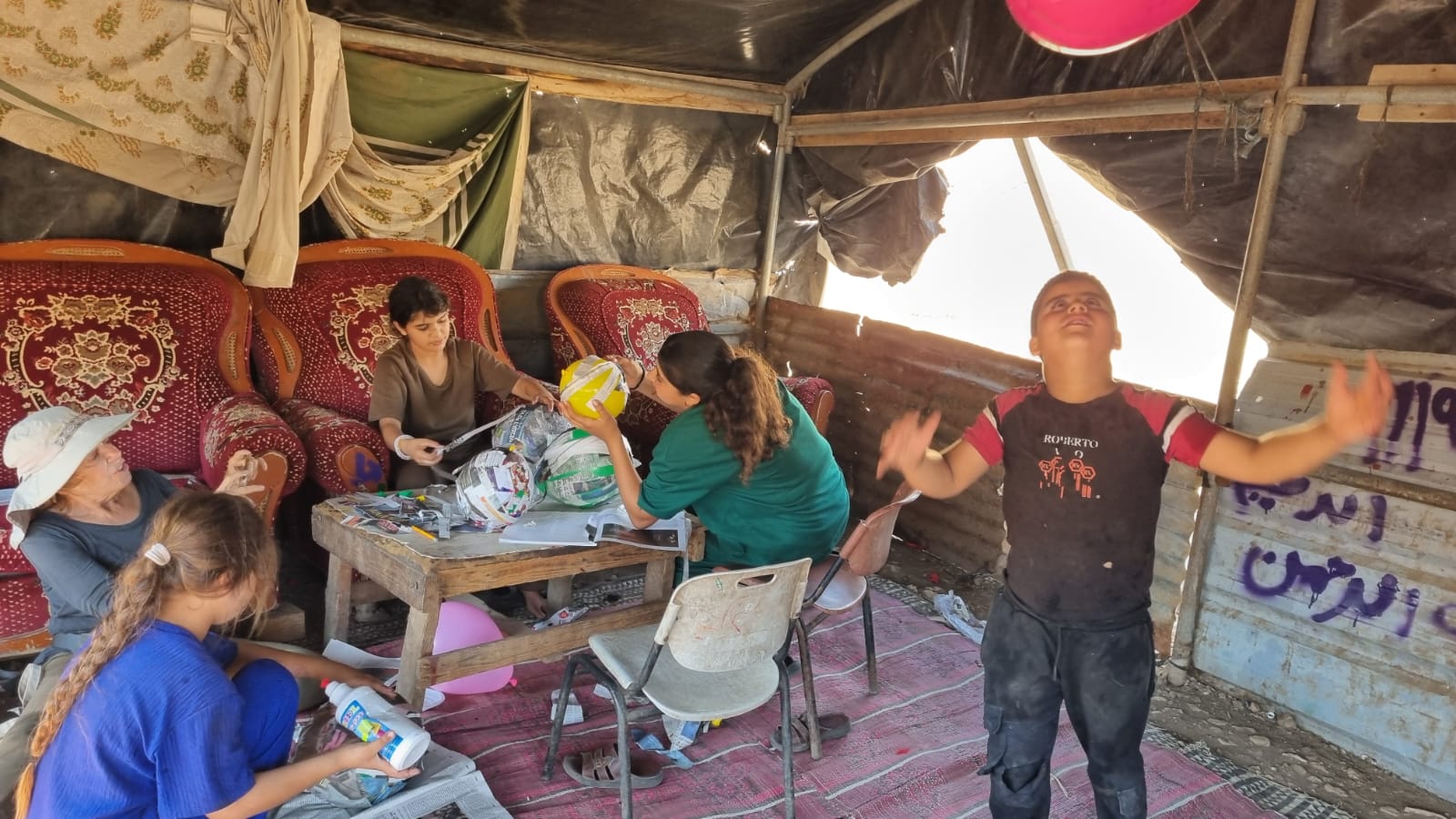 Bosmat HetzroniJul-2-2026Samra. Paper balloons
-