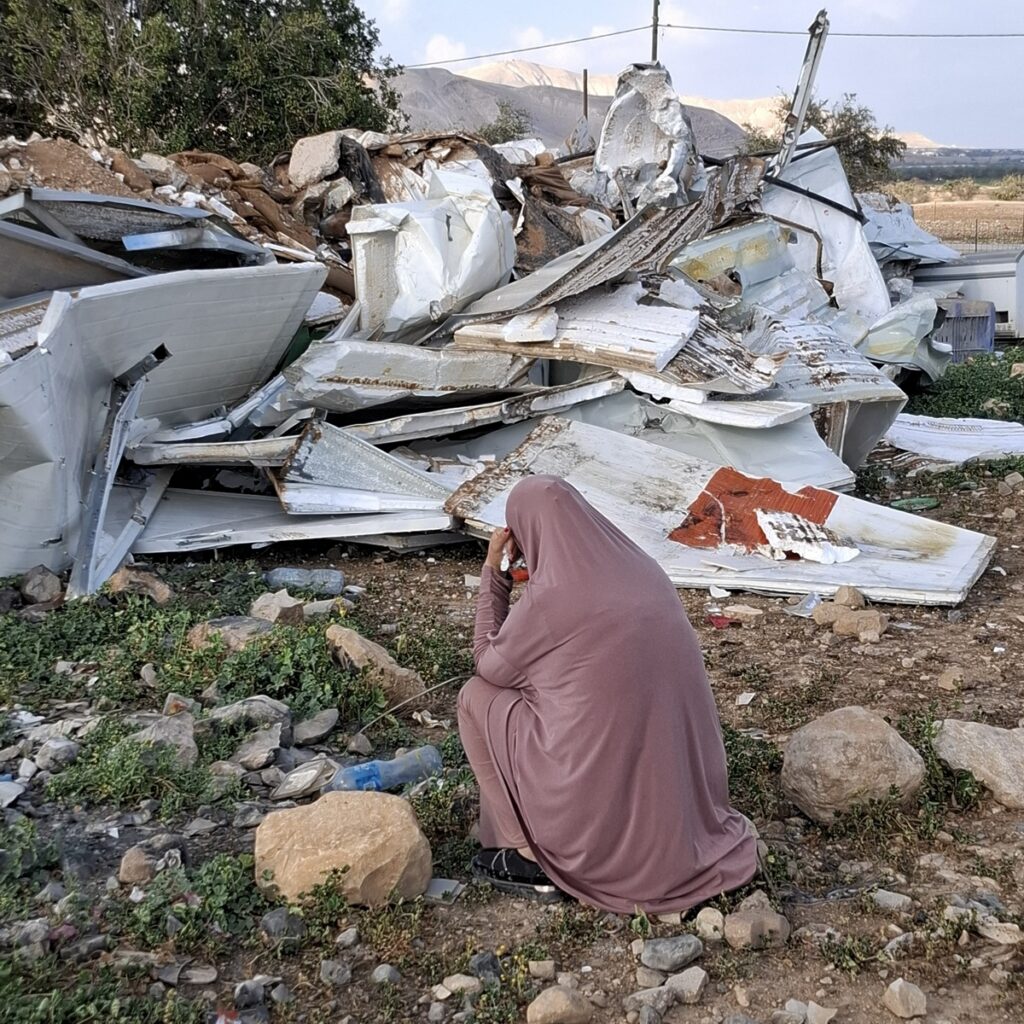
Jordan Valley: The Army and the Settlers versus the Shepherds' Community
During the past few days shepherds from Parsia and Ein el Hilwa in the northern Palestinian Jordan Valley have been attacked by D., the head of security from the settlement of Rotem in efforts to prevent them from grazing their herds on the pasture land east or the Alon Route. Volunteers from Taayush and Daharma came to their aid. The head of security came to conduct a sulha [a ceremony of reconciliation to end hostilities between the two parties] with the shepherds on the condition that the volunteers would not be invited. In exchange, he would not bother them while they were grazing their flocks. The agreement held for one day, and the next day Jewish settlers arrived on horseback and drove the flocks away.
According to the Palestinian residents of the area, D. the head of security has set up his own private outpost during the last year next to Rotem and built several buildings there. This was reported by Rocheleh and Revital from Machsom Watch. All this can be seen from the Alon Route. He keeps a flock of sheep there and is therefore interested in keeping the grazing land for himself. D.’s claim to the people from Taayush is that the grazing land they are talking about is state land that was leased to the settlements and therefore Palestinians have no right to use it for grazing (!!). When looking at the map one can see that the land that supposedly belongs to the settlements is ten times larger than the settlement actually is and includes land outside the fence.
The army personnel who were called in on January 31st sided with the settlers and called for the Palestinians to leave the place.
This is a Sisifusian struggle for survival because the flocks are the only source of income for the Palestinian shepherds. It is clear that the shepherds are no match for the settlers, and the army who controls the area views its job as that of protecting the settlers and does whatever they ask. The shepherds are considered people who should be gotten rid of because the Jordan Valley will always be in Israeli control and therefore as few Palestinians as possible should remain there. For this reason Taayush, Daharam, and other private volunteers are doing important work by aiding the shepherds.
Jordan Valley
See all reports for this place-
Jordan Valley The Jordan Valley is the eastern strip of the West Bank. Its area consists of almost a third of the West Bank area. About 10,000 settlers live there, about 65,000 Palestinian residents in the villages and towns. In addition, about 15,000 are scattered in small shepherd communities. These communities are living in severe distress because of two types of harassment: the military declaring some of their living areas, as fire zones, evicting them for long hours from their residence to the scorching heat of the summer and the bitter cold of the winter. The other type is abuse by rioters who cling to the grazing areas of the shepherd communities, and the declared fire areas (without being deported). The many groundwaters in the Jordan Valley belong to Mekorot and are not available to Palestinians living in the Jordan Valley. The Palestinians bring water to their needs in high-cost followers.
 Rachel AfekAug-20-2026Samra. Baby Chick
-