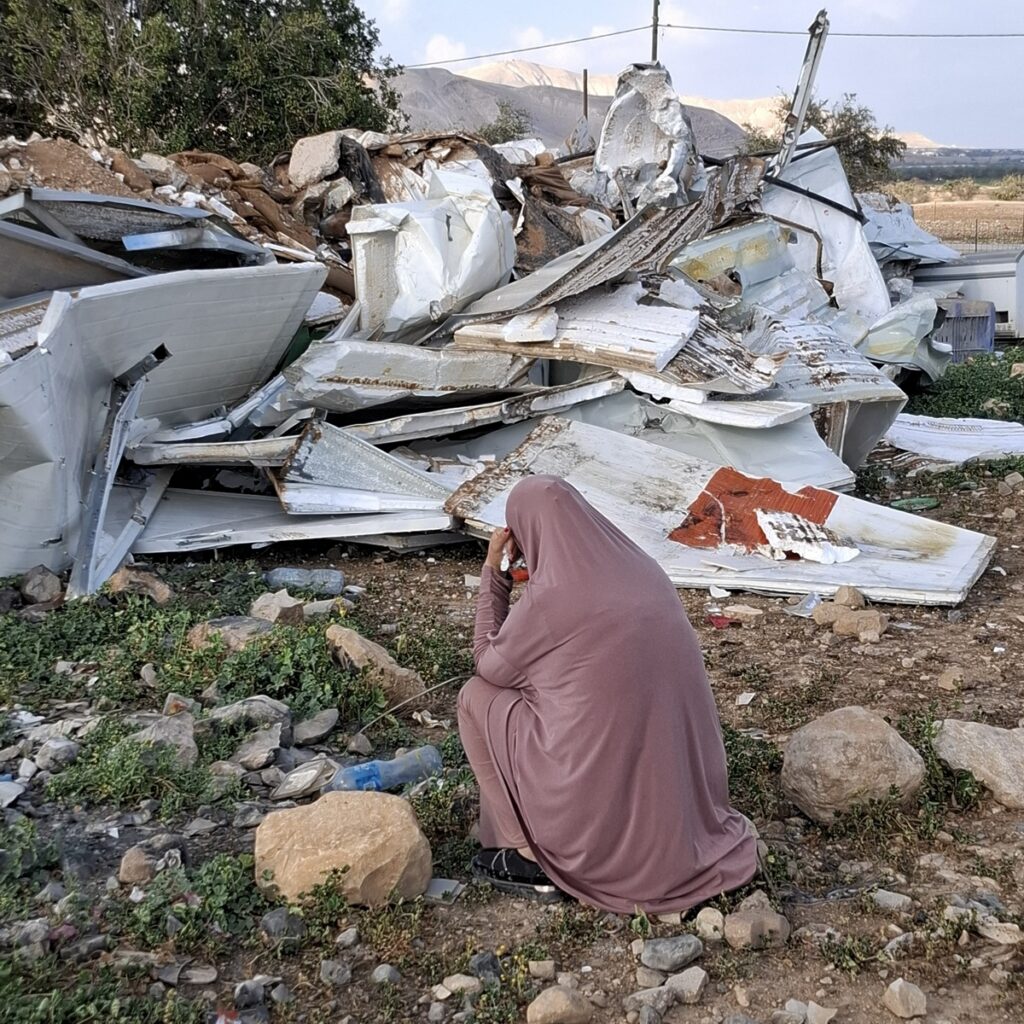
Jubara
Jubara, Wednesday, 3.8.05, PMObservers: Daliah V. ,Deborah L. (reporting) Summary: At the Jubara Checkpoint traffic coming from Tulkarm was stopped for about an hour(2:35PM – 3:30PM) because of a warning that a stolen Honda which had hit 2 policemen was on its way to the checkpoint. Traffic in all other directions was held up for less time. Israeli Arabs are not allowed into Tulkarm or the near by villages of Shufa and Farun. It was difficult to see all the women, children, and men turned away who wanted to visit family. There is also a problem for Israeli Arabs coming in who want to go in the direction of Qalqiliya, or villages like Tzur or Jamal. Theoretically they are allowed in. However, there are no taxis waiting for them as there once was. The area near the road heading in that direction has been declared “a sterile area”. The people must go over to the Tulkarm checkpoint and leave their IDs at the booth. They must then go and get a taxi that is leaving in the direction of Qalqiliya on the road heading for Tulkarm just north of the checking booth. When the taxi comes through the line leaving Tulkarm the people can then get their IDs back. Many of the soldiers were very sympathetic but the rules of the day did not allow them to act in accordance with their feelings. We were told by taxi drivers that at Anabta pedestrian traffic (that’s the only kind of traffic there since no cars are allowed to enter or leave from the checkpoint) was closed for about 45 minutes (from approximately 1:15PM – 2:00PM)because a car was parked too close to the gate and soldiers were afraid it was a bomb. Even though the local taxi drivers were willing to go near the car and open it to prove to the soldiers it was safe, the soldiers continued the closure. Details: 2:00PM drop off Ria Y. and Sara F. at Beit Iba 2:17PM Anabta is closed to vehicle traffic. We reached the gate that is about 500 meters from the cement blocks near the turn off from route 60. There was a hummer at the gate that was leaving just as we arrived. We were told by taxi drivers that the checkpoint had been closed for the last 45 minutes because a car had been parked too close to the gate and the soldiers were afraid it was a bomb (see in summary above). 2:35 Jubara : As we approached the checkpoint we saw at least 25 cars lined up from Tulkarm and there were more we couldn’t see. There is one detainee who, we are told by the soldiers, has been there for ten minutes. . Things come to a stand still. We are told not to move the checkpoint has just been closed because a stolen Honda tried to run over 2 policemen not far from here in Israeli territory and it is on it’s way to this checkpoint. The DCO representative looks very tense. A woman volunteer tells us what is happening and is helpful the entire time. She claims the officer M.(Moron) is a well-mannered, correct, and humanistic soldier. This turns out to be true. It seems there was an incident of a stolen car yesterday as well. And although the Honda never showed up we saw 2 other stolen cars parked on the security road near the entrance to Tulkarm being examined by the police and soldiers and two Israeli Arabs were waiting at the checkpoint for their cars that had been stolen. Ironically one of the men waiting for his car which had been stolen was questioned by the police who thought he might have stolen a car part he had in the back seat of the car he came in. It was not stolen. 2:47PM The detainee was released after a phone check by the soldiers. The traffic coming in from Israel is now released but all other movement in the checkpoint is still halted. Traffic building up in all directions. 2:52PM The line of “Israeli citizens living in the territories” entering Israel is opened.` 2:50PM Traffic coming in from Israel is again halted. 2:55PM Settlers get out of their cars to discuss the situation with soldiers. 3:03PM Traffic coming from Israel released once again. Only one line of traffic coming in to Israel is allowed in but everyone can wait on that line. Traffic to and from Jubara and to and from Tulkarm still not allowed to move. 3:13PM Try to call K. from the DCO to complain about the traffic from Tulkarm building up. The connection is not clear. He tells me to talk to the DCO at the checkpoint. The DCO Representative seems under a great deal of pressure from the situation and isn’t that approachable. 3:14PM Traffic coming from Qalqiliya to Tulkarm allowed in but not from other directions. 3:14PM Pedestrian traffic from Tulkarm starts moving. There are about 20 people. I’m later told that the only pedestrian traffic from Tulkarm are people who are going to Jubara. 3:27PM All traffic into Tulkarm allowed in. And traffic leaving Tulkarm released. I speak to the officer about putting more soldiers on the traffic line to help facilitate the checking. Officer M. tells me that when the army has left roads to Tulkarm open there have been bombers so now they have to cut off those roads. Because this is the only checkpoint that allows vehicle traffic, it is busy. He doesn’t have enough soldiers right now. A soldier guarding the traffic wants to know why I do what I do. He can’t understand having sympathy for the Palestinians when they are responsible for suicide bombings. 3:29PM The traffic coming into Israel which built up during the closure has vanished. The road going into the Tulkarm area is impossible for large vehicles to maneuver and they have to go back and forth until they are able to make the turn without falling into the deep holes. 3:37PM Officer M. helps out the traffic line leaving Tulkarm and then puts an extra crew there to move things faster. There is almost no checking other then IDs and I was told that those leaving Tulkarm are allowed anywhere in the territories. Does this mean the “seperation” is over for traffic coming from Tulkarm to Ramallah? 3:48PM I speak with the police in the police jeep number 22264 which arrived about 3:13PM because of the warning about the stolen car. They move around the checkpoint during our shift and turn on their siren from time to time. They are now at the security road area near the entrance to Tulkarm watching over 2 grey cars whose doors are wide open (including the trunk and motor) with no drivers. I ask them what the cars are here for. They say they can not answer but they are here at my service should I need them. I’m told by soldiers that these are stolen cars. Later a crew of soldiers start checking the car and I’m told they are checking to see if they have been tampered with. I’m told that the army was tipped off about stolen cars and a special army unit went into Tulkarm and recovered them. 3:59PM Minibus from Tulkarm stopped and ID of one of the passengers more thoroughly checked and then released. 4:01PM A taxi driver comes to the soldier who is guarding and asks about the IDs. I hadn’t noticed but a taxi with passengers was off to the side. He had been told to wait about 10 minutes ago while they checked the IDs. The soldier hadn’t done anything about it. The soldier then makes a phone call and on the phone he gets an immediate answer that the IDs are okay. He returns them and the taxi leaves. 4:05PM The traffic jam leaving Tulkarm is over for now.4:35PM A young woman with a blue ID wants to visit her husband in Tulkarm. She is turned away. 2 men coming from Israel. One lives in the village of Jamal and one in Tzur. They head toward Tulkarm to get a taxi which will take them in the direction they want to go in. They are afraid about leaving their IDs with the soldiers until the taxi passes through the checkpoint. They have heard stories of IDs getting lost. A woman with 6 children (the youngest a baby in her arms) wants to visit her mother in Shufa. The soldier says no. But he feels bad and calls the officer to see if maybe there is a way out. The officer says no. She waits around. Many of the soldiers on this shift, including the officer, are very sympathetic to the Israeli Arabs who have family in Tulkarm but they are afraid to take the responsibility of letting them in because of the instructions they have been given. There is a closure and no Israeli Arabs are allowed in except for dire humanitarian cases. 4:55PM Traffic leaving Tulkarm has built up again. I ask Officer M. what is going on. They’ve had to stop the traffic again because one crew is on break and the other has to check pedestrians. I can’t make any calls since my cell phone doesn’t seem to work in this area. I somehow have the faith that M. will take care of the situation since he has constantly tried to keep things moving the whole time despite the lack of manpower which is ALWAYS the problem at the checkpoints. We leave for Beit Iba to pick up the other women. 5:30PM Beit Iba. A men asks for our help . He’d like to give some medical documents to the MW shift tomorrow morning in order to get permission for an operation at Meir Hospital. We take his number and name and when we get home we notify the person going to Beit Iba tomorrow. The Beit Iba women have been told by a taxi driver that there is a long line of traffic at Shimrah Shimron. We head for that checkpoint. 5:40PM Shavei Shomron. The traffic is moving swiftly there. We are told by the soldiers that there was a little traffic jam awhile ago. We head for home.
Shufa
See all reports for this place-
Shufa
-