
Khashen al Darej - Huda's Kindergarten
We went to visit Huda’s Kindergartden again with a huge cooking pot, equipment for children such as plasticine, paints, drawing pages and a granddaughter.
Passing through the Meitar checkpoint was normal, many cars in the parking lot, a routine of the occupation.
I asked Aya to write the report because I wanted to know how it looks to eyes that are not used to the occupation and this is the first time for them to encounter and experience what we are already used to.
********************************
Aya’s report
Huda’s Kindergarten, Khashem a-Darej
I went with Grandma Ariela and Muhammad to their shift in the south of Mount Hebron, this time to Huda’s Kindergarten in
Khashem al-Darej. This is my first visit to the area and as soon as I saw the view of the hills after crossing, I could easily distinguish it from the Israeli Negev landscape. Palestinian villages and settlements can also be seen in the Negev which are built in a shabby way in relation to the Jewish settlements, but in the area of the hills along road 317 the feeling is the same.
You see the Jewish outposts and farms being built right between the Palestinian villages and thus isolating them until they give up and leave.
(Sha’b al Butum which is sandwiched between Abigail and Mitzpe Yair or a the Ma’on farm which is right on the road Between Tuba and A-Tuwani). The reality in the South Hebron Hills area speaks of the policy of which I had only heard before this visit, the creation of Palestinian enclaves within a completely Israeli space.
Throughout the visit we did not see any military presence in the area, which strengthened the feeling of a normative Israeli space that naturally continues until reaching the green line. It is the Palestinian cities and villages that appear to the visitor as exceptions in the area.
On the way to Huda’s kindergarten we passed through Khashem al-Karm and, on the side of the road, we saw an elementary school built with light construction.
Muhammad said that there is a demolition order for the school because it was built with donations that were not part of the outline prepared by the army which had not allocated a place for an elementary school in the plan. The salaries of the school teachers are financed by the Palestinian Aauthority. Huda’s kindergarten, on the other hand, began as a building of one room and has since developed from donations 6 years ago within the outline plan of the village.
As soon as the car entered the parking lot, all the children wanted to greet us and waved at us excitedly. I could hardly get out out of the car because of the many smiling children who were clinging to the doors We gave a high five and as we said hello to the children, I asked each one their name. We had brought packs of coloured plasticine with us so I played with the children showed them how to use it.
The kindergarten teacher was enthusiastic and grandmother said she had never seen her so excited during the activity. Little by little the children became more creative with the material, and I became very much a part of them.
It is evident that the group of children is a very mixed one and some of them suffer from a certain developmental problem which must also make it difficult.
I was terribly sorry that my Arabic is not good enough to communicate naturally with the children and the teachers. The language barrier made me feel like we were very far apart even though they live an hour away from my house.
Only now is the kindergarten starting to be equipped with supplies and equipment to prepare a hot meal for the children at noon. The situation is that some children cannot even bring a light meal from home. In addition to basic groceries Huda needs to get an electric plate with which to cook the meal. Even for the graduation party, Huda asked that we bring print photographs of the children and graduation certificates.
When we left the kindergarten, on the road leaving the village, a Palestinian car drove in front of us with an inscription in Arabic calligraphy and underneath it was written in Hebrew: There is no luck in life – there is no faith in friends.
Even though during the shift we did not see anything unusual, this message sums up the residents’ experience in Masafer Yaffa and the fact that you can’t help but wonder how many of those children in the kindergarten will turn 18.
Meitar checkpoint / Sansana
See all reports for this place-
Meitar Checkpoint / Sansana The checkpoint is located on the Green Line and serves as a border crossing between Israel and the West Bank. It is managed by the Border Crossing Authority of the Defense Ministry. It is comprised of sections for the transfer of goods as well as a vehicle checkpoint (intended for holders of blue identity cards, foreign nationals or diplomats and international organizations). Passing of Palestinians is prohibited, except for those with entry permits to Israel. Palestinians are permitted to cross on foot only. The crossing has a DCO / DCL / DCL / DCL (District Coordination Office), a customs unit, supervision, and a police unit. In the last year, a breach has been opened in the fence, not far from the crossing. This breach is known to all, including the army. There does not appear to be any interest in blocking it, probably as it permits needed Palestinian workers without the bureaucratic permits to get to work in Israel. Food stalls and a parking area economy have been created, but incidents of violent abuse by border police have also been recorded. Updated April 2022
-
South Hebron Hills
See all reports for this place-
South Hebron Hills
South Hebron Hills is a large area in the West Bank's southern part.
Yatta is a major city in this area: right in the border zone between the fertile region of Hebron and its surroundings and the desert of the Hebron Hills. Yatta has about 64,000 inhabitants.
The surrounding villages are called Masafer Yatta (Yatta's daughter villages). Their inhabitants subsist on livestock and agriculture. Agriculture is possible only in small plots, especially near streams. Most of the area consists of rocky terraces.Since the beginning of the 1980s, many settlements have been established on the agricultural land cultivated by the Palestinians in the South Hebron Hills region: Carmel, Maon, Susia, Masadot Yehuda, Othniel, and more. Since the settlements were established and Palestinians cultivation areas have been reduced; the residents of the South Hebron Hills have been suffering from harassment by the settlers. Attempts to evict and demolish houses have continued, along with withholding water and electricity. The military and police usually refrain from intervening in violent incidents between settlers and Palestinians do not enforce the law when it comes to the investigation of extensive violent Jewish settlers. The harassment in the South Hebron Hills includes attacking and attempting to burn residential tents, harassing dogs, harming herds, and preventing access to pastures.
There are several checkpoints in the South Hebron Hills, on Routes 317 and 60. In most of them, no military presence is apparent, but rather an array of pillboxes monitor the villages. Roadblocks are frequently set up according to the settlers and the army's needs. These are located at the Zif Junction, the Dura-al Fawwar crossing, and the Sheep Junction at the southern entrance to Hebron.
Updated April 2022
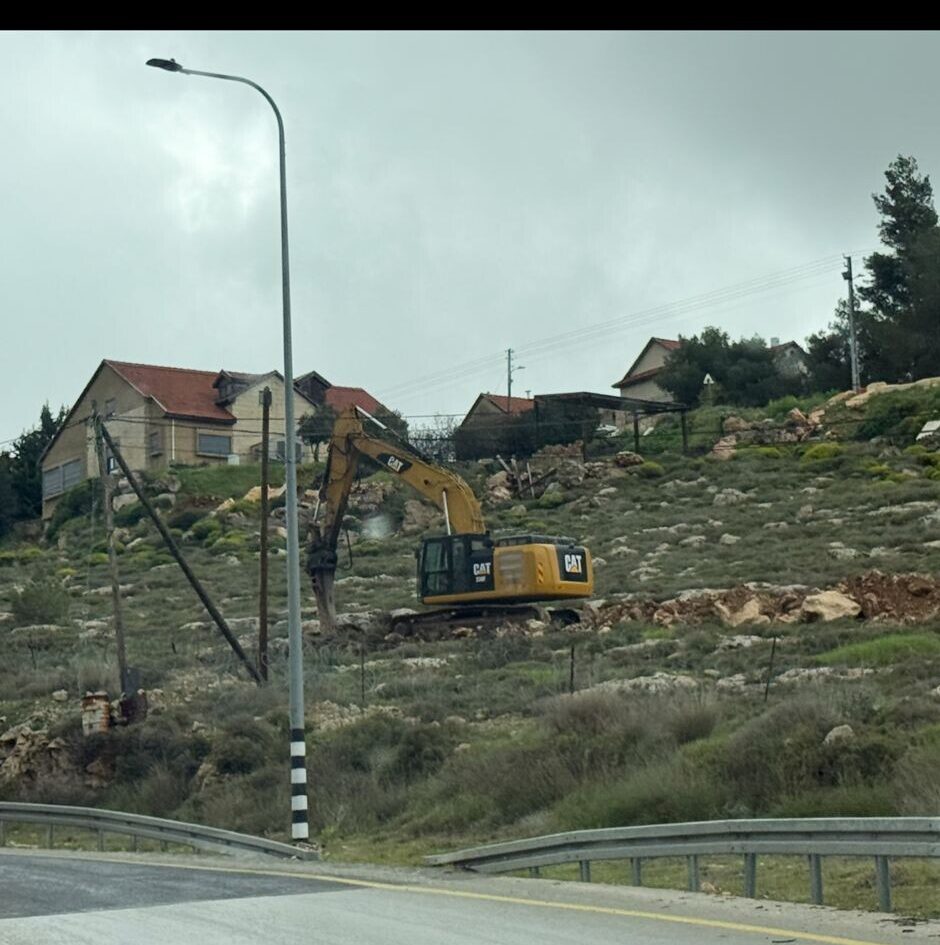 MuhammadFeb-24-2026South Hebron Hill, Beit Hagai: Paving an internal security road
-