
Military Court Ofer
Military court Ofer, 7.8.06Observers: Irus ., Roni H. (reporting)Room Nr.2, Judge TiroshWe came to hear the continuation in the law suit of Iman Abu Daud who is accused of trying to kill a settler in Hebron by shooting and of planting a bomb ( defense lawyer Sha’aban). Tova S. reported about the session on 31.7.06, in which a witness of the prosecution was investigated, Muhammed Abu Bahag, who has incriminated the accused under heavy torture. He related in details the various forms of torture which were applied to him and said that under this torture he would have incriminated his own father as well. When Muhammed Abu Bahag, a client of Leah Tsemel, was brought into the courtroom, he looked apologetically at Iman. Muhammed himself has not yet been convicted and his appearance as witness without the presence of his lawyer poses a weighty question.Today another witness of the prosecution was supposed to be heard. Iman’s lawyer, Sha’aban, was not prepared for this particular witness and the one for whom he was prepared, could not be brought before the court. Therefore the hearing was postponed for Tuesday, 8.8.06, 10 o’clock.One of the fringe benefits of observing in the military court is to witness the bursts of joy of the prisoners when they can see their family members for the short time of their hearing. It is the only opportunity they have to exchange some words, some news, some smiles and to receive encouragement. The families have to sit in the last row of the court room and the prisoners have to be in the dock. But there are innumerable ways to communicate between loved ones. Lips reading, sign language, gesticulation and also, of course, loud speaking. The soldiers who guard the courtroom are responsible for “order” at court and try to prevent the conversations between prisoners and his family and very often they threaten the families with eviction of the room. Today there was, for a change, a humorous incident in room Nr.1, under the presidency of the judge Ronen. One of the prisoners, whose name I could not understand, because the lawyer, the interpreter, the prosecutor and the prisoners were speaking simultaneously, raised his hand and asked to say something. He protested vigorously against the fact that he is shut up by the soldiers whenever he wants to talk to his parents. The judge was flabbergasted. He did not know how to react. After a couple of seconds of recovered and said that this was not a family visit, but a court and that he could speak with his parents but without shouting. The soldiers were even more surprised about this “judgement”, but for a couple of minutes they did not interfere. Sometimes it seems that the prisoners are much less interested in the conduct of their law suit, than in the conversations with the family and that there are 2 different circles of interaction. One between the defense lawyers, prosecutor and judge and one between the prisoners and their families. Given the complete lack of influence the prisoners have on the outcome of their case, this is not surprising.
Hebron
See all reports for this place-
According to Wye Plantation Accords (1997), Hebron is divided in two: H1 is under Palestinian Authority control, H2 is under Israeli control. In Hebron there are 170,000 Palestinian citizens, 60,000 of them in H2. Between the two areas are permanent checkpoints, manned at all hours, preventing Palestinian movement between them and controlling passage of permit holders such as teachers and schoolchildren. Some 800 Jews live in Avraham Avinu Quarter and Tel Rumeida, on Givat HaAvot and in the wholesale market.
Checkpoints observed in H2:
- Bet Hameriva CP- manned with a pillbox
- Kapisha quarter CP (the northern side of Zion axis) - manned with a pillbox
- The 160 turn CP (the southern side of Zion axis) - manned with a pillbox
- Avraham Avinu quarter - watch station
- The pharmacy CP - checking inside a caravan with a magnometer
- Tarpat (1929) CP - checking inside a caravan with a magnometer
- Tel Rumeida CP - guarding station
- Beit Hadassah CP - guarding station
Three checkpoints around the Tomb of the Patriarchs
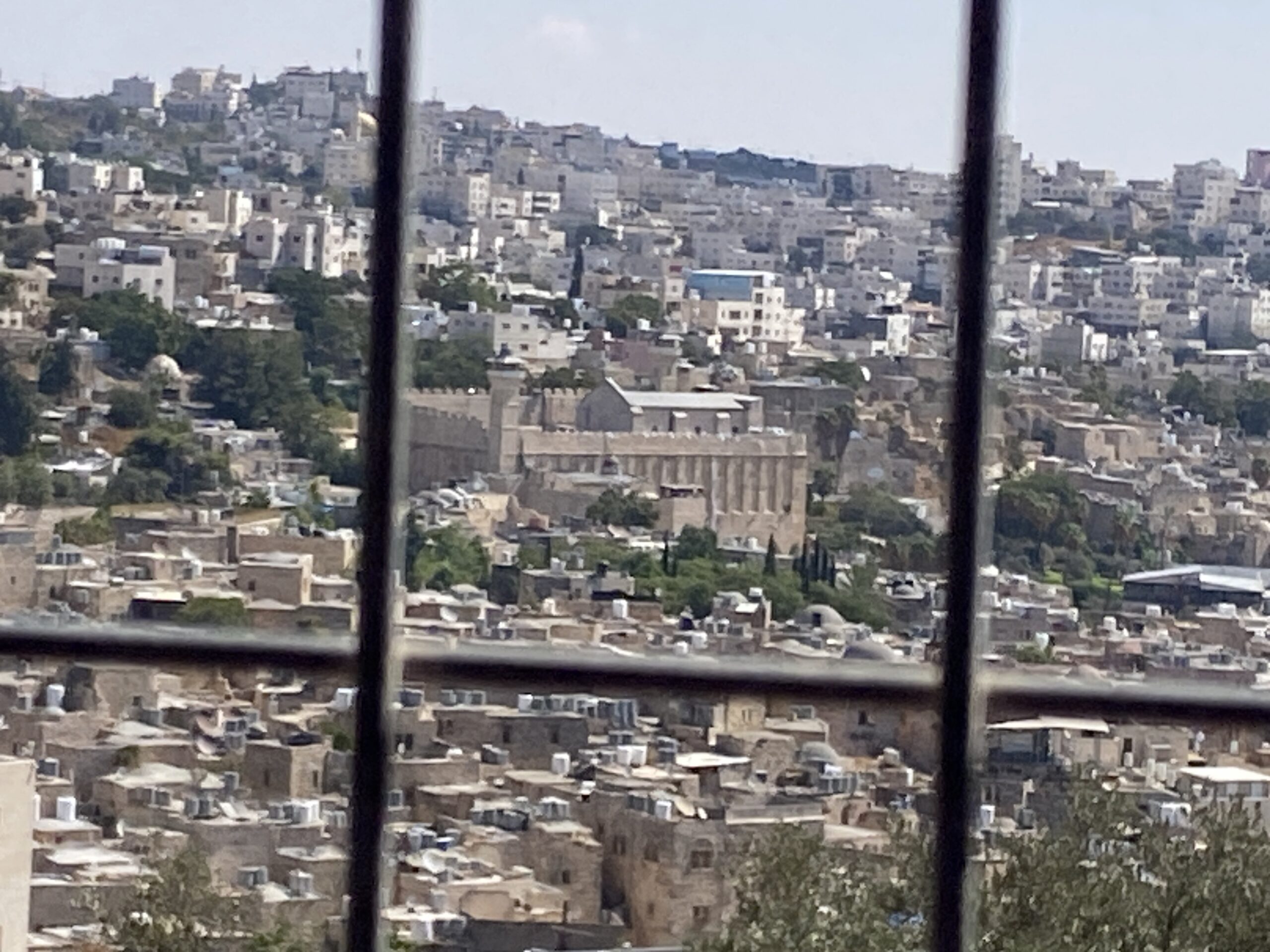 Yael ZoranSep-24-2026Hebron and the Cave of the Patriarchs from Beit Hashalom
-
Ofer
See all reports for this place-
Ofer The Military Court in the Ofer camp is located halfway between Ramallah and Jerusalem. The place has seven courtrooms, most of them spacious. This court is one of two courts of the "first instance", in addition to the military court in Salem. Here are the Palestinian hearings trials and some of the hearings in detention extensions. In addition, there is also a military court of appeals (on rulings of the courts of 'the first instance' in Salem and Ofer). Family members of detainees from the territories (usually only two family members) are allowed to enter the hearings but are prohibited from talking to the detainees. The families have at their disposal a waiting yard and a large, air-conditioned waiting room.
 Jun-25-2024Ofer prison
-
