
Nebi Samuel, Monday afternoon, March 11, 2013
Life in no-man’s-land under the Occupation
We decided to take Yael S. suggestion: we contacted M. from Nebi Samuel on Monday and arranged to meet him in the village. We drove to Nebi Samuel through Ramot, on the road that leads to the archaeological site. We turned right in the parking area, onto an unpaved road, and found ourselves in the village – no fence, no checkpoint – encircled by a bunch of children of various ages, some of them a bit hostile while others helpfully pointed out M. house down the road.
M. himself had not yet reached home, but we were greeted warmly by his mother and several brothers who gave us a “guided tour” of their one-room house, presenting us to a sister-in-law holding a tiny baby to whom she had given birth a few days ago. We were invited to sit in the courtyard where we were joined by several neighbors who began to tell us stories of life in no-man’s-land under the Occupation. It’s almost impossible to comprehend what these people are living through, their frustration and hopelessness, and how they somehow manage to get on with their lives.
They told us that there are now 300 people living in Nebi Samuel, all of them in 10 houses most of which have only one room. Today’s residents once lived in more comfortable houses at the top of the hill around the ancient mosque where the Prophet Samuel is supposed to be buried, but in 1971 they were evacuated by the Israeli Authorities who allowed them to occupy the shacks further down the hill that had been abandoned by Palestinians who fled during the 6 Day War. The people of Nebi Samuel are not allowed to build or develop their village which is located on land that has been decreed a National Park – they are not even allowed to plant trees (Mr. I., a resident of the village, showed us a copy of a decree issued in 2005 which prevents planting of trees on the land of the National Park). When children grow up and wish to marry they must move to one of the nearby villages (Bir Naballa, Gib or Beit Iksa) – returning to their family home only when their parents die. There are only 11 children in the village school: 4 classes conducted in one room.
I. told us that he had erected a simple enclosure from tin sheets to protect his two cows from the weather. A soldier came with a tractor and told him that the construction was “ugly” and could therefore be demolished. No sooner said than done! Mr. I. went and got assistance from a European organization which helped him put up a new enclosure, small but orderly and “pretty”. It even has a poster on one wall proclaiming the organization’s contribution. The soldier returned and took a look. He told I. that he must demolish the new structure and, if not, he would return with the tractor and destroy both the enclosure and the house of Mr.I. family. I. asked the soldier to give him an official order in writing, but the soldier refused. For the time being both the enclosure and Mr. I. house are still standing, but the two cows, who spent part of the winter with no protection from the cold weather, have stopped giving milk.
The village stands on an amazing site, looking out over Jerusalem to the east and hills dotted with Arab villages and Israeli settlements to the north. It’s no wonder that one Isar Orbach decided to establish a private settlement of his own on some of the village land. He built himself an attractive home, cowing the villagers who are afraid to register a complaint. They told us that they had seen a report on Israel’s Channel 2 saying that this person has been charged with stealing $7 million from Jewish people whom he cheated.
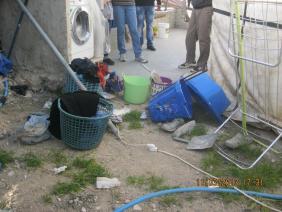 In the courtyard where we sat, a new washing machine was standing in an alcove built of cinder blocks, connected to the electricity in the house via an extension line lying on the ground exposed to the elements next to the plastic pipes bringing water and evacuating the sewage from the machine. It was a strange sight and we asked them how they had brought up the washing machine. They looked at us in surprise and told us there was no problem – there are no checkpoints between them and Jerusalem. They just ordered the machine in a store and had it delivered to their home as it would be anywhere in the world. They could even order a pizza if they wanted or groceries from the supermarket! On the other hand, when I. tried to bring home a gas canister from Ramallah, he had to go through a checkpoint in Gib where the soldiers refused to allow the canister through. After being detained at the CP for 3 hours, he brought the canister back to Ramallah. Returning to the CP on his way home (with no canister) he was detained for another 3 hours. He told a similar story about trying to bring a sack of barley to feed his animals. He was not allowed to carry the sack through the CP but was imprisoned for 2 weeks and fined NIS 1,000.
Members of the M. family also complained about the fines to which they are subject. Although the village is open to Jerusalem, villagers are not allowed to enter the city (without permits), and those caught within the city limits, even in the adjacent Ramot neighborhood, are subject to imprisonment and fines amounting to thousands of shekels. The only member of the family who has a job (because he has a permit) is the 60-year old father. All his sons, their wives and children are dependent on him for support. The sons have all been arrested at one time or other for entering Israel illegally and therefore cannot hope to receive a permit allowing them to work in Israel. It’s not clear how they pay the huge fines imposed on them when they cannot work.
That, in essence, is what all the villagers asked – that they be allowed to work in Israel, if not in Jerusalem then in the archaeological dig being conducted in their own village of Nebi Samuel. They said that the dig was being conducted by the DCO office in Qalandiya.
A shepherd who joined us in the courtyard told us that not only Israel but also the Palestinian Authority was not at all concerned with what is happening in Nebi Samuel. He suggested that the villagers should organize and hire a lawyer to present their case before Israel’s Supreme Court of Justice and demand a solution.
What can we do to help these people?
Nabi Samwil
See all reports for this place-
Nabi Samwil - a village literally placed in a transparent cage.
This Palestinian village is 800 years old. It is located on top of a hill, its altitude 890 meters above sea level, and overlooks the entire area. According to Jewish, Christian, and Muslim traditions, the Prophet Samuel was buried here. In recent years the mosque has been turned into a popular Jewish prayer site. Jews use the basement for prayer, and Muslims the upper part of the mosque. New signs are placed here, containing verses from the Jewish scriptures and mention of exclusively Israeli historical times. The nearby spring has become a popular site of ritual bathing. On Iyar 28th, every year, a mass-celebration is held in memory of the Prophet Samuel.
Until 1967 this was a well-off village that developed around the mosque, with a population of 1,000 owning thousands of dunams of farmland. In 1967 most of the villagers fled, and only 250 remained. In 1971 Israel expelled them, and until the 1990s completely razed its houses that were sitting on a Crusader and Hellenist archeological stratum, without any kind of compensation for the expelled inhabitants. Parts of the village lands are at present used for the settler-colony of Har Shmuel, another part has been declared a national park. Villagers have tried to restore their lives on their remaining lands, a short distance from their original homes, in an area that formerly held structures to house the village’s livestock.
Then the Separation Fence was erected in the West Bank, the village remained an enclave caught between the Green Line and the Fence, and its inhabitants were torn away from other West Bank villages. Any exit to the West Bank requires crossing the distant Jib checkpoint, with a permit. The movement to Israel inside the Green Line is forbidden as well. In 1995 the entire village area was declared a national park – not only around the mosque and antiquities around it which take up about 30 dunams, but an area of no less than 3,500 dunams including the new village and all of its land. Any additional construction is forbidden: any room, caravan, fence, a newly planted tree. Work permits are issued sparingly. There is a tiny school made up of several caravans.
Watch the movie by Eran Turbiner and MachsomWatch: NABI SAMWIL 1099-2099, a film by Eran Torbiner
-
Qalandiya Checkpoint / Atarot Pass (Jerusalem)
See all reports for this place-
Click here to watch a video from Qalandiya checkpoint up to mid 2019 Three kilometers south of Ramallah, in the heart of Palestinian population. Integrates into "Jerusalem Envelope" as part of Wall that separates between northern suburbs that were annexed to Jerusalem in 1967: Kafr Aqab, Semiramis and Qalandiya, and the villages of Ar-Ram and Bir Nabala, also north of Jerusalem, and the city itself. Some residents of Kafr Aqab, Semiramis and Qalandiya have Jerusalem ID cards. A terminal operated by Israel Police has functioned since early 2006. As of August 2006, northbound pedestrians are not checked. Southbound Palestinians must carry Jerusalem IDs; holders of Palestinian Authority IDs cannot pass without special permits. Vehicular traffic from Ramallah to other West Bank areas runs to the north of Qalandiya. In February 2019, the new facility of the checkpoint was inaugurated aiming to make it like a "border crossing". The bars and barbed wire fences were replaced with walls of perforated metal panels. The check is now performed at multiple stations for face recognition and the transfer of an e-card. The rate of passage has improved and its density has generally decreased, but lack of manpower and malfunctions cause periods of stress. The development and paving of the roads has not yet been completed, the traffic of cars and pedestrians is dangerous, and t the entire vicinity of the checkpoint is filthy. In 2020 a huge pedestrian bridge was built over the vehicle crossing with severe mobility restrictions (steep stairs, long and winding route). The pedestrian access from public transport to the checkpoint from the north (Ramallah direction) is unclear, and there have been cases of people, especially people with disabilities, who accidentally reached the vehicle crossing and were shot by the soldiers at the checkpoint. In the summer of 2021, work began on a new, sunken entrance road from Qalandiya that will lead directly to Road 443 towards Jerusalem and Tel Aviv. At the same time, the runways of the old Atarot airport were demolished and infrastructure was prepared for a large bus terminal. (updated October 2021)
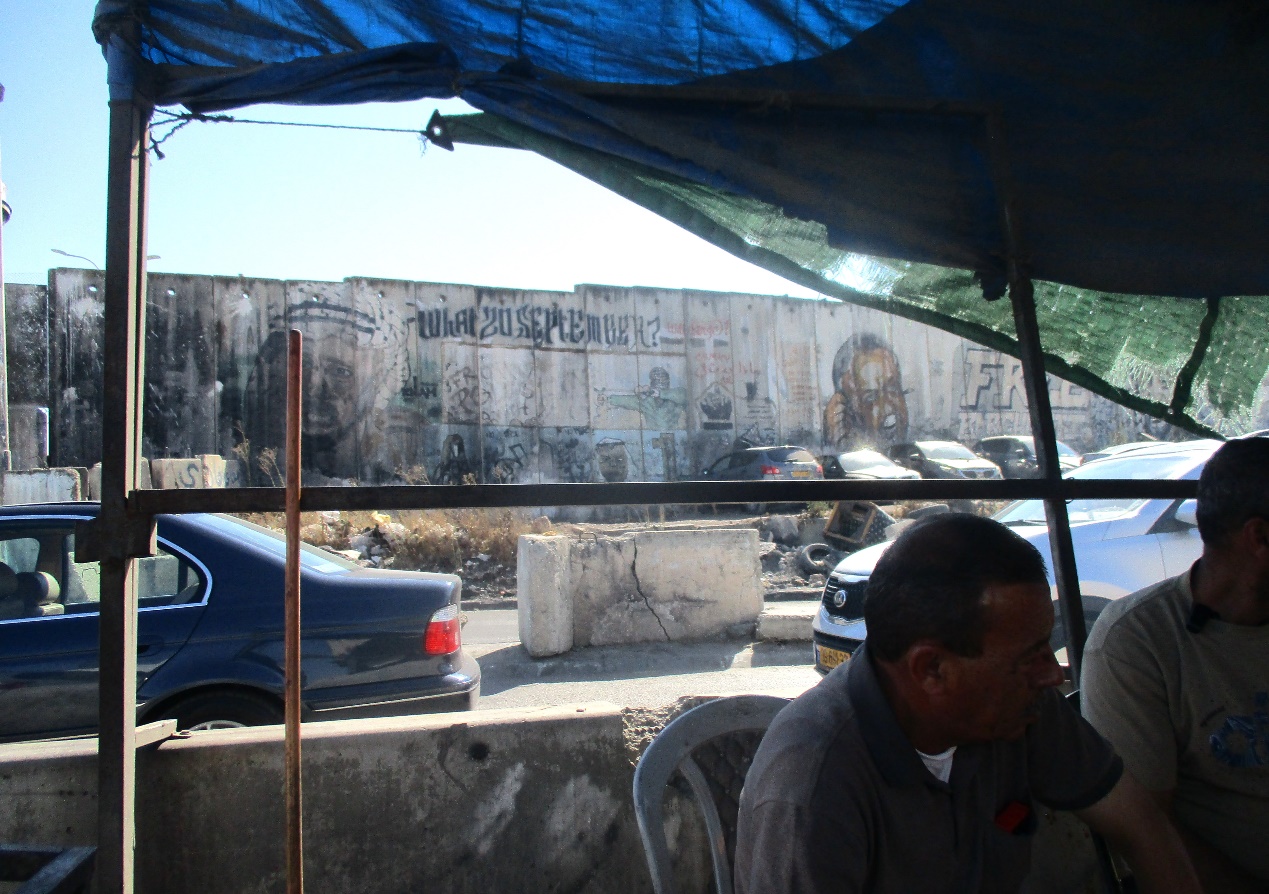 Tamar FleishmanJul-21-2026Qalandiya. Conversation in the shadow of the wall
-
