
Northern checkpoint: The best army in the Middle East
N 6-8 a.m.
Agricultural checkpoint 174 Tayibe-Roumana
On both sides of the gate, no soldiers nor farmers…
Opposite the last house before the descent to the checkpoint there is already a tarpaulin shelter for the use of the “collectors” from Umm Al Fahm. These are youngsters mercilessly charging 50 shekel from illegal crossers of the fence who must cross here and pay out of hear. Three fellows were inside, apparently not belonging to those thugs.
We got back to Anin checkpoint, but first, on Umm Al Fahm’s main street we saw the “slave market”, that attracts dozens, perhaps hundreds of West Bank residents. These people walk a considerable distance in order to find work. Numerous local vehicles are parked there, collecting the day-workers fortunate enough to be needed. In the meantime, the coffee houses in the area enjoy a large new clientele.
East Barta’a Junction, road 6115 – an active transport station has developed at this junction (today, due to the first rains, activity slowed down). Many workers from all over the West Bank (Area A) cross the Separation Fence every morning at several regular places (known to the soldiers). They are picked up by vans along road 611 stretching from Harish City to Barta’a Checkpoint. At the junction, many vehicles are parked, belonging to workers coming from inside Israel to Harish.
In the evening, when it is dark and the builders of Harish have long gone home, smuggling activity flourishes here… What is being smuggled? Much farm produce back to back, animals for slaughter, cigarettes, as well as drugs and other natural resources. As we stand there and listen in wonder to fascinating theories on the matter, clouds of smoke rise from the holes in the fence below Dhaher Al Abid. These are teargas grenades thrown at smugglers who do not wait for the dark.
“The Israeli soldiers come to catch them. We workers do not interest them”, says I. He also believes in the theory that while the surreal farce of entirely free crossing is still taking place, Israel is erecting another fence that will close all possibility of crossing over. “It will be disclosed as soon as Harish City is completely constructed”, he promises. “I just don’t know where it is exactly. You’ll see. Just as your name is Shuli, and mine I.”… Unlike him, A. thinks that opening the fence by the soldiers is nothing but a trick Israel uses to check to what extent the Palestinians have shirked their terrorist aspirations.
Anyway, the holes in the fence have existed and are active for over a year now, and have not been used for hostile terrorist activity. A. believes that the Palestinians have indeed changed their tendencies. Livelihood and life in peace with a strong Israel are more attractive now.
At Anin agricultural checkpoint 214 only a single tractor has crossed, bearing several passengers, all travelling to their olive harvest. There are three gates at this checkpoint: the lowest is on the village side and is apparently wide open. The middle one, the only one locked has electronic surveillance beside it, and the third, on the side of the Seamline Zone, too, has stood wide open for at least two years. The Israeli soldiers used to be very careful about opening and locking all three gates as a regular ritual. No longer. The Israeli army has taken efficiency measures…
Toura Checkpoint – small and filled to bursting with security installations and traffic control – was very crowded: 2-3 vehicles exited from there to the Seamline Zone… ! Opposite the nearby Israeli army base, military waste streams out of several dumpsters and is scattered in all directions. It doesn’t seem to ever be picked up here. An electricity pole with a cable that must have fallen on the pavement is functioning, apparently, but a long part of it is simply thrown on the ground. Filth, neglect and the abandonment of military equipment – this is the face of the best army in the Middle East…
In answer to several Machsomwatch members who have written me asking not to disclose details the free crossing matter, for fear of our friends being targeted: you are invited to see this with your own eyes. It’s no secret. From the Northern West Bank all the way to the South Hebron Hills, Palestinians cross through dozens of holes in the fence in broad daylight, on foot and in vehicles, into the Seamline Zone and into Israel.
We are not revealing a secret to the army here, the publicity will not motivate them to close the pirate crossings before they will to do so . It is the citizens of Israel who know nothing and do not want to know about the change in the function of the security fence.
'Anin checkpoint (214)
See all reports for this place-
'Anin checkpoint (214)
'Anin checkpoint is located on the Separation Fence east of the Israeli community Mei Ami and close to the village of Anin in the West Bank. It is opened twice a week, morning and afternoon, on days with shorter light time, for Anin farmers whose olive groves have been separated from the village by the fence it became difficult to cultivate their land. Transit permits are only issued to those who can produce ownership documents for their caged-in land, and sometimes only to the head of the family or his widow, eldest son, and children. Sometimes the inheritors lose their right to tend to the family’s land. The permits are eked out and are re-issued only with difficulty. 55-year-old persons may cross the checkpoint (into Israel) without special permits. During the olive harvest season (about one month around October) the checkpoint is open daily and more transit permits are issued. Names of persons eligible to cross are held in the soldiers’ computers. In July 2007, a sweeping instruction was issued, stating that whoever does not return to the village through this checkpoint in the afternoon will be stripped of his transit permit when he shows up there next time. Since 2019, the checkpoint has not been allways locked with the seam-line zone gate (1 of 3 gates), and the fence around it has been broken in several sites.
-
East Barta'a Junction
See all reports for this place-
East Barta'a Junction
The main station at the eastern Barta'a junction (Roads 611/6115).
A junction without special activities became about April 2020 a bustling center of transportation to workplaces in Israel, following the free passage through loopholes in the nearby separation fence.
Palestinian workers from all over the West Bank gather here every morning, without transit permits and often without masks. The army is turning a blind eye and the occupation is losing control.
There is also no shortage of coffee and pastry stalls.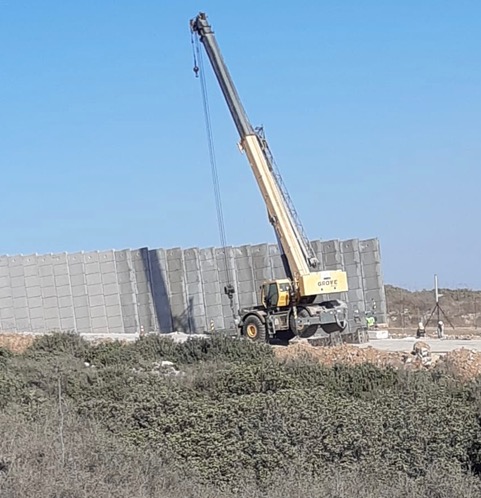 Hagar DrorSep-26-2023Barta'a: rapid construction of the separation fence
-
Tayba-Rummana
See all reports for this place-
Tayba-Rummana is an agricultural checkpoint. It is located in the separation fence in front of the eastern slopes of the Israeli city of Umm al-Fahm. The Palestinian villages next to the checkpoint are Khirbet Tayba and Rummana. Dozens of dunams of olive groves were removed from their owners, the residents of these villages on the western side of the separation fence. The Palestinian villages next to the checkpoint are Khirbet Tayba and Rumna. Dozens of olives dunams were removed from these villages' residents and swallowed up in a narrow strip of space, on the western side of the separation fence. The checkpoint allows the plantation owners who have permits to pass. Twice a week, the checkpoint opens for fifteen minutes in the morning and evening. During the harvest season, it opens every day for fifteen minutes in the morning (around 0630) and fifteen minutes in the afternoon (around 1530). (February 2020).
-