
Northern Checkpoints: agricultural gates and ‘security’ fence wide open day and night

m. Barta’a checkpoint – the largest checkpoint in the north of the country
Traffic flows, consisting of few workers holding work and transit permits to Barta’a, the seam-line zone and into Israel. In the afternoon dozens if not hundreds of workers who have work in Israel will be passing here, not having been allowed to use this checkpoint in the morning.
The metal shed has been dark for days now, says Ibrahim, but everything around it is lit. In the terminal we can see a crowded waiting line that disperses after a few minutes. The toilets, says Neta, are clean but stink. This large checkpoint used to be bustling until about half a year ago. Now, the many workers who want to hurry to their workplace are sent to further checkpoints, which makes life more difficult for them, and easier for the checkpoint personnel…
6:30 a.m. Anin agricultural checkpoint
At the entrance to the access road leading to the checkpoint, amidst the olive trees, all kinds of junk and waste are scattered. Anin villagers (headed by our old acquaintance M.) gather the junk in the nearby seam-line zone, hoping to bring them back to the village and earn a pittance. They tell us there is a recycling plant there, and perhaps it’s just junk dealers. The junk initiative faces occupation authorities’ opposition, leading mostly by military policemen, who claim that Anin is an agricultural checkpoint and an old easy chair is not agricultural goods… So when the authorities do not let such things through everything is thrown amidst the olive trees and waits for the Messiah. At times the soldiers ignore the junk and let people pass it through to the village as if it were agricultural goods. Now it’s ‘no-no’ time. M. has been denied his transit permit several times already because he tried to get junk through in spite of regulations. He managed to get his permit back each time, after waiting a week or two.
The main gate of the checkpoint is open or broken or simply has not been locked for quite some time. The soldiers arrive and take their time getting organized. No rush… This morning two tractors pass through and no more than ten people. Olive harvest season is near but the special permits for it have not yet been issued. The season lasts a month, and during this time the checkpoint is open daily (not just twice a week), and additional family members are allowed to get through for the harvest itself. Whoever has no permit for this specific checkpoint crosses through the more distant Barta’a checkpoint.
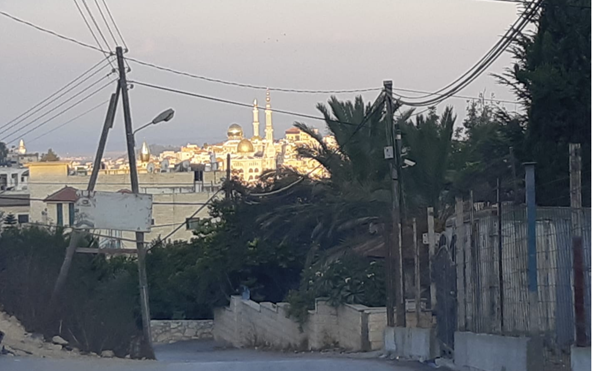
On our way to the checkpoint we drive through the outskirts of Umm Al Fahm. This large city is a chaos of fascinating and beautiful urban landscape: old and ancient side by side with new and shiny, narrow, old alleys amidst dilapidated old houses; new villas – huge, megalomaniac, with plenty of marble columns reminding us of the plantation houses in “Gone with the Wind”, lots of mosques with tall minarets and gold or silver domes.
7 a.m. Tayibe-Roumane agricultural checkpoint
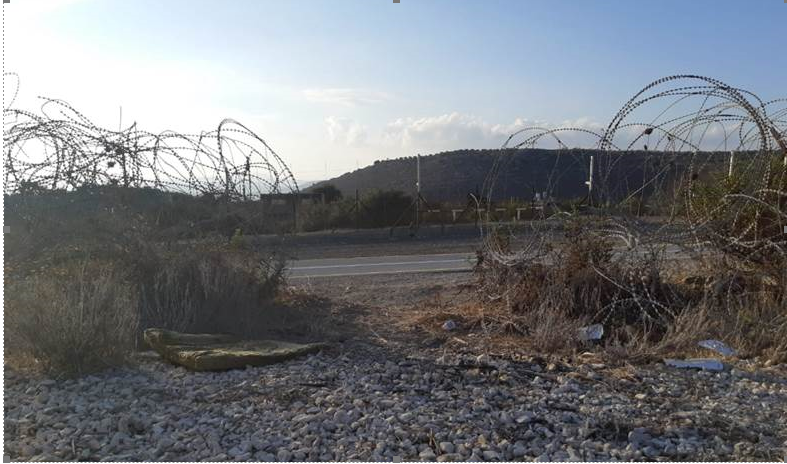
Lately we have been hearing from Palestinian acquaintances that the ‘security’ fence is open in numerous, obvious places, that agricultural checkpoints opened officially by soldiers once or twice a week stay wide open day and night, neither locked nor closed. People cross freely, and cars cannot since the army, leaving the checkpoint open, has blocked passage with concrete blocs brought especially for this purpose. Thus at Zeita agricultural checkpoint, where a large hole in the fence is seen in the direction of Zemer. Near Nizlat Issa (close to Baqa) right after the separation wall, there is a large hole in the fence where people cross openly, even holders of transit permits and especially people without them. We were told that hundreds of people cross there into western (Israeli) Baqa, and ride buses to Hadera and Tel Aviv. We are told that the army makes no effort to fix the holes or even catch the ‘foxes’. We are asked whether this is some sort of sophisticated tactics? Associated with the elections? People are confused and wonder how come the occupation authorities see this and do not react? And perhaps this is the form of the hoped-for peace… They enjoy this new situation and have already begun to fear that one day they would wake up and realize this was all a dream.
At the Tayibe-Roumana checkpoint we met the DCO representative, right next to two large holes in the fence, one just beside the outer gate, and another opposite. He claims there is no point in repairing them, for other holes will immediately appear (?). Around them numerous tracks are seen, obviously they have long been serving as an accessible passage point.
'Anin checkpoint (214)
See all reports for this place-
'Anin checkpoint (214)
'Anin checkpoint is located on the Separation Fence east of the Israeli community Mei Ami and close to the village of Anin in the West Bank. It is opened twice a week, morning and afternoon, on days with shorter light time, for Anin farmers whose olive groves have been separated from the village by the fence it became difficult to cultivate their land. Transit permits are only issued to those who can produce ownership documents for their caged-in land, and sometimes only to the head of the family or his widow, eldest son, and children. Sometimes the inheritors lose their right to tend to the family’s land. The permits are eked out and are re-issued only with difficulty. 55-year-old persons may cross the checkpoint (into Israel) without special permits. During the olive harvest season (about one month around October) the checkpoint is open daily and more transit permits are issued. Names of persons eligible to cross are held in the soldiers’ computers. In July 2007, a sweeping instruction was issued, stating that whoever does not return to the village through this checkpoint in the afternoon will be stripped of his transit permit when he shows up there next time. Since 2019, the checkpoint has not been allways locked with the seam-line zone gate (1 of 3 gates), and the fence around it has been broken in several sites.
-
Barta’a-Reihan Checkpoint
See all reports for this place-
This checkpoint is located on the Separation Fence route, east of the Palestinian town of East Barta’a. The latter is the largest Palestinian community inside the seam-line zone (Barta’a Enclave) in the northern West Bank. Western Barta’a, inside Israel, is adjacent to it. The Checkpoint is open all week from 5 a.m. to 9 p.m. Since mid-May 2007, the checkpoint has been managed by a civilian security company subordinate to the Ministry of Defense. People permitted to cross through this checkpoint into and from the West Bank are residents of Palestinian communities inside the Barta’a Enclave as well as West Bank Palestinian residents holding transit permit. Jewish settlers from Hermesh and Mevo Dotan cross here without inspection. A large, modern terminal is active here with 8 windows for document inspection and biometric tests (eyes and fingerprints). Usually only one or two of the 8 windows are in operation. Goods, up to medium commercial size, may pass here from the West Bank into the Barta’a Enclave. A permanent registered group of drives who have been approved by the may pass with farm produce. When the administration of the checkpoint was turned over to a civilian security firm, the Ya’abad-Mevo Dotan Junction became a permanent checkpoint. . It is manned by soldiers who sit in the watchtower and come down at random to inspect vehicles and passengers (February 2020).
-
Tayba-Rummana
See all reports for this place-
Tayba-Rummana is an agricultural checkpoint. It is located in the separation fence in front of the eastern slopes of the Israeli city of Umm al-Fahm. The Palestinian villages next to the checkpoint are Khirbet Tayba and Rummana. Dozens of dunams of olive groves were removed from their owners, the residents of these villages on the western side of the separation fence. The Palestinian villages next to the checkpoint are Khirbet Tayba and Rumna. Dozens of olives dunams were removed from these villages' residents and swallowed up in a narrow strip of space, on the western side of the separation fence. The checkpoint allows the plantation owners who have permits to pass. Twice a week, the checkpoint opens for fifteen minutes in the morning and evening. During the harvest season, it opens every day for fifteen minutes in the morning (around 0630) and fifteen minutes in the afternoon (around 1530). (February 2020).
-
