
Patrol shift to get to know the Seam Zone area of Elkana, Azzun and Habla checkpoint
Azzun has been in quarantine for several days, collective punishment again.
We started as usual in the Elkana enclave. We stopped by the Hani checkpoint for a story about the family and home that were separated from their village, Mas’ha, by a wall, and for explanations about the settlements and the separation fence that cuts them off from their agricultural lands and also from the neighboring villages that they can only reach by traveling through another village far from them. At every visit the appearance changes: the western gate is closed and locked.

The mountain of building debris in front of it is apparently starting to be cleared, but no trace of the olive grove that was here in the past remains. During the explanations, a military vehicle arrived on the perimeter road. It stopped by the gate, and a soldier came to us to ask what we were doing. I asked about the opening of the agricultural gates during the olive harvest, and he did not know about them. He just announced that Palestinians will not pass through the gates because it puts us at risk.
We also met soldiers near the Oranit checkpoint, unrelated to its opening. The IDF did indeed increase its forces in the West Bank. They said the opening hours have changed. Now: 8:00, 14:00, 18:00.
We returned to road 444 north. The new section of the road connecting its parts from both sides of Qalqilya has been opened and you can continue straight to Tayba and Kochav Yair. We headed east on road 55, at the first roundabout we headed for the observation of the southern Qalqilya checkpoint. There was no vehicular traffic.
We informed Z that we wanted to visit, he said that it was not possible because the entrance road has been closed for a week and that we would not try to come through Izbat Tabib either. We continued on road 55 east to Azun. The access road has been re-paved and there are railings on both sides but iron bars block the entrance to the city. The soldiers explained that children threw stones at a bus and therefore it was impossible to enter. They don’t know how long it will last. When I asked (as our Palestinian friends are wont to ask) why they don’t catch them in the act (instead of entering the houses a few days later at night) and why collective punishment, they answered that they had orders.

We returned to observe the villages that were “returned” to the West Bank after the removal of the fence, following the High Court of Justice, from the road leading to Alfei Menashe. There, too, we met soldiers in a car who asked about our actions and recommended observation from another point. After a short tour of the village of Arab al-Ramadin, which is cut off from the West Bank, and its residents must pass through checkpoints to get to it, we continued down the road to Highway 55, which was very busy in both directions. We passed what appeared to be an accident involving a private car and two motorcycles. A U-turn at the newly built square and driving east on the path adjacent to the nurseries brought us at 1:30 p.m. to the Habla checkpoint.
Nothing has changed. Cars, trucks and tractors have been waiting over 10 minutes for the gates to open. The gate has not been repaired and soldiers guard the entrance 24/7. five minutes later, soldiers get out of a civilian vehicle and the passage begins. The pedestrians who passed by looked up and photographed something above our heads – a helicopter hovering above us.
We dropped in on A., who treated us to coffee and cold water, and for close to an hour, between the cactus vendor and the next customer, he told us, and especially Alin, when he heard she was new, about his dealings with the arbitrariness of the army and the humiliations by the soldiers and female officers. And also praised us and our activity. He heard that the accident we saw was related to attempted car theft.
'Azzun
See all reports for this place-
Azoun (updated February 2019)
A Palestinian town situated in Area B (under civil Palestinian control and Israeli security control),
on road 5 between Nablus and Qalqiliya, east of Nabi Elias village. The inhabitants are allowed to construct and improve infrastructures. The Separation Fence has confiscated lands belonging to the town's people. In 2018 olive tree groves owned by one of its inhabitants were confiscated for the sake of paving a road to bypass Nabi Elias. Azoun population numbers 13,000, its economic state dire. Its infrastructures are poor, neglect and poverty rampant. In the meantime, the town council has completed paving an internal road for the inhabitants' welfare.
Because of its proximity to the Jewish settler-colony of Karnei Shomron and its outposts, the town suffers the intense presence of the Israeli army, especially at nighttime: soldiers enter homes, arrest suspects, trash the house and sometimes ruin it, as they do in numerous places in the West Bank. At times a checkpoint closes the entrance to the town, so no one can come in or get out.
-
Habla CP (1393)
See all reports for this place-
Habla CP (1393)
The Habla checkpoint (1393) was established on the lands of the residents of Qalqilya, on the short road that
connected it for centuries to the nearby town of Habla. The separation barrier intersects this road twice and cut off the residents of Qalqilya from their lands in the seam zone.(between the fence and the green line).
There is a passage under Road 55 that connects Qalqilya to the sabotage This agricultural barrier is used by the farmers and nursery owners established along Road 55 from the Green Line and on both sides of the kurkar road leading to the checkpoint.
This agricultural checkpoint serves the residents of Arab a-Ramadin al-Janoubi (detached from the West Bank), who pass through it to the West Bank and back to their homes. The opening hours (3 times a day) of this agricultural checkpoint are longer than usual, about an hour (recently shortened to 45 minutes), and are coordinated with the transportation hours of a-Ramadin children studying in the occupied in the West Bank.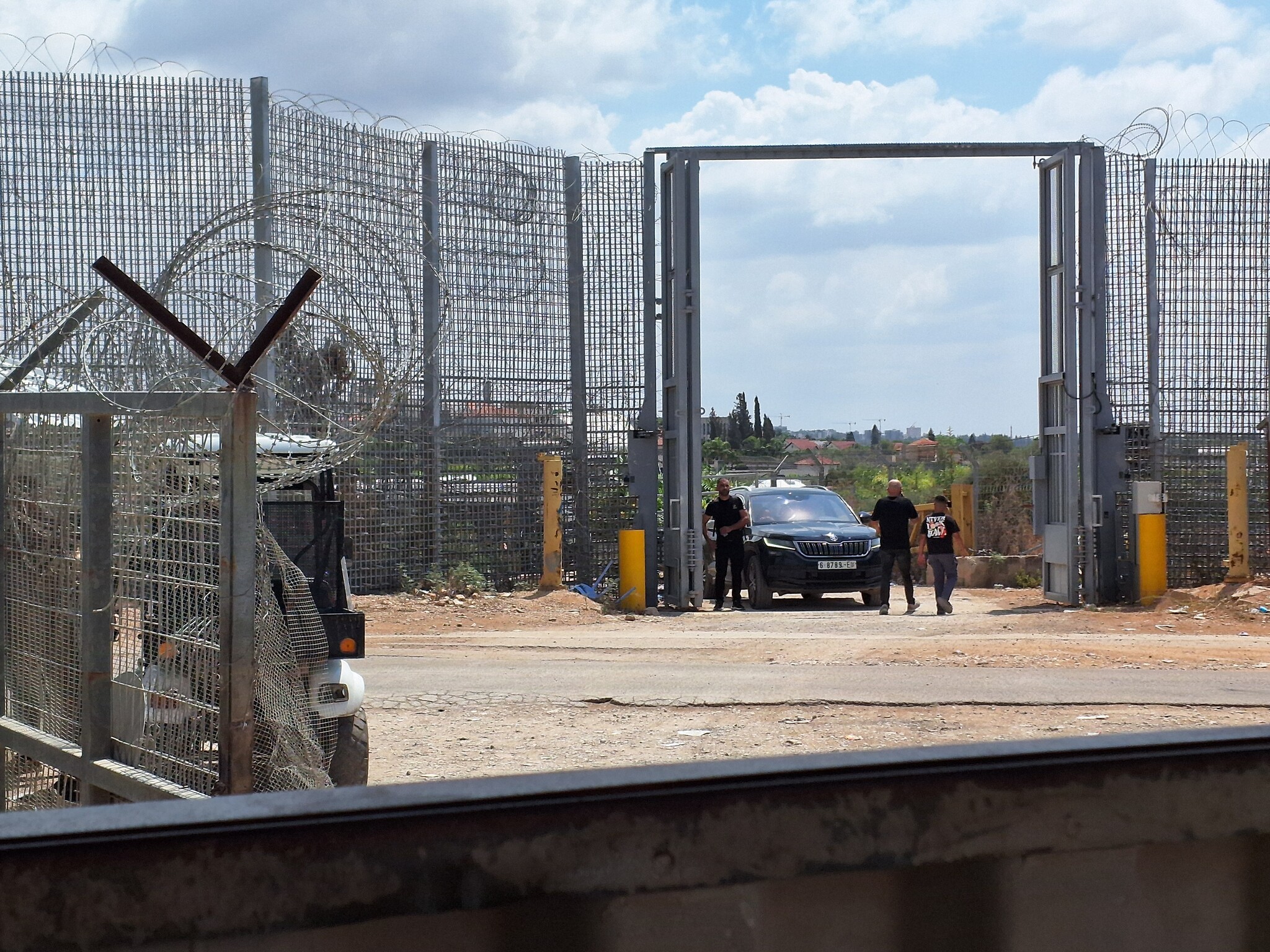 Ronit Dahan-RamatiAug-31-2026Habla. The gate is open
-
