
PM
BEIT IBA, SARRA THE ARMY OCCUPIED HOUSE AT HUWWARATuesday, 9 March, 2004, PMObservers: Edna K., Tammi R., Dafna N.In summary: The checkpoint at Sarra was closed and no one was allowed through, not even “humanitarian” cases. At Beit Iba there were about 100 angry detainees, some of whom had been there for five hours. Our intervention was successful in releasing many of them. We also visited the house that the army occupied last week and spoke with its inhabitants.13:10 Encountering no sudden checkpoints en route, we went up to Sarra by car– the lower gate was open. The checkpoint was closed from both directions and blocked with barbed wire coils. There were no soldiers there. But beyond the barbed wire coils, at the entrance to the village, there were people waiting. An officer appeared at the top of the hill and the whole exchange was by shouting. We went in. There was a taxi there whose driver had had his keys and his identity card confiscated in the morning. Four teachers from Kotsin who teach at Sarra and come through the checkpoint there and back every day were today prevented from proceeding. The officer informed us that today no one can go through. For security reasons. He was not allowed to tell us why. Until 17:00 (when, apparently, the “security reasons” will cease to exist). Meanwhile, a small van belonging to the Health Ministry of the Palestinian Authority drew up. It was flying a Red Crescent flag. The four people in it, doctors and nurses, were returning from the village where they had been giving immunizations. They had the vaccines with them in a cold bag but needed to get to their destination before the material began to deteriorate. The officer, rude and hostile towards them, refused to let them through We called the army’s humanitarian centre where they took the details and said they would deal with the matter. (And as a comment on the those Shin Bet checks that always take such hours: ever time that we call the humanitarian centre, we have no sooner finished giving them the person in question’s identity card number than they have before them all the information on that person!) And we also called the Association of Physicians for Human Rights. Among others who were not allowed to come through: some trucks with all the necessary papers and a man (in possession of a permit)who lives only 20 metres away in the direction of Nablus. 14:00– the officer, D., accompanied by a soldier, decided to come down to the people — but only in order to yell at them to get back and tell them to clear off! Two nine-year-olds wanted to go home, to the house referred to above. D. refused, we pleaded. The children were given permission and made a big detour around the soldiers, keeping well away from them. It is so obvious that the children were terrified of them . E. accompanied them on their way. D. again yelled everyone to clear off and come back at 17:00 when they would be allowed through. Some of the people replied: “But you told us earlier that we could go through at 14:30” “So now I’m saying come back at 17:00″ he barked back, while the second soldier shouted” Don’t you understand? What’s so difficult for you to understand?”14:30 We set off for Beit Iba, taking with us the phone numbers of the teachers and the truck with the medical supplies. They were allowed through at 15:00, when anyway the checkpoint was again opened. There was a sudden checkpoint en route. At Beit Iba there were a great many people coming from the Nablus direction, but very few going towards Nablus. There were about 100(!) detainees standing at the side. Some claimed that they had been there since 10:00 in the morning. They had come “leaking” out of the hillside, the officer said. In other words they had tried to by-pass the checkpoint, and they had only been there two hours, he maintained, adding that he would leave them there until nightfall. Th e folk at the side were very angry and denied trying to slip past the checkpoint. One of them was a student who told us that he had been similarly detained last week for three hours, today, he said, he had already been held up for five hours. He told us that he came through the checkpoint every day and on average he is detained every three days or so. We called the humanitarian centre and reported that the situation was on the verge of an explosion, and that it would be a good idea for them to take action before a tragedy occurred. Before very long, some 50 identity cards were returned to the waiting people and at 16:00 another 40 people got their cards back (meanwhile, new people had joined the detainees), with 20 still left waiting.Huwwara — we met up with the group of observers who had gone to Huwwara, (G. Efrat and Ada) and all of us went to visit the family that had been “imprisoned” last week when the army seized their house in a so-called “grass widow” operation: the father of the family, an 81-year-old and his wife, the brothers Fuad, Farouk and Razi and their wives and what seemed to be umpteen children, all with amazingly good manners. The great grandfather had been the mukhtar of Huwwara in 1918, and our 81-year-old had followed in his footsteps as mukhtar, a post he held until 1986. They told us about how the army had shut them all into one room in the first days of the seizure (later they had been allowed to move around the rest of the house), and of how they had had to plead with the soldiers to be allowed to go to the lavatory — the soldiers had told them to control themselvesd and wait. And how were little children supposed to wait for the lavatory, they had asked.It was a very warm and heartwarming meeting, the family very much want to meet Netta E., Hannah B.and Yehudit E. ( the Machsomwatch group that had discovered what was going on and had been instrumental in securing the release of the family. Netta had pushed her cellular phone through the shutters so that the family could be interviewed on an Israeli radio station which aired the story), and they sent them an open invitation to come whenever they want.
Beit Iba
See all reports for this place-
A perimeter checkpoint west of the city of Nablus. Operated from 2001 to 2009 as one of the four permanent checkpoints closing on Nablus: Beit Furik and Awarta to the east and Hawara to the south. A pedestrian-only checkpoint, where MachsomWatch volunteers were present daily for several hours in the morning and afternoon to document the thousands of Palestinians waiting for hours in long queues with no shelter in the heat or rain, to leave the district city for anywhere else in the West Bank. From March 2009, as part of the easing of the Palestinian movement in the West Bank, it was abolished, without a trace, and without any adverse change in the security situation.
 Jun-4-2014Beit-Iba checkpoint 22.04.04
-
Huwwara
See all reports for this place-
The Huwwara checkpoint is an internal checkpoint south of the city of Nablus, at the intersection of Roads 60 and 5077 (between the settlements of Bracha and Itamar). This checkpoint was one of the four permanent checkpoints that closed on Nablus (Beit Furik and Awarta checkpoints to the east and the Beit Iba checkpoint to the west). It was a pedestrian-only barrier. As MachsomWatch volunteers, we watched therre since 2001 two shifts a day - morning and noon, the thousands of Palestinians leaving Nablus and waiting for hours in queues to reach anywhere else in the West Bank, from the other side of the checkpoint the destination could only be reached by public transport. In early June 2009, as part of the easing of Palestinian traffic in the West Bank, the checkpoint was opened to vehicular traffic. The passage was free, with occasional military presence in the guard tower. Also, there were vehicle inspections from time to time. Since the massacre on 7.10.2023, the checkpoint has been closed to Palestinians.
On February 26, 2023, about 400 settlers attacked the town's residents for 5 hours and set fire to property, such as houses and cars. Disturbances occurred in response to a shooting of two Jewish residents of Har Bracha by a Palestinian Terrorist. The soldiers stationed in the town did not prevent the arson and rescued Palestinian families from their homes only after they were set on fire. No one was punished and Finance Minister Smotrich stated that "the State of Israel should wipe out Hawara." Left and center organizations organized solidarity demonstrations and support actions for the residents of Hawara.Hawara continued to be in the headlines in all the months that followed: more pogroms by the settlers, attacks by Palestinians and a massive presence of the army in the town. It amounted to a de facto curfew of commerce and life in the center of the city. On October 5, 2023, MK Zvi established a Sukkah in the center of Hawara and hundreds of settlers backed the army blocked the main road and held prayers in the heart of the town all night and the next day. On Saturday, October 7, 23 The "Swords of Iron" war began with an attack by Hamas on settlements surrounding Gaza in the face of a poor presence of the IDF. Much criticism has been made of the withdrawal of military forces from the area surrounding Gaza and their placement in the West Bank, and in the Hawara and Samaria region in particular, as a shield for the settlers who were taking over and rioting.
On November 12, 2023, the first section of the Hawara bypass road intended for Israeli traffic only was opened. In this way, the settlers can bypass the road that goes through the center of Hawara, which is the main artery for traffic from the Nablus area to Ramallah and the south of the West Bank. For the construction of the road, the Civil Administration expropriated 406 dunams of private land belonging to Palestinians from the nearby villages. The settlers are not satisfied with this at the moment, and demand to also travel through Hawara itself in order to demonstrate presence and control.(updated November 2023)
.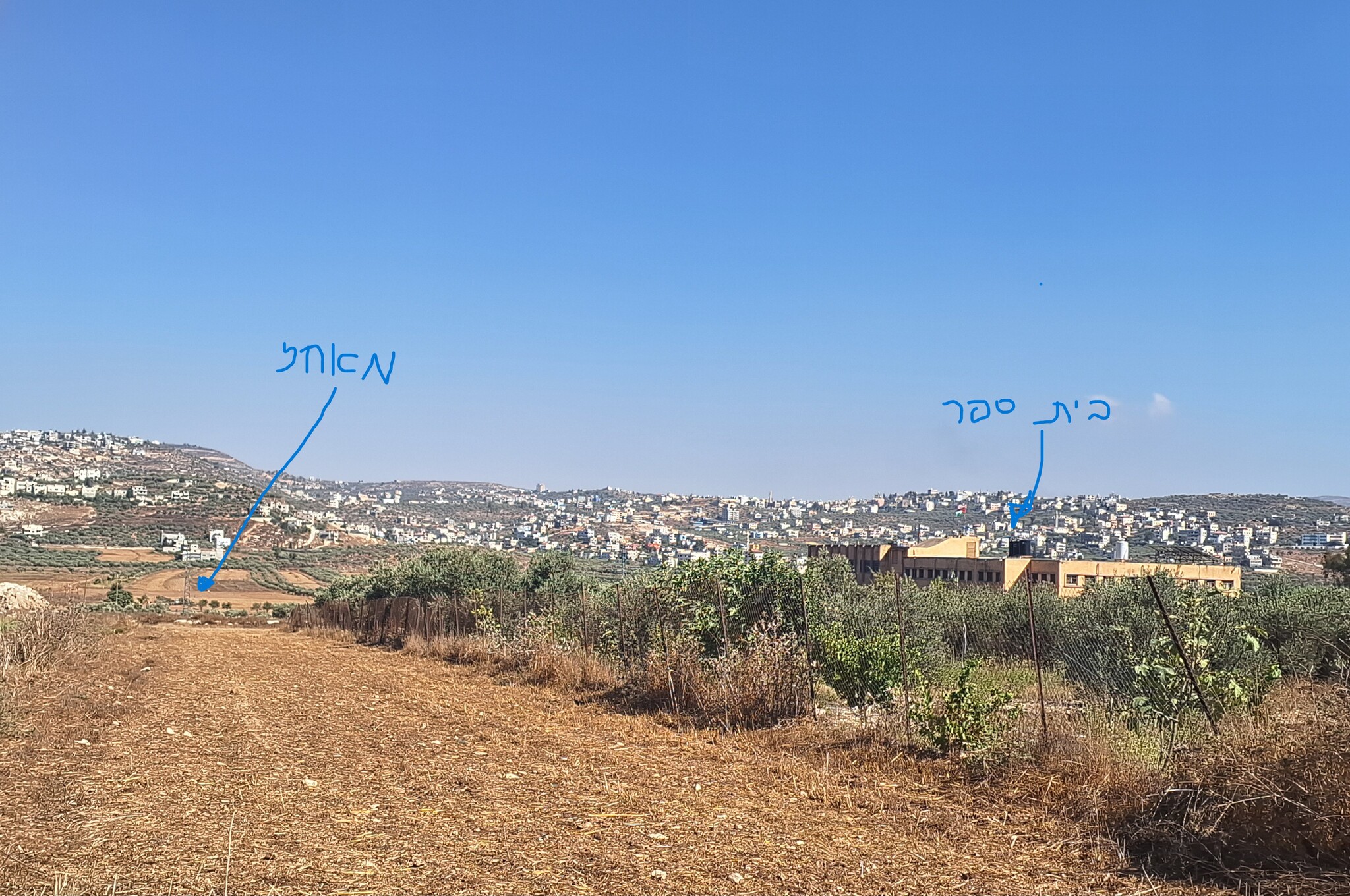 Ronit Dahan-RamatiAug-24-2026Huwara: The school on the outskirts of town and an outpost hidden among the trees
-
Sarra
See all reports for this place-
Sarra
The checkpoint is installed between the Palestinian village of Sera and the district city of Nablus,
Since 2011, internal barriers Located among the West Bank Israeli settlements have somehow allowed, Palestinian residents to travel and move and reach various Palestinian cities.
After the terrible massacre by the Hammas on October 7 upon Israelis in the communities around Gaza, internal checkpoints manned by the army were installed to prevent free passage for Palestinians.
Many restrictions were imposed on the Palestinians in the West Bank. The prevention of movement shuttered the possibility of making a living in Israel. The number of Palestinian attacks by Israeli extremist settlelers increased along with the radicalization of the army against the Palestinians.
The conduct at the Sera checkpoint is one of the manifestations of the restrictions on all aspects of the Palestinians' lives.
-
