
PM
HUWWARA, Wednesday 7 April 2004 ? PMObservers: Mekki, Yudit A., Eilat B., Ada R. (reporting)color=red>It was a long and very difficult watch which brought tears to the eyes of even the most experienced of us. Initially, as we entered the territories, it seemed that there were no checkpoints operating (we thought this might be because of the intermediate days of the Passover holiday!) But in the course of the shift, we came across flying checkpoints manned by the most obdurate and hostile of troops, particularly at the Jitt junction and at the one after that in the direction of Beit Iba. All the passengers of all the buses were checked one by one and all the young men — i.e. those aged between 16 and 35– were taken off every bus and made to wait while their documents were “checked” — a process that takes approximately four hours — and this was repeated at every junction, all over again. The buses, meanwhile, proceeded onwards after the checks — and sometimes after the damage done to the bus itself — with the remaining passengers.The soldiers were aggressive and hostile towards the Palestinians: “They aren’t human beings, they’re animals, blowing up Jews!” Many of them were young recent immigrants to Israel who, while still making elementary mistakes in Hebrew, have yet managed in their brief time in Israel to learn to hate both the Palestinians and us too: “You’re terrorists yourselves for helping them”. To the extent that it lies ion their power, they do their best to get their own backs on the Palestinians and on us.Huwwara:Soldiers still resort to the illegal practice of “grounding” taxis as a means of punishing taxi drivers for what they term “causing a disturbance”. All the young men in the 16 to 35 years-old bracket are detained in the stony pit alongside the checkpoint while their documents are cross-checked by the General Security Services (Shin Bet), which takes hours on end. Anyone without a permit is denied passage through the checkpoint, but even those who do have permits, and even holders of magnetic cards — which attest to their generally accepted security clearance — are detained in the pit. Huwwara South:There is no line of people waiting to go in the Nablus direction — perhaps this was because we came in the afternoon ( we got held up at the flying checkpoint at Jitt partly, but not entirely, because Nadim our driver — who is an Israeli citizen — was held up together with all the Palestinians. )Huwwara North:Throughout the time we were there the line of those waiting to go through the checkpoint always numbered between 60 to 100 men and women — the latter in the majority — and it moved painfully slowly. The soldiers staffing this side of the checkpoint, including their commander, B., were fair and businesslike. This was also our experience the week previous when things went so well that we left full of praise for officers and soldiers alike. The story would have repeated itself this week, too, were it not for a second performance by S., from the army’s “humanitarian” centre , of the disgraceful behaviour he had shown at the Beit Iba checkpoint a week ago. Just as he had done then, this week too he treated us with utter impudence and hostility and as for the Palestinians — they were subjected to his power games and his exercising of control. This was all the more galling when we remember that S. is not the commander of the checkpoint, but the man sent by the army to try to ease the lot of the Palestinians. Yet it was he who mistreated them and tried by means of threats and inciting one of the soldiers against us to prevent any contact between our group and the locals, claiming all the while, of course, that he was acting in the best interests of our safety. And all this despite the fact that every week when we are here we always go and stand in the line for the Palestinians going through the checkpoint just to see whether and what humanitarian problems there may be that require some attention. S. himself threatened me physically and also threatened to arrest me (something which he is not entitled to do), tried to incite the commander and the soldiers against us , though he only succeeded with one of them, who anyway apparently hates us. Later, just as he had done at Beit Iba the week before, he tried to get at us by driving a wedge between the members of the group: this time he said I was the problem, as he had last week said that our colleague Dafna was the trouble-maker. A complaint must be lodged against him, most particularly because of his attempts to interfere with our contacts with the Palestinians.The situation is, as others of our colleagues have noted, deteriorating, particularly in regard to the attitude to the Palestinians and to the blocking of their channels to any legal or other redress. Meetings with senior army personnel have not resulted in any change or improvement in Machsomwatch’s ability to work out there in the field; the “rules” of behaviour towards the Palestinians have not changed, nor have we seen an improvement in the application of such rules as do protect the local population. Intuitively, I would say that everything has deteriorated. We have to do some thinking. One example: the behaviour of the soldiers at the Jitt junction, and one of them in particular. Not only were the young men taken off the buses — thereby losing the fares they had paid from their anyway very poor earnings — and held for four hours in the sun, without water or toilets, while their documents were “checked”, but then the soldiers took their precious documents — and they are the staff of life to the Palestinians, more precious even than gold– and carried them some two kilometres away before hurling them into the drainage channels at the side of the road. And to add insult to injury, the soldiers threatened (in Arabic, according to the Palestinians) to take a knife and kill any of them who dared to run after the soldiers and discover just where the documents were being dumped. Some of the Palestinians did manage to find their documents once the soldiers had disappeared. But others did not.What on earth is one to say about such behaviour, what is one to call it? We have the name of the one who was the cruelest among them. For this is real cruelty. And the fact that soldiers can behave like this, without any fear of punishment to come, speaks volumes regarding the deterioration of the norms of behaviour to which we are witness every week in the occupied territories.
Beit Iba
See all reports for this place-
A perimeter checkpoint west of the city of Nablus. Operated from 2001 to 2009 as one of the four permanent checkpoints closing on Nablus: Beit Furik and Awarta to the east and Hawara to the south. A pedestrian-only checkpoint, where MachsomWatch volunteers were present daily for several hours in the morning and afternoon to document the thousands of Palestinians waiting for hours in long queues with no shelter in the heat or rain, to leave the district city for anywhere else in the West Bank. From March 2009, as part of the easing of the Palestinian movement in the West Bank, it was abolished, without a trace, and without any adverse change in the security situation.
 Jun-4-2014Beit-Iba checkpoint 22.04.04
-
Huwwara
See all reports for this place-
The Huwwara checkpoint is an internal checkpoint south of the city of Nablus, at the intersection of Roads 60 and 5077 (between the settlements of Bracha and Itamar). This checkpoint was one of the four permanent checkpoints that closed on Nablus (Beit Furik and Awarta checkpoints to the east and the Beit Iba checkpoint to the west). It was a pedestrian-only barrier. As MachsomWatch volunteers, we watched therre since 2001 two shifts a day - morning and noon, the thousands of Palestinians leaving Nablus and waiting for hours in queues to reach anywhere else in the West Bank, from the other side of the checkpoint the destination could only be reached by public transport. In early June 2009, as part of the easing of Palestinian traffic in the West Bank, the checkpoint was opened to vehicular traffic. The passage was free, with occasional military presence in the guard tower. Also, there were vehicle inspections from time to time. Since the massacre on 7.10.2023, the checkpoint has been closed to Palestinians.
On February 26, 2023, about 400 settlers attacked the town's residents for 5 hours and set fire to property, such as houses and cars. Disturbances occurred in response to a shooting of two Jewish residents of Har Bracha by a Palestinian Terrorist. The soldiers stationed in the town did not prevent the arson and rescued Palestinian families from their homes only after they were set on fire. No one was punished and Finance Minister Smotrich stated that "the State of Israel should wipe out Hawara." Left and center organizations organized solidarity demonstrations and support actions for the residents of Hawara.Hawara continued to be in the headlines in all the months that followed: more pogroms by the settlers, attacks by Palestinians and a massive presence of the army in the town. It amounted to a de facto curfew of commerce and life in the center of the city. On October 5, 2023, MK Zvi established a Sukkah in the center of Hawara and hundreds of settlers backed the army blocked the main road and held prayers in the heart of the town all night and the next day. On Saturday, October 7, 23 The "Swords of Iron" war began with an attack by Hamas on settlements surrounding Gaza in the face of a poor presence of the IDF. Much criticism has been made of the withdrawal of military forces from the area surrounding Gaza and their placement in the West Bank, and in the Hawara and Samaria region in particular, as a shield for the settlers who were taking over and rioting.
On November 12, 2023, the first section of the Hawara bypass road intended for Israeli traffic only was opened. In this way, the settlers can bypass the road that goes through the center of Hawara, which is the main artery for traffic from the Nablus area to Ramallah and the south of the West Bank. For the construction of the road, the Civil Administration expropriated 406 dunams of private land belonging to Palestinians from the nearby villages. The settlers are not satisfied with this at the moment, and demand to also travel through Hawara itself in order to demonstrate presence and control.(updated November 2023)
.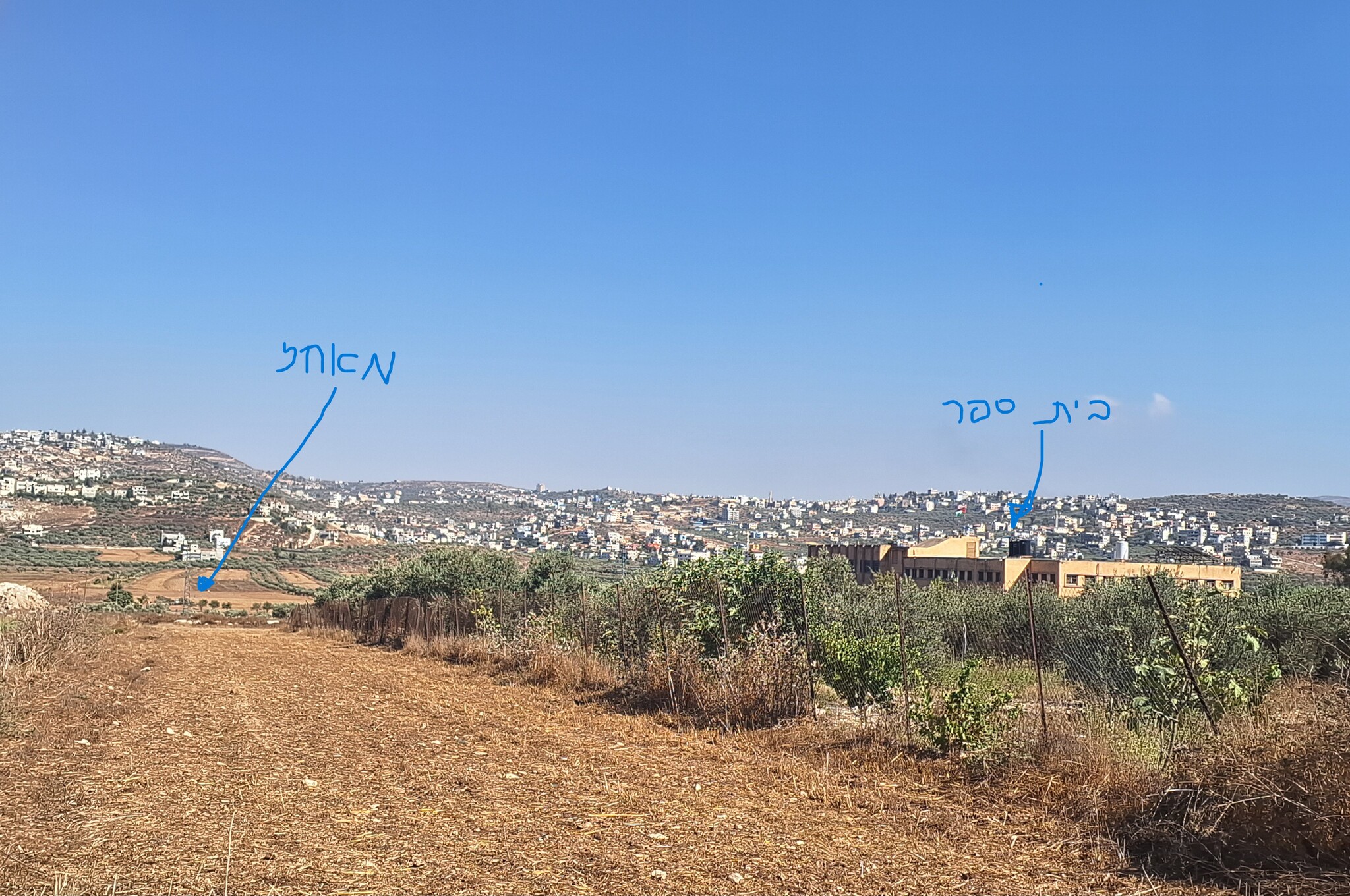 Ronit Dahan-RamatiAug-24-2026Huwara: The school on the outskirts of town and an outpost hidden among the trees
-
