
PM
BEIT IBA and HUWWARA, Sunday April 25 2004Observers: Aliyah S., Anat S., Shelly M., Neomi L.(reporting)color=red>Despite the talk about removing checkpoints, the one at Qalqiliya was very active, complete with soldiers, cars, lines and detainees. At the Jitt -Sarra junction we found an unannounced road block where we saw a bus crowded with men, women and children which, only 10 minutes earlier, had been held up for half an hour of checking at Beit Iba, and now here it was stopped again, and doubtless it will be checked for yet a third time when it enters Qalqiliya. There were only few people wanting to go through at Beit Iba, checks were fast and there were no long lines. We were pleased to meet N. a down-to-earth, pleasant and effective officer. About 30 men had been detained : these are some of their stories:A business administration student from an-Najah University in Nablus, due to take an examination at 15:00 had been detained since 10:00. After a short conversation they let him go.A student of economics at el-Kuds was detained here yesterday from 08:00 to 17:00 and then sent back to where he had come from. Today he is also detained and needs to have some university papers signed in Nablus. After some intervention from us, he got permission to go into Nablus, on condition that he deposit his ID card with the soldiers with a promise that it will be returned to him when he comes back through the checkpoint in the opposite direction.The father of a two-year-old wants to get to the hospital where his child is being treated. After he had been detained for two hours, we intervened and the officer let him go through. We had been about to call the doctors, but the handling was fast and effective. A taxi owner from one of the nearby villages, who works in Nablus, wants to drive his two cabs which have been in the garage back into Nablus. In addition to taking away his ID card for checking, the soldiers have also confiscated his car keys. Initially we are told that there is no chance of his going through ; later, they let him go and tell him he can drive through with the cabs at 18:00.A young man who had been hospitalized for three days in Watani hospital had been held for half an hour before we intervened and they let him go. A psychologist had lately become the father of another child, so he and his family have moved to a bigger home. He wanted to go to Nablus to arrange for the changes to be registered, but, because his present papers did not match what he said about his address and the number of children in the family, he was refused permission to proceed through the checkpoint! We called the officer , N., who let him through. Two hours later he came back with the right papers, but written in Arabic, which the soldiers couldn’t read, and so again they refused to let him pass. We called for our Arab driver, N., to ask him to translate, but before he got to us, the soldiers had found a translator among those waiting to go through and the man was free to return home. Because the soldiers were behaving as well as possible, and because all but three of the detainees were free before 16:00 we decided to visit Huwwara south.Huwwara SouthWe found 17 detainees, some of whom claimed to have been held for five hours, most of them students on their way to Nablus. There was no water available , so we brought some to them. An aggressive soldier told them and us to keep apart from one another after the detainees had approached close to us to talk . But we stood our ground and insisted on talking to them.Huwwara NorthIt was the same story here: 20 students detained while their papers were checked for five hours. Among them was a wanted man who had had his eyes blindfolded and his hands tied. Here, too, there was no water, and the soldiers let us fill some bottles with raspberry juice from their own supply, but not all the Palestinians would drink it. We called the army’s “humanitarian” hot-line and even as we spoke to them the IDs were handed back and the detainees released. The relationship between the soldiers and the detainees was quite good: both groups are about the same age and both are depressed. Together they were drawing a sign that said “Yasin Village” named for one of the detainees. One of the soldiers said, laughing, “You’re gonna stay here for 8 more hours. ” The detainees laughed back.As we stood there, smiling with them, our driver, N., came and told us about a military jeep carrying some soldiers, one of them a Druze with fluent Arabic, who had stopped four young Palestinian women who just crossed the checkpoint. The soldiers had said that they were from the General Security Services (Shin Bet) and they wanted to question the young women, separately. They had asked the girls for their phone numbers, and the frightened girls had replied that they didn’t have phones.We left at around 18:00. And another little episode: On our way home, a soldier asked our driver where he was from and when N. replied that he came from Tira, he was asked to stop the car for a quick check. I found this very upsetting: clearly we are Israelis, and if settler cars aren’t asked to stop for a check, why are we? Had we been driving our own car, the soldiers would have said nothing. N. said that this was not the first time he had been stopped and that it would all be over soon.But when I get home , it is not all over for me….as it will be said in the rubric to be used in two days time when the Independence Day beacons are lit, this is all “to the glory of the State of Israel!”
Beit Iba
See all reports for this place-
A perimeter checkpoint west of the city of Nablus. Operated from 2001 to 2009 as one of the four permanent checkpoints closing on Nablus: Beit Furik and Awarta to the east and Hawara to the south. A pedestrian-only checkpoint, where MachsomWatch volunteers were present daily for several hours in the morning and afternoon to document the thousands of Palestinians waiting for hours in long queues with no shelter in the heat or rain, to leave the district city for anywhere else in the West Bank. From March 2009, as part of the easing of the Palestinian movement in the West Bank, it was abolished, without a trace, and without any adverse change in the security situation.
 Jun-4-2014Beit-Iba checkpoint 22.04.04
-
Huwwara
See all reports for this place-
The Huwwara checkpoint is an internal checkpoint south of the city of Nablus, at the intersection of Roads 60 and 5077 (between the settlements of Bracha and Itamar). This checkpoint was one of the four permanent checkpoints that closed on Nablus (Beit Furik and Awarta checkpoints to the east and the Beit Iba checkpoint to the west). It was a pedestrian-only barrier. As MachsomWatch volunteers, we watched therre since 2001 two shifts a day - morning and noon, the thousands of Palestinians leaving Nablus and waiting for hours in queues to reach anywhere else in the West Bank, from the other side of the checkpoint the destination could only be reached by public transport. In early June 2009, as part of the easing of Palestinian traffic in the West Bank, the checkpoint was opened to vehicular traffic. The passage was free, with occasional military presence in the guard tower. Also, there were vehicle inspections from time to time. Since the massacre on 7.10.2023, the checkpoint has been closed to Palestinians.
On February 26, 2023, about 400 settlers attacked the town's residents for 5 hours and set fire to property, such as houses and cars. Disturbances occurred in response to a shooting of two Jewish residents of Har Bracha by a Palestinian Terrorist. The soldiers stationed in the town did not prevent the arson and rescued Palestinian families from their homes only after they were set on fire. No one was punished and Finance Minister Smotrich stated that "the State of Israel should wipe out Hawara." Left and center organizations organized solidarity demonstrations and support actions for the residents of Hawara.Hawara continued to be in the headlines in all the months that followed: more pogroms by the settlers, attacks by Palestinians and a massive presence of the army in the town. It amounted to a de facto curfew of commerce and life in the center of the city. On October 5, 2023, MK Zvi established a Sukkah in the center of Hawara and hundreds of settlers backed the army blocked the main road and held prayers in the heart of the town all night and the next day. On Saturday, October 7, 23 The "Swords of Iron" war began with an attack by Hamas on settlements surrounding Gaza in the face of a poor presence of the IDF. Much criticism has been made of the withdrawal of military forces from the area surrounding Gaza and their placement in the West Bank, and in the Hawara and Samaria region in particular, as a shield for the settlers who were taking over and rioting.
On November 12, 2023, the first section of the Hawara bypass road intended for Israeli traffic only was opened. In this way, the settlers can bypass the road that goes through the center of Hawara, which is the main artery for traffic from the Nablus area to Ramallah and the south of the West Bank. For the construction of the road, the Civil Administration expropriated 406 dunams of private land belonging to Palestinians from the nearby villages. The settlers are not satisfied with this at the moment, and demand to also travel through Hawara itself in order to demonstrate presence and control.(updated November 2023)
.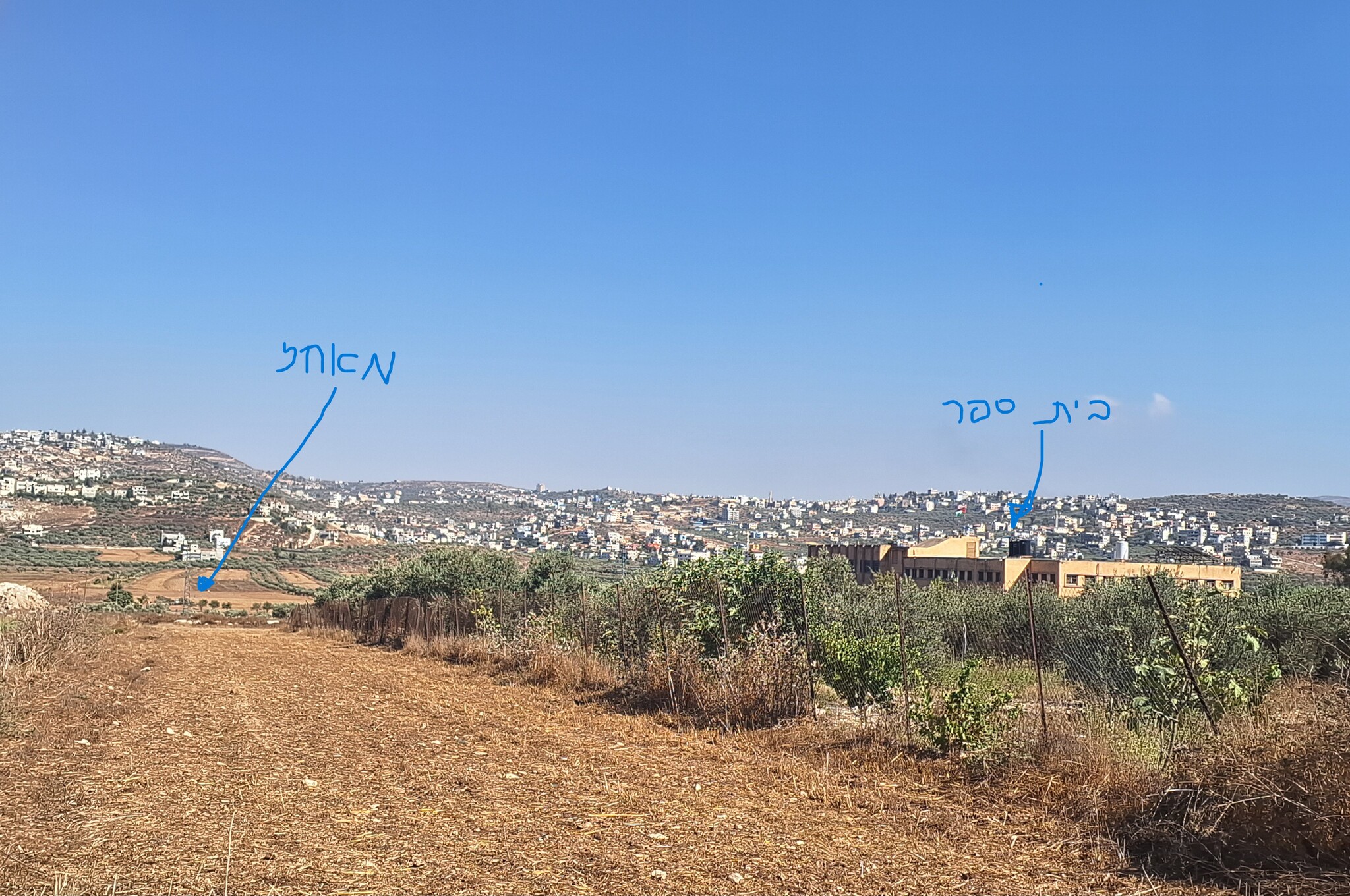 Ronit Dahan-RamatiAug-24-2026Huwara: The school on the outskirts of town and an outpost hidden among the trees
-
