
PM
BEIT IBA, HUWWARA, Monday 3 May 2004 PMObservers: Ruthi K., Maki, Miri K., Noya A., Maya K. (reporting) colour=red>SummaryThere was a “closure” here today, or, as we learned today at Beit Iba, a damming [there is a play on words here: on the Hebrew words seger , meaning closure, and seher , meaning dam] , so that only “humanitarian” cases were allowed through the checkpoint. We were also told that this had been further narrowed to only extreme “humanitarian” cases , i.e. only the injured in ambulances and not the sick! Nonetheless, in Beit Iba, where we received the explanation, all the ambulances went through. In Huwwara the soldiers were tougher. So: few people, particularly in Beit Iba, while in Huwwara the main activity was dealing with humanitarian cases. We split into two groups13:30 — Qalqiliya When we arrived, there was a line of about 15 cars on their way out. The delay was caused by a taxi being very meticulously checked by two soldiers. All the passengers had been told to get out, and the driver explained that he hadn’t halted at (or hadn’t seen) the red plastic barrier on the road. He had thus driven beyond it and now the soldier was punishing him. After taking the passengers out and checking the inside of the cab, the soldier asked the driver to dismantle the engine. A noisy argument ensued. The driver brought a spanner and opened some part of the engine, closed it again and was allowed to continue on his way. When we asked about this strange procedure, the soldier told us not to interfere with his work. After this saga, the other cars went through rapidly. Several were told to halt for a random check but were immediately allowed to leave.A private vehicle with an Israeli licence plate wanted to enter Qalqiliya but was not allowed to. A woman passenger appealed to us: she was from Taibeh, had only one leg, and wanted to visit her daughter in Qalqiliya . While we were talking, her other daughter, an Israeli student who was the driver of the car, had already managed to arrange entry for them.The Zer farm checkpointWhen we arrived, a bus from Jenin was on its way to Ramallah. The passengers were taken off, their papers were checked, and in the end the bus was sent back to Jenin after having been checked at three previous checkpoints.Five young men were sitting by the road , one of them, above the “problematic” age [Palestinian males aged between 16 and 35 have great difficulty in moving freely around the Occupied Territories even if they are in possession of all the required permits], sitting there because he didn’t want to leave his young nephew alone. Their papers had been taken for checking an hour ago. They wanted to go north ( to Jenin and Tubas). When we passed by two or three hours later, they were no longer there.Jitt junction We found a detained taxi and a detained private car here. The taxi-driver, from Qabatiya, had driven south on Road 60 which is open only to the privileged [i.e. it is open only to Israelis and is closed to Palestinians]. He claimed that he didn’t often travel there and didn’t know about the ban. He said he had been waiting since 06:00, but the soldiers said he had been there only from 10:00 (that means – at least four hours). The car driver was from Ramallah, and, at the junction, he had turned from Road 55 onto the forbidden Road 60 and been arrested as he made the turn. We asked the soldiers to release him, since he’d scarcely been on the road. We talked to the army’s “humanitarian” hotline, where they promised nothing and did nothing. From a phone conversation later that night we discovered that the car driver had been released after about an hour, but the taxi had been confiscated for four days at [the police station of] Shavei Shomron.Five people were waiting on one side for the check. We asked for water for them. The soldiers had none so we gave them ours. Perhaps we should suggest to the authorities that if some roads are banned to a certain population, there should be proper signposting? The explanation that “everyone knows” is unsatisfactory.Beit Iba Today, as noted above, there was a “damming” in place here. For most of the time we were there scarcely anyone went into Nablus and only a trickle came out, or tried to. At any given time there were a few detainees waiting, including a group of women with small children: a girl from Nablus, with a mother and two aunts and their children from Jenin who all wanted to visit her In the end, after the check,each went her own way (the first back to Nablus, the rest to Jenin).We tried hard to help a student who wanted to return from Nablus to his home in Deir Sharaf ( a stones-throw from the checkpoint). He had been detained for a long time and our appeals to the “humanitarian” hotline did not help. In the end he went through,but many others living in the vicinity (Qusin, Burka) were forced to turn back.We succeeded in helping a man with back problems, who was dragging his leg and had a medical certificate, to get home.We tried to help a young man with a nursing certificate (auxiliary medical personnel). The soldiers claimed that the document was forged and S. from the District Coordinating Office (DCO) [the army section that deals with civilian matters] claimed that the young man had admitted to him that he wasn’t working as a nurse. S. added that even UNWRA personnel wanted to impose some sanctions on Nablus for forging UNWRA documents.As usual at Beit Iba, N. was very helpful, attentive and ready to exercise judgment, even though the results were meagre. S., another soldier, was rough and shouted at the passersby even about trivial matters such as checking briefcases and purses.HuwwaraHere too there was complete closure. Nobody moved in and out except for acute “humanitarian” cases. Palestinians continued to wait at the two checkpoints even after being refused, in the hope that their luck might change. Among the cases: a diabetic with a letter declaring that she needs treatment. She was refused and we contacted I. from the Physicians for Human Rights organization (PHR). Even so, she was not allowed through until, suddenly, the checkpoint was opened for women over 40. A little boy needing dialysis went through with his mother thanks to our pleas. Two children with Thalassemia had gone through to Nablus with their father in the morning for treatment and were returning home; But a mother with two children suffering from the same condition were not allowed back home.An elderly man treated for kidney stones was not allowed through to return home.A man recovering from open heart surgery was allowed home only after we intervened.An old man was not allowed back home after undergoing eye surgery. When we looked later, he had disappeared.The wife of a couple from Nablus had a different address in her ID card. She was not allowed back into Nablus and both turned back.An ambulance with medicines was not allowed to pass at first when the soldiers claimed that the ambulance crew were trafficking in medical drugs; it went through later following our pleading. At the northern checkpoint, a detainee had been sitting with his wife beside him from 06:00. The soldiers claimed that he had hit a soldier, and was under arrest and awaiting the arrival of the [Israeli General Security Services] Shin Bet. They explained that they would release him at dark (in other words the Shin Bet story was an invention).The commander of the northern checkpoint was very helpful, contacted his superiors on every issue but did not exercise judgment of his own. The soldiers were very tough, and two soldiers at the northern checkpoint spoke very offensively to the Palestinians.
Beit Iba
See all reports for this place-
A perimeter checkpoint west of the city of Nablus. Operated from 2001 to 2009 as one of the four permanent checkpoints closing on Nablus: Beit Furik and Awarta to the east and Hawara to the south. A pedestrian-only checkpoint, where MachsomWatch volunteers were present daily for several hours in the morning and afternoon to document the thousands of Palestinians waiting for hours in long queues with no shelter in the heat or rain, to leave the district city for anywhere else in the West Bank. From March 2009, as part of the easing of the Palestinian movement in the West Bank, it was abolished, without a trace, and without any adverse change in the security situation.
 Jun-4-2014Beit-Iba checkpoint 22.04.04
-
Huwwara
See all reports for this place-
The Huwwara checkpoint is an internal checkpoint south of the city of Nablus, at the intersection of Roads 60 and 5077 (between the settlements of Bracha and Itamar). This checkpoint was one of the four permanent checkpoints that closed on Nablus (Beit Furik and Awarta checkpoints to the east and the Beit Iba checkpoint to the west). It was a pedestrian-only barrier. As MachsomWatch volunteers, we watched therre since 2001 two shifts a day - morning and noon, the thousands of Palestinians leaving Nablus and waiting for hours in queues to reach anywhere else in the West Bank, from the other side of the checkpoint the destination could only be reached by public transport. In early June 2009, as part of the easing of Palestinian traffic in the West Bank, the checkpoint was opened to vehicular traffic. The passage was free, with occasional military presence in the guard tower. Also, there were vehicle inspections from time to time. Since the massacre on 7.10.2023, the checkpoint has been closed to Palestinians.
On February 26, 2023, about 400 settlers attacked the town's residents for 5 hours and set fire to property, such as houses and cars. Disturbances occurred in response to a shooting of two Jewish residents of Har Bracha by a Palestinian Terrorist. The soldiers stationed in the town did not prevent the arson and rescued Palestinian families from their homes only after they were set on fire. No one was punished and Finance Minister Smotrich stated that "the State of Israel should wipe out Hawara." Left and center organizations organized solidarity demonstrations and support actions for the residents of Hawara.Hawara continued to be in the headlines in all the months that followed: more pogroms by the settlers, attacks by Palestinians and a massive presence of the army in the town. It amounted to a de facto curfew of commerce and life in the center of the city. On October 5, 2023, MK Zvi established a Sukkah in the center of Hawara and hundreds of settlers backed the army blocked the main road and held prayers in the heart of the town all night and the next day. On Saturday, October 7, 23 The "Swords of Iron" war began with an attack by Hamas on settlements surrounding Gaza in the face of a poor presence of the IDF. Much criticism has been made of the withdrawal of military forces from the area surrounding Gaza and their placement in the West Bank, and in the Hawara and Samaria region in particular, as a shield for the settlers who were taking over and rioting.
On November 12, 2023, the first section of the Hawara bypass road intended for Israeli traffic only was opened. In this way, the settlers can bypass the road that goes through the center of Hawara, which is the main artery for traffic from the Nablus area to Ramallah and the south of the West Bank. For the construction of the road, the Civil Administration expropriated 406 dunams of private land belonging to Palestinians from the nearby villages. The settlers are not satisfied with this at the moment, and demand to also travel through Hawara itself in order to demonstrate presence and control.(updated November 2023)
.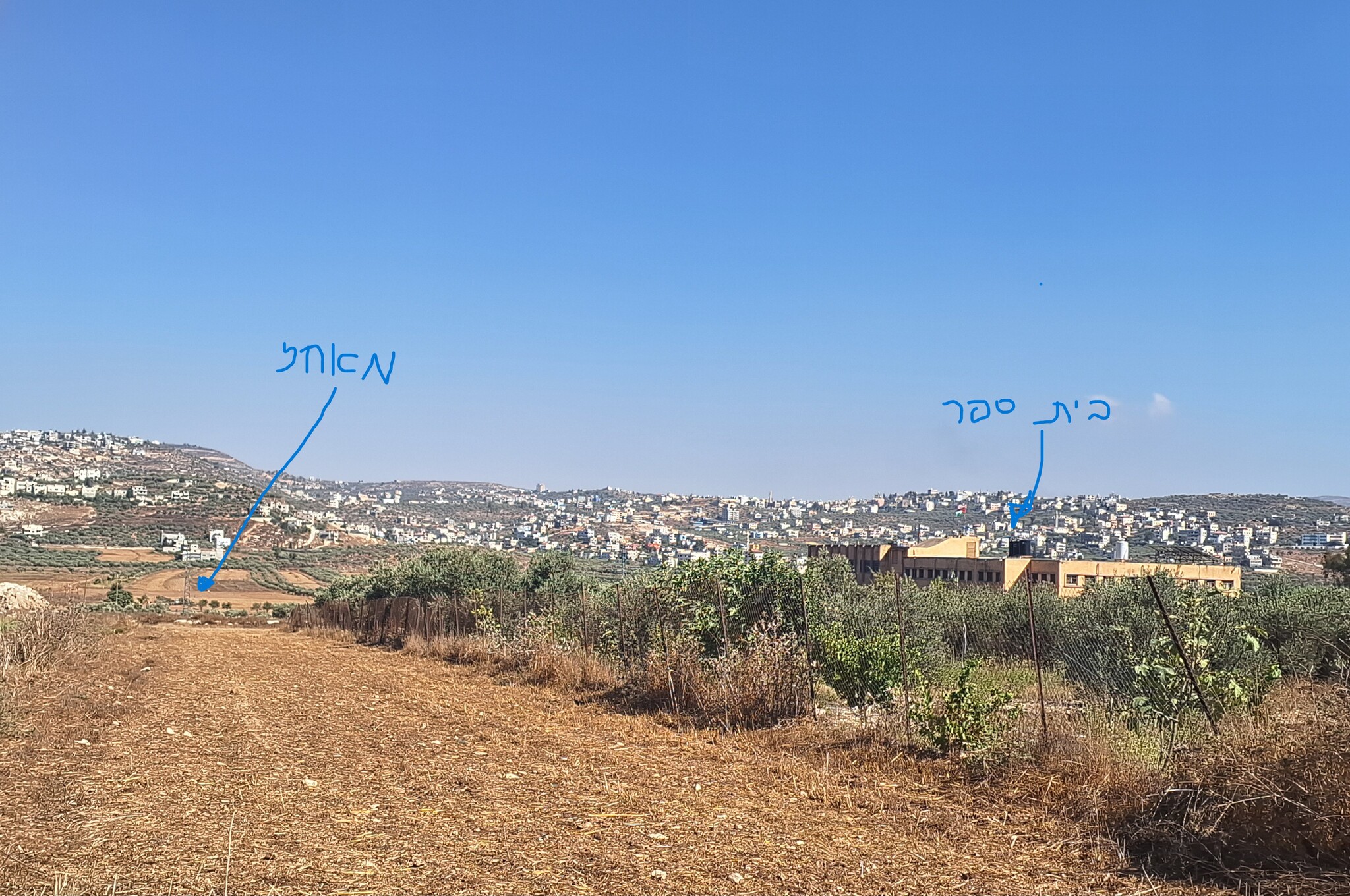 Ronit Dahan-RamatiAug-24-2026Huwara: The school on the outskirts of town and an outpost hidden among the trees
-
