
PM
Huwwara, Beit Furiq, Beit Dajan, Deir Sharaf, Beit Iba 31/1/2004 Watchers: Roni H., Hava H., Vivi S., Victoria B., Amalia, Michal M., guests: 3 Journalists from France Channel 4 During a break at the Eli gas station private security vehicles arrived to see who we were and what we’re doing. They blocked in our vehicle and came over to look inside the van. The security guard asked: 1) Where are you from? (Answer: Jerusalem); 2) Is everyone in the van Jewish? (Answer: MLM slammed the door in his face). But, they left anyway. Team split into two separate units. Victoria’s report on Huwwara follows below. Team 1: Roni H., Vivi S., Michal M. (reporter) and Journalists Not much activity at Beit Furiq, very few people because of the holiday. We didn’t stay long. At the taxi area a few men reported a flying checkpoint at Maraqa. They reported that no one was able to pass and that there had been violence. We decided to visit the area. They claimed that it was 15 minutes away; in reality it took approximately 25 minutes each direction because of the roads and distance. Our driver followed another van (For reference: Maraqa is the passage area just after Beit Dajan. On the road the first village is Beit Furiq, then Beit Dajan, then an open, hilly region with a narrow, uneven and winding road that leads to other villages in the valley. The villages in the valley are: Ein Bidan and Farah). The soldiers and jeep were positioned on high ground overlooking the other villages. They were preventing passage for everyone on all conditions. Their orders were that this is not a passage, and that the people need to use alternate routes that pass through the established checkpoints. When asked which routes those are, the soldiers did not know. They said that this is a place that they only come to on occasion. There was intelligence of violent activists coming from this region using this passage, therefore they were there to check who was using it. The men who had asked us to come told the soldiers that we said that they could pass if we joined them. Not true. The Vice Chairman of Beit Dajan council arrived and spoke with us for a few minutes; he explained how the entire area is blocked in at one side Beit Furiq checkpoint and the other Maraqa passage. The soldiers were very worried about how we arrived there and wanted us to have a military escort out. They warned of threats to kidnap Israeli civilians including those who work in human rights in the West Bank. We were successful in convincing them to allow us to leave without the military escort. At this point, Vivi and Victoria switched teams, and the journalists went to Huwwara (see Team 2’s report below). Sarra (see VB report) Dir Sharaf, Beit Iba. Long, slow pedestrian line checked by one soldier for both directions. Eight detainees were standing inside of the secured area. We were forbidden by the commander (Ofir) to be inside. He was uncooperative and refused to speak with us. The people in line were anxious and pushing forward causing the level of tension to rise amongst themselves and with the soldiers. The pedestrian line was incomprehensibly slow. Vehicular lanes were much faster (fewer vehicles than pedestrians), and ambulances passed within minutes.Soldiers caught many people walking around the checkpoint area and detained them for ID checks, among them two pregnant women. Some people had been waiting for hours. In the end, all of the people were released but this was only after massive pressure by us, the Army Humanitarian Hotline, Physicians for Human Rights, and the Center for the Defence of the Individual (Moked). More soldiers were needed. The DCO was unresponsive. The second team with journalists joined us here, and the large number of Watchers plus camera crew was immensely helpful. Team 2: Vivi Z., Hava H., Amalia, and Victoria B. (reporter) At Huwwara, we encountered a large angry crowd of people who needed to go to Nablus to shop, get money from the bank etc., before the holiday, and an army unit that could not handle the pressure. An officer who was quite decent when we first saw him a few weeks ago has become nasty, and was displaying the usual ego trip – “The CP is closed until everybody moves back behind the line” – and meanwhile more and more people were streaming, desperate folks were pushing from the sides, and at some point people broke through the barrier. The soldiers were not the worst lot, but it was scary enough. We kept calling DCO frantically for reinforcements, finally officer Itai showed up. On the scale of this horrible place he was an angel, he was running here and there, shouting, cajoling, stood at the top of the line, and kept the place going. Did not enforce the rule that only sick in ambulances could pass. One could ask him for help now and then, when the local officer was not looking – the officer took offence at us, apparently for calling the DCO reinforcements and expressing relief at their arrival. Some 15 detained were waiting on the side, finally most were released. A young man with X-ray pictures and medical referral for broken wrist waited for GSS checkup. Even Itai would not release him until the GSS answer arrived. Two teenage boys were detained with hands bound behind them. Apparently, they did not have documents, and tried to pass again and again and that was their punishment. Finally they were released. The family of one of them kept waiting for him after being allowed through the CP, but he was turned back. Then the officers left, and a soldier had a great idea of detaining for GSS checkup everybody in the 16-35 age range – some 30 people – who did not have permits. That included Nablus residents – supposedly, they left Nablus illegally, without a permit, and as a result they had to be checked upon their return. Hava tried to expedite ID checkups, the soldier said that the GSS is getting requests from 700 army units and is therefore overloaded.Meanwhile, Michal, Roni and Victoria proceeded to Sarra and Deir Sharaf. At Sarra, Michal remained with the driver – taught by the last week’s harassment of the driver by the army. Another yellow-plated car with young Arab people inside was ordered away by soldiers in an armored vehicle. They were from Kfar Qasem and tried to visit parents with orange ID. On the hilltop some thoroughly unfriendly and uncommunicative soldiers stationed above the road tried to chase us off and then scare us off with stories about nearby terrorists. Itai showed up in a DCO jeep. A detained man and a boy were released after some admonition against future breaking of a curfew, the men had to scramble up to the soldiers’ station to get his ID. We did not understand where was the curfew declared, perhaps in Sarra, since the place looked deserted. An elderly couple was begging to see their son, downhill, to no avail, and sent home. We slipped them a Moked card and our phone number. The couple called us, the son brought some money, we considered bringing it over for the couple, but Itai left and we decided against doing it in front the awful pair of the remaining soldiers.
Beit Iba
See all reports for this place-
A perimeter checkpoint west of the city of Nablus. Operated from 2001 to 2009 as one of the four permanent checkpoints closing on Nablus: Beit Furik and Awarta to the east and Hawara to the south. A pedestrian-only checkpoint, where MachsomWatch volunteers were present daily for several hours in the morning and afternoon to document the thousands of Palestinians waiting for hours in long queues with no shelter in the heat or rain, to leave the district city for anywhere else in the West Bank. From March 2009, as part of the easing of the Palestinian movement in the West Bank, it was abolished, without a trace, and without any adverse change in the security situation.
 Jun-4-2014Beit-Iba checkpoint 22.04.04
-
Huwwara
See all reports for this place-
The Huwwara checkpoint is an internal checkpoint south of the city of Nablus, at the intersection of Roads 60 and 5077 (between the settlements of Bracha and Itamar). This checkpoint was one of the four permanent checkpoints that closed on Nablus (Beit Furik and Awarta checkpoints to the east and the Beit Iba checkpoint to the west). It was a pedestrian-only barrier. As MachsomWatch volunteers, we watched therre since 2001 two shifts a day - morning and noon, the thousands of Palestinians leaving Nablus and waiting for hours in queues to reach anywhere else in the West Bank, from the other side of the checkpoint the destination could only be reached by public transport. In early June 2009, as part of the easing of Palestinian traffic in the West Bank, the checkpoint was opened to vehicular traffic. The passage was free, with occasional military presence in the guard tower. Also, there were vehicle inspections from time to time. Since the massacre on 7.10.2023, the checkpoint has been closed to Palestinians.
On February 26, 2023, about 400 settlers attacked the town's residents for 5 hours and set fire to property, such as houses and cars. Disturbances occurred in response to a shooting of two Jewish residents of Har Bracha by a Palestinian Terrorist. The soldiers stationed in the town did not prevent the arson and rescued Palestinian families from their homes only after they were set on fire. No one was punished and Finance Minister Smotrich stated that "the State of Israel should wipe out Hawara." Left and center organizations organized solidarity demonstrations and support actions for the residents of Hawara.Hawara continued to be in the headlines in all the months that followed: more pogroms by the settlers, attacks by Palestinians and a massive presence of the army in the town. It amounted to a de facto curfew of commerce and life in the center of the city. On October 5, 2023, MK Zvi established a Sukkah in the center of Hawara and hundreds of settlers backed the army blocked the main road and held prayers in the heart of the town all night and the next day. On Saturday, October 7, 23 The "Swords of Iron" war began with an attack by Hamas on settlements surrounding Gaza in the face of a poor presence of the IDF. Much criticism has been made of the withdrawal of military forces from the area surrounding Gaza and their placement in the West Bank, and in the Hawara and Samaria region in particular, as a shield for the settlers who were taking over and rioting.
On November 12, 2023, the first section of the Hawara bypass road intended for Israeli traffic only was opened. In this way, the settlers can bypass the road that goes through the center of Hawara, which is the main artery for traffic from the Nablus area to Ramallah and the south of the West Bank. For the construction of the road, the Civil Administration expropriated 406 dunams of private land belonging to Palestinians from the nearby villages. The settlers are not satisfied with this at the moment, and demand to also travel through Hawara itself in order to demonstrate presence and control.(updated November 2023)
.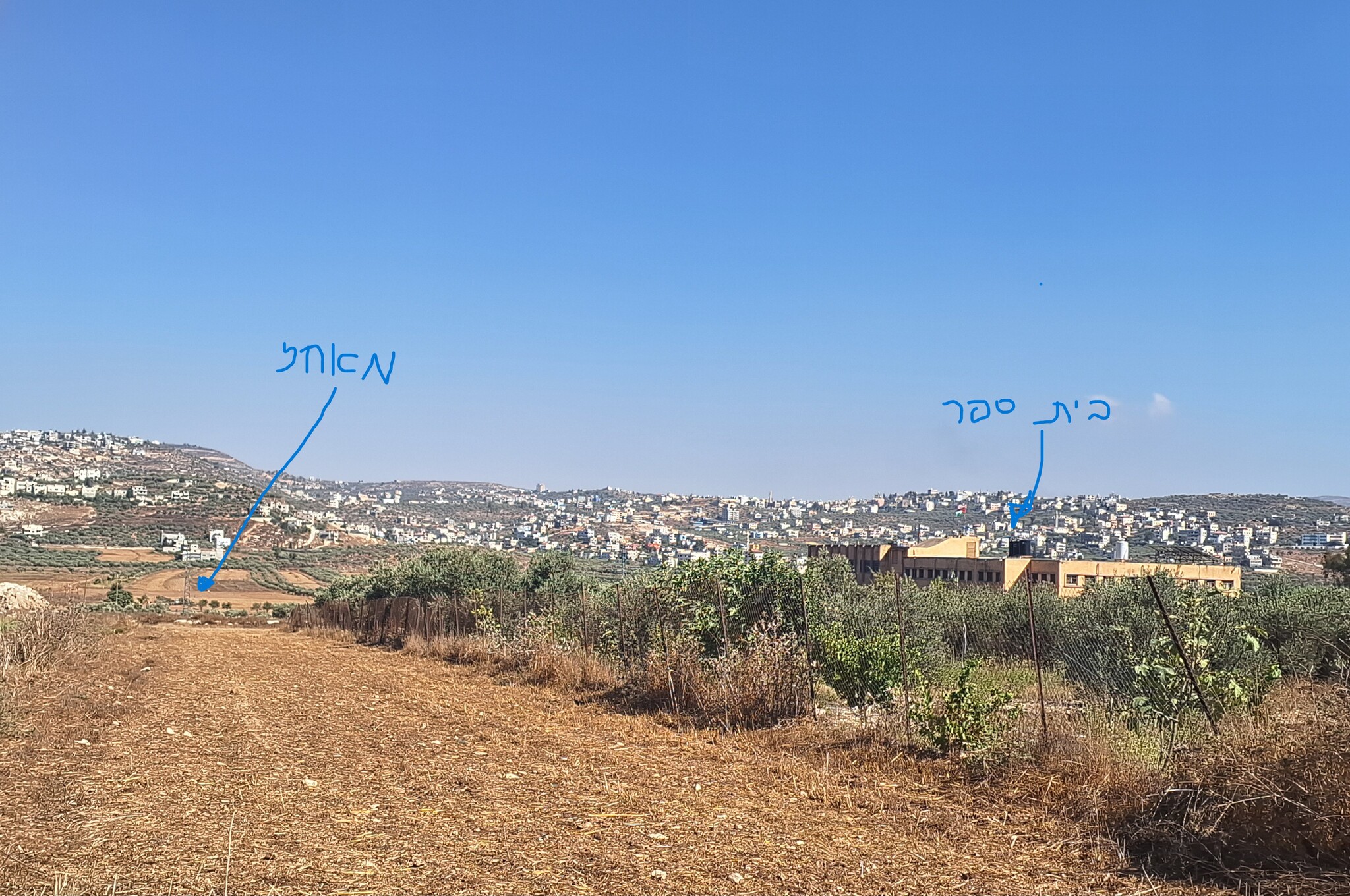 Ronit Dahan-RamatiAug-24-2026Huwara: The school on the outskirts of town and an outpost hidden among the trees
-
Jerusalem
See all reports for this place-
The places in East Jerusalem which are visited routinely by MachsomWatch women are Silwan and Sheikh Jarrah. During the month of Ramadan, also the Old City and its environs are monitored.
-
