
Qaddum
· In Qaddum the Friday demonstration is quiet. Just a few stun grenades were fired. Palestinian TV cameramen rush off in mid-demonstration to cover another event – in Nablus.
·On our way back through Eliyahu Checkpoint, a thorough inspection takes place in search of a suspected object. An inhaler tube is placed inside the car to identify suspicious materials.
· MW members are apparently very suspect.
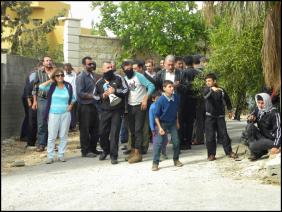
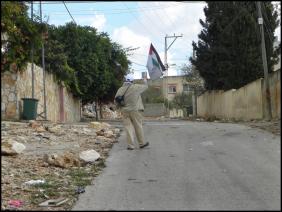
Getting ready for the demonstration The flag bearer
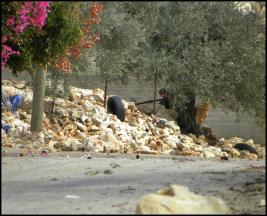
Soldiers finding shelter under trees
 A child plays with grenade parts
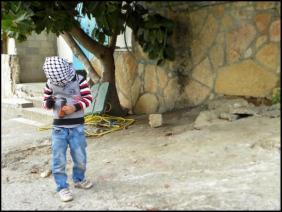
Qaddum 12:00 People leave the mosque. At the street corner, men prepare for the weekly demonstration. A routine matter. Children skittering about, taking part in the struggle. A boy, his head wrapped in a keffiya, plays with parts of a stun grenade. Apparently the plaything fascinates him. Is he trying to figure out the operating mechanism?
The flag bearer today – I. – heads the procession. This time he bears the flag because his fellow struggler, the regular flag bearer, was hurt in a previous demonstration by an Israeli army sniper and is presently in Jordan for treatment and recovery.
The demonstration is joined by two young European women, one a journalist from Spain, the other from France. They are staying in Nablus. This is their first time attending a Qaddum demonstration. They look determined. Confident that their presence protects the protesters from snipers, although they have been told that the soldiers have no qualms about firing at internationals and journalists.
After about 15 minutes, the Palestinian TV cameramen rush off toward the mosque, where they have parked their car. Apparently they have been informed of casualties in Nablus. It is a special event and they hurry off to cover it. The demonstration here looks orphaned without the cameras.
We speak with M., a regular participant in the weekly demonstrations. Until the second intifada, he worked in Israel and knows the country inside-out. Now he has no entry permit to Israel. His wife’s family lives in Jaffa. They come for visits, but he cannot go to visit them. His dream is of two states and good neighborly relations.
The demonstration is quiet. The soldiers take shelter under the trees, from where they seem to be looking on at the demonstrators. Since this is olive harvest time, the presence today is not so impressive. Stun grenades are heard being fired, but only infrequently. There is no “skunk” today, nor pepper gas. We leave after about an hour and a half.
Eliyahu Checkpoint (Terminal) 13:30
Did we look like the enemy of the people? A diligent inspector insisted on opening our car door and then discovered our MachsomWatch flag. We were ordered to move over to the inspection area, disembark, and enter a structure with a monitoring belt for x-raying belongings. A Palestinian worker explained the procedure to us. We moved over to the exit facing the vehicle inspection area. A tube was introduced into our car, connected to a machine that identifies suspect materials. We were forced to wait even after the end of this inspection. Additional cars passed a similar check, and only after all they were done were we permitted to enter our car. We were held up nearly half an hour.
Qaddum
See all reports for this place-
Qaddum
The village of Qaddum dates back approximately 4,000 years. Today’s villagers mostly work in agriculture and cultivae olive groves. The hilly landscape is covered with olive trees and are dotted with patches of green fields.
Qaddum was attached to the district of Nablus until 1994 at which time it joined the Qalqiliya district. The village is home to 4,000 inhabitants (2013), with 22,000 dunams (5,400 acres) of which 11,000 dunam (2700 acres) are in Area C*. Access to Area C requires coordination with the Israeli army, which means that access is almost non-existent.
The settlement of Kedumim was founded in 1975 on lands belonging to the ancient the village of Qaddum. Since then, Kedumim has expanded to include 5 settlements. The Kedumim settlements separate Qaddum village from its lands and from access to the main road. The road connecting Qaddum village to Route 55 was closed to its residents in 2003. The short ride (1.5 km or less than a mile) between Qaddum and a neighboring village - Jit, turned into a 12 km (7.5 miles) bumpy ride on an unpaved gravely road. Since 2004, residents of the village of Qaddum have been submitting requests to the authorities to reopen the old road leading to Route 55.
On July 2011, the villagers began holding weekly demonstrations in protest of the road closure and of the theft of their lands. They march to the edge of the village and there they stop. There is a regular routine to the demonstration which always follows with a confrontation with the army when it enters the village at the end of the blocked road. The army reacts to the demonstrations with sharp weapons, rubber bullets, tear gas and lately also live ammunition. Villagers are injured and hurt each week and often, dozens are arrested by the army. Young people and children are intimidated by the army when they photos are posted in the village streets.
On 12/7/19 a 10 year old boy was criticaaly wounded after he was shot in the head by live ammunition while standing at the entrance to his home in Qaddum during a demonstration.*Area C is an administrative division of the West Bank established by the Oslo II Accords in 1995. The Palestinian Authority is responsible for medical and education services and Israel is responsible for infrastructure and administration.
-
