
Qalandiya, יום א’ 22.11.09, אחה”צ
The coffee salesman, who stands with his cart at the entrance to the
checkpoint, told us that a few days earlier, during the morning hours, the
peddlers had noticed a group of inspectors from city hall; they were escorted
by police officers and were getting ready for a raid. Each one of the peddlers
got hold of his cart and ran towards the alleys at the refugee camp. He told us
the sugar fell into the coffee container, and that boiling water had spilled on
top of that mixture. But he managed to keep his cart and even avoided getting
fined. The inspectors wondered around until noon but weren't able to get hold
of anyone- until the next time.
Every couple of months those officials hold a raid in that area, which
is under the jurisdiction of the municipality of Jerusalem, and fine those who
only barely manage to make ends meet, under pretext that they don't' have a
peddlers license. How could they obtain such a license?- Most of them aren't
residents of that area and none of them has the required ID, which if they did
have they wouldn't be obliged to stand at the entrance of the checkpoint from
sunrise to sunset. Other than that, peddler's licenses aren't issued for people
who live on the dark side of the moon.
City hall fines the "outlaws" but doesn't bother to provide
those living under its jurisdiction with basic services: the garbage doesn't
get vacated, not even once in every couple of months, but is burned inside the
garbage disposer by the residents.
The lines leading to the inspection area moved slowly, tens of people
were waiting in each one of the three lanes that were open. We each stood
inside one of the lane. The line in which I stood worked in a horizontal
manner: people stood crowded by the turnstiles, they were clenched together and
the movement of the line was in accordance with the movement of the whole
group, and not of that of the individual at the beginning of the line. This
took 25 minutes. The soldiers sitting behind the dirty bullet proof glasses
were in no hurry, they did their job as slow as possible handing out
educational pointers from time to time.
A young man with a baby in his arms pressed the intercom button in hope
that the soldiers might notice him and open the gate intended for strollers.
But the intercom was disabled and the man had to fold the stroller and cram
together with it in the turnstile while I was holding the weeping baby.
A man who was on his way to his home in Gaza, was inspected strictly and
with suspicion- he had to walk back and forth under the metal detector, while
passing to the other side he noticed he had left his watch in the inspection
area. But he couldn't communicate with the people behind the window and making
the whole way back again might take too much time, so he had given up on the
watch.
Ambulances were transferring a cancer patient in a critical condition
from one to the other, his destination was Augusta-Victoria hospital. The
blanket slipped from his body and his pain and wretchedness were exposed to all,
he no hope for privacy or for the protection of his dignity.
Who is supposed to protect the law from those in charge of enforcing
it?
Apparently everything or nearly everything is personal. The commander of
the passage, superintendent Abu-Hatzera, had pick me out from all those
standing on the side walk at the vehicle checkpoint, and threaten to detain and
arrest me for coming back to the place in spite of his request/demand.
Towards sundown, the waiting shed transforms to a gathering place for
men arriving from their distant work place, they don't return home until the
end of the week because of the distance and the checkpoints. They rent horrid
rooms at the refugee camp, which was where we met our acquaintance that said:
"The Jews have two faces, a white one and a black one. You are
the white face".
Qalandiya Checkpoint / Atarot Pass (Jerusalem)
See all reports for this place-
Click here to watch a video from Qalandiya checkpoint up to mid 2019 Three kilometers south of Ramallah, in the heart of Palestinian population. Integrates into "Jerusalem Envelope" as part of Wall that separates between northern suburbs that were annexed to Jerusalem in 1967: Kafr Aqab, Semiramis and Qalandiya, and the villages of Ar-Ram and Bir Nabala, also north of Jerusalem, and the city itself. Some residents of Kafr Aqab, Semiramis and Qalandiya have Jerusalem ID cards. A terminal operated by Israel Police has functioned since early 2006. As of August 2006, northbound pedestrians are not checked. Southbound Palestinians must carry Jerusalem IDs; holders of Palestinian Authority IDs cannot pass without special permits. Vehicular traffic from Ramallah to other West Bank areas runs to the north of Qalandiya. In February 2019, the new facility of the checkpoint was inaugurated aiming to make it like a "border crossing". The bars and barbed wire fences were replaced with walls of perforated metal panels. The check is now performed at multiple stations for face recognition and the transfer of an e-card. The rate of passage has improved and its density has generally decreased, but lack of manpower and malfunctions cause periods of stress. The development and paving of the roads has not yet been completed, the traffic of cars and pedestrians is dangerous, and t the entire vicinity of the checkpoint is filthy. In 2020 a huge pedestrian bridge was built over the vehicle crossing with severe mobility restrictions (steep stairs, long and winding route). The pedestrian access from public transport to the checkpoint from the north (Ramallah direction) is unclear, and there have been cases of people, especially people with disabilities, who accidentally reached the vehicle crossing and were shot by the soldiers at the checkpoint. In the summer of 2021, work began on a new, sunken entrance road from Qalandiya that will lead directly to Road 443 towards Jerusalem and Tel Aviv. At the same time, the runways of the old Atarot airport were demolished and infrastructure was prepared for a large bus terminal. (updated October 2021)
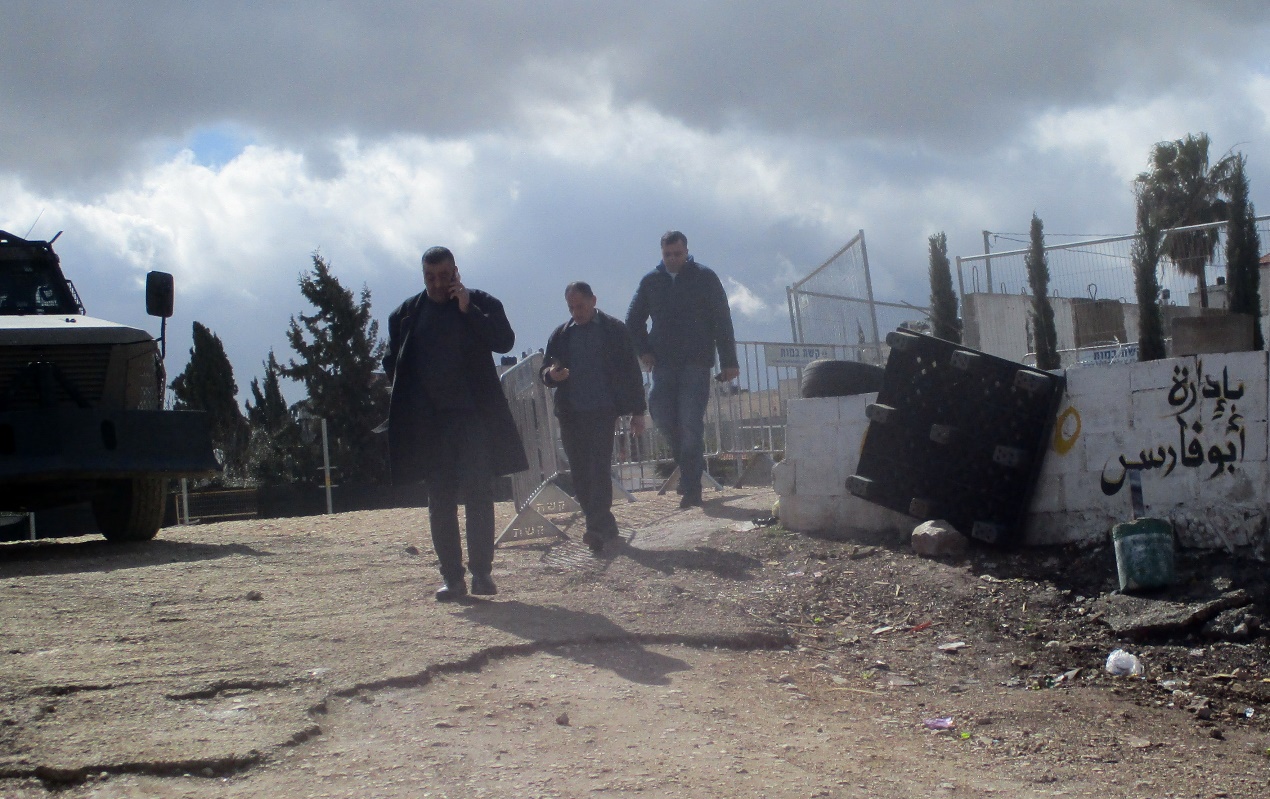 Tamar FleishmanFeb-27-2026Qalandiya: On the way to prayer
-