
Qalandiya
The other is just a target in the gun sights.
Oversight of people reaching the checkpoint entrance, of thousands of families who live in the Qalandiya refugee camp and of the dozens of businesses on the main road from Ramallah to East Jerusalem is tightening, and the asymmetry between the soldiers armed with guns and grenades and the youths throwing rocks and improvised Molotov cocktails or rolling burning tires toward them is growing.
After the murder of the two youths in Beitunia by a bored soldier and the kidnapping in Shu’afat of Muhammad Abu-Khadeir, the boy who was burned alive, when the mood in Palestine and in East Jerusalem darkened and demonstrations by youths became more frequent, additional observation cameras were installed atop the tower overlooking the refugee camp, flanked by powerful lamps projecting a bright-green light 24 hours a day that invades every private and public space.
These aren’t only means of surveillance and harassment but also a threat undermining the ordinary person’s sense of security inside their own home.
These actions are intentional, their purpose – in the army’s words – to “make the residents feel persecuted.”
In addition to the equipment installed above the pillbox, three more posts have been erected atop the wall, only a few dozen meters distant from one another, overlooking the route the demonstrating youths take to the checkpoint entrance.
The observation and sniper posts have been erected on the outer side of the wall. Only one of them, almost touching the Palestinian homes, is visible from inside the wall and is surrounded by fencing to protect the soldiers from stones and bottles.
The location of the others can be identified by the metal anchors atop the wall.
From the this side of the apartheid wall the posts resemble hanging cages or, as a Palestinian acquaintance described them, “They built scaffolding to the top, you know, like at a construction site; that’s how they go up and observe, and also shoot.”
And when everything is visible and everything is photographed and everything is known and there’s no need for human contact or for one body to touch another, and the other is just a target in the gun sights, it’s not inconceivable that the time will come to borrow the lethal methods employed against the residents of Gaza and firing by remote control begin here as well.
Qalandiya Checkpoint / Atarot Pass (Jerusalem)
See all reports for this place-
Click here to watch a video from Qalandiya checkpoint up to mid 2019 Three kilometers south of Ramallah, in the heart of Palestinian population. Integrates into "Jerusalem Envelope" as part of Wall that separates between northern suburbs that were annexed to Jerusalem in 1967: Kafr Aqab, Semiramis and Qalandiya, and the villages of Ar-Ram and Bir Nabala, also north of Jerusalem, and the city itself. Some residents of Kafr Aqab, Semiramis and Qalandiya have Jerusalem ID cards. A terminal operated by Israel Police has functioned since early 2006. As of August 2006, northbound pedestrians are not checked. Southbound Palestinians must carry Jerusalem IDs; holders of Palestinian Authority IDs cannot pass without special permits. Vehicular traffic from Ramallah to other West Bank areas runs to the north of Qalandiya. In February 2019, the new facility of the checkpoint was inaugurated aiming to make it like a "border crossing". The bars and barbed wire fences were replaced with walls of perforated metal panels. The check is now performed at multiple stations for face recognition and the transfer of an e-card. The rate of passage has improved and its density has generally decreased, but lack of manpower and malfunctions cause periods of stress. The development and paving of the roads has not yet been completed, the traffic of cars and pedestrians is dangerous, and t the entire vicinity of the checkpoint is filthy. In 2020 a huge pedestrian bridge was built over the vehicle crossing with severe mobility restrictions (steep stairs, long and winding route). The pedestrian access from public transport to the checkpoint from the north (Ramallah direction) is unclear, and there have been cases of people, especially people with disabilities, who accidentally reached the vehicle crossing and were shot by the soldiers at the checkpoint. In the summer of 2021, work began on a new, sunken entrance road from Qalandiya that will lead directly to Road 443 towards Jerusalem and Tel Aviv. At the same time, the runways of the old Atarot airport were demolished and infrastructure was prepared for a large bus terminal. (updated October 2021)
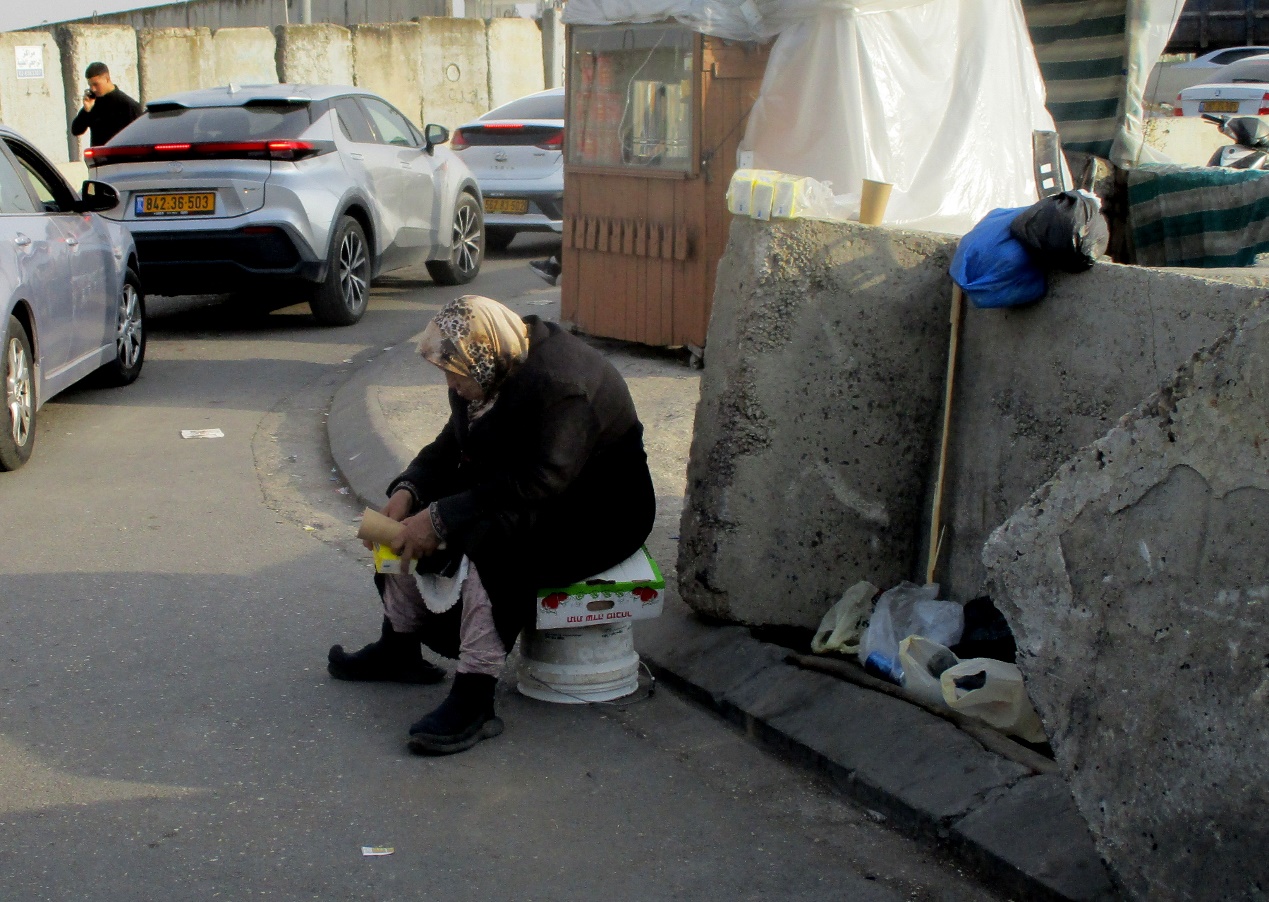 Tamar FleishmanOct-11-2026Qalandiya. Female Beggar
-
