
Qalandiya
The dawn invasion by soldiers from Duvdevan of the Qalandiya refugee camp was the first link in a chain of incidents which could best be described as the chronicle of a death foretold.
Mahmoud Abdullah Adwan, age 21, was the victim this time.

Mahmoud climbed onto the roof, wanted to see what was happening, said his father to a British journalist I spoke to, one soldier, a sniper, shot him from below. The bullet entered through his throat, passed through his skull and exited through the forehead.
The refugee camp mourned.
Mourning and lamenting Mahmoud, remembering also the others who were murdered.
Weeping for the sons and brothers and fathers, mourning friends and neighbors.
The walls of the camp’s buildings support each other, as do their inhabitants, whose lives and deaths are intertwined.
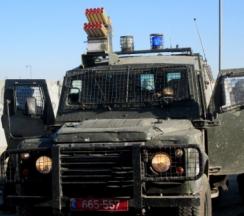
While the funeral was underway units of various security forces gathered outside the camp waiting, armed and ready.
When the funeral had ended the children burst from the alleys, climbed onto the roofs, onto the hill next to the wall and threw rocks.
In response the soldiers fired and fired and fired and fired.
Many tear gas grenades and stun grenades were fired.
The malkosh accompanied the soldiers (it was the first time I’d seen it in action at Qalandiya):
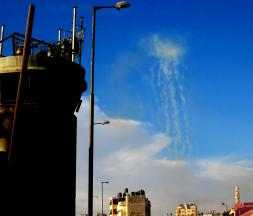
The malkosh has twenty firing tubes and is installed on the roof a vehicle; all are fired simultaneously by pressing a button inside the vehicle.
An innovation in the arsenal of dispersing demonstrations whose damage is very, very serious.
The grenades fired from the malkosh rise into the air, leave a trail of white smoke behind them and descend on the children in a dense, suffocating gas cloud.
Many years ago an attempt was made to create here an agricultural society. People waited for rain in its season and hoped “the earth would bring forth bread.” As the years passed, things changed. People no longer pray for blessed rains but entreat the god of hosts and war.
The malkosh no longer refers to rain, the rimon is no longer a fruit and the ze’ev is no longer an animal.
And the same has become of the truth, which is now distorted and becomes P.R. Someone’s truth, for a purpose.
The army’s version of how Mahmoud was killed:
“During military activity by the Duvdevan unit to arrest a wanted person, the unit was fired on. As a result fire was exchanged between the armed persons and the army, and an improvised explosive device was thrown at the soldiers. They responded by firing at the person who threw the device and he was killed.”
http://www.haaretz.co.il/news/politics/1.2513297
“My grandfather used to say to my father: Look, in fifty year things will be good. My father used to say to me: “Look, in fifty years things will be good. I say the same thing to my children, I tell them that in fifty years things will be good. But I don’t really believe what I’m saying, I know things will never be good.”
That’s what Abu-Niyaz said.
Qalandiya Checkpoint / Atarot Pass (Jerusalem)
See all reports for this place-
Click here to watch a video from Qalandiya checkpoint up to mid 2019 Three kilometers south of Ramallah, in the heart of Palestinian population. Integrates into "Jerusalem Envelope" as part of Wall that separates between northern suburbs that were annexed to Jerusalem in 1967: Kafr Aqab, Semiramis and Qalandiya, and the villages of Ar-Ram and Bir Nabala, also north of Jerusalem, and the city itself. Some residents of Kafr Aqab, Semiramis and Qalandiya have Jerusalem ID cards. A terminal operated by Israel Police has functioned since early 2006. As of August 2006, northbound pedestrians are not checked. Southbound Palestinians must carry Jerusalem IDs; holders of Palestinian Authority IDs cannot pass without special permits. Vehicular traffic from Ramallah to other West Bank areas runs to the north of Qalandiya. In February 2019, the new facility of the checkpoint was inaugurated aiming to make it like a "border crossing". The bars and barbed wire fences were replaced with walls of perforated metal panels. The check is now performed at multiple stations for face recognition and the transfer of an e-card. The rate of passage has improved and its density has generally decreased, but lack of manpower and malfunctions cause periods of stress. The development and paving of the roads has not yet been completed, the traffic of cars and pedestrians is dangerous, and t the entire vicinity of the checkpoint is filthy. In 2020 a huge pedestrian bridge was built over the vehicle crossing with severe mobility restrictions (steep stairs, long and winding route). The pedestrian access from public transport to the checkpoint from the north (Ramallah direction) is unclear, and there have been cases of people, especially people with disabilities, who accidentally reached the vehicle crossing and were shot by the soldiers at the checkpoint. In the summer of 2021, work began on a new, sunken entrance road from Qalandiya that will lead directly to Road 443 towards Jerusalem and Tel Aviv. At the same time, the runways of the old Atarot airport were demolished and infrastructure was prepared for a large bus terminal. (updated October 2021)
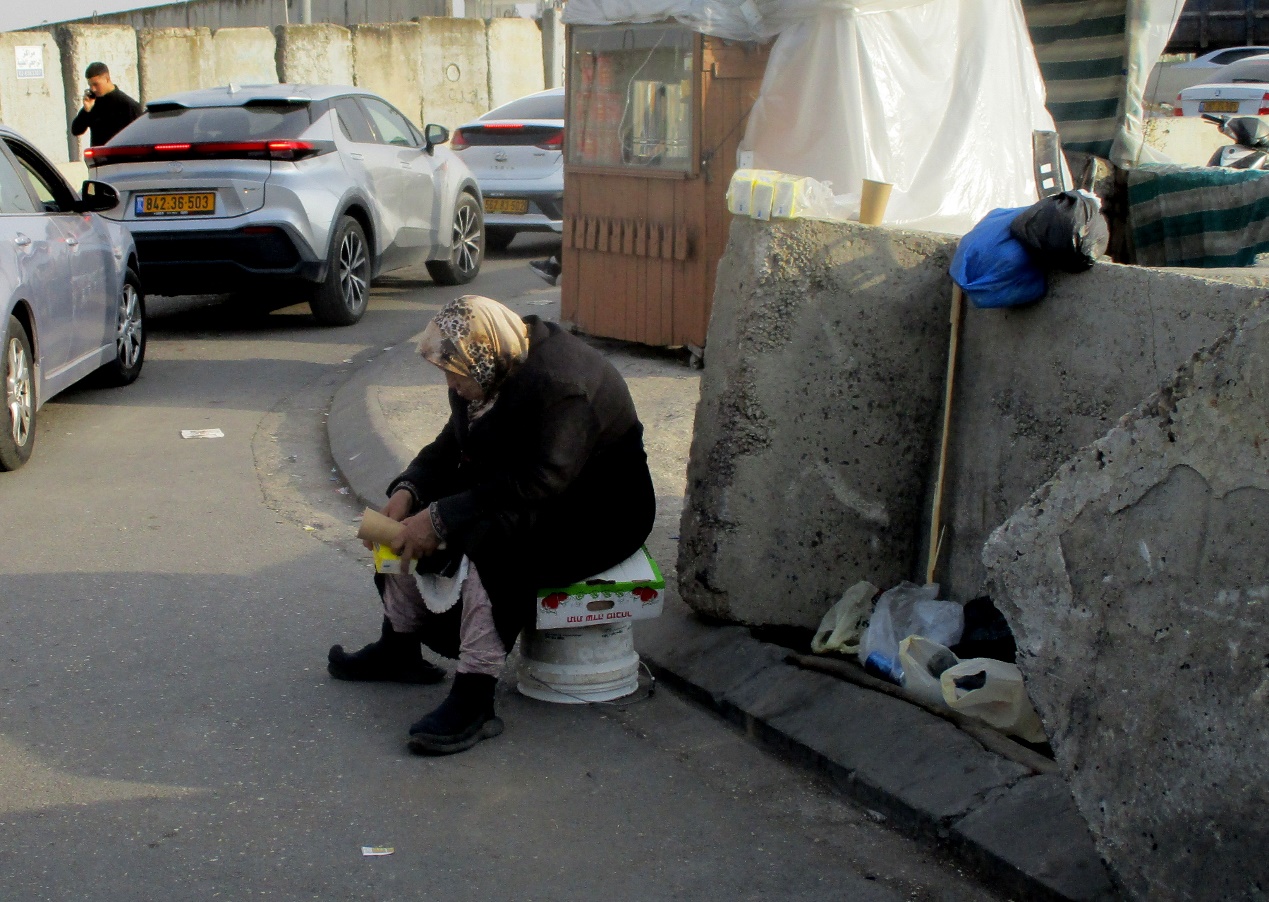 Tamar FleishmanOct-11-2026Qalandiya. Female Beggar
-
