
Qalandiya
When we arrived at 09:00 there were about 50 people at the gate. All the lanes inside were open. We saw new directional signs to the inner crossings – with a green circle and an Israeli flag. We also noticed a new sign: “Keep the area clean,” in Hebrew, Arabic and English. The place was slightly cleaner than on previous visits but there was a strong odor of urine.
After a short time more people joined the line which now reached the benches. It seems there are delays at the inner crossings.
We met an elderly man near the kiosk who was accompanying his 35-year old son to cancer treatments at Augusta Victoria hospital but wasn’t allowed through. He wasn’t yet the right age and was told by the DCL he’s been blacklisted “for security reasons.” He’s trying to find out what they are and wants to accompany his son to treatment, and has been waiting one month for an answer. He spoke by phone to a representative of a human rights organization which is dealing with his problem. He points to his crippled leg (from when he was a child) and asks why Israel is afraid of him and preventing him from assisting his ill son.
At 09:40 most of those waiting outside had entered but there was now congestion at the inner gates. A few minutes later more people arrived and the line stretched to the benches.
A young man in a wheelchair, accompanied by his cousin, waited for the humanitarian gate to open. The soldier in the booth sat with his back to us and saw nothing. We telephoned the DCL and reported there’s no DCL representative on site who can deal with the problem and that the soldier isn’t doing anything. The DCL said there is someone on site and they’ll contact him. Meanwhile the escort was able to get the soldier’s attention and pointed to the man in the wheelchair. The soldier signaled them to wait. A few minutes later an older woman arrived in a wheelchair, accompanied by a young couple and three children. The soldier, who’d come outside, said the DCL representative isn’t answering. We called the DCL again; they promised they’re looking for their representative at the checkpoint.
About 15 minutes later a policeman arrived and walked toward the humanitarian gate. A few people who noticed he was about to open it hurried to stand next to it. Eventually the policeman allowed only the two handicapped people and a very old couple to go through.
We called to the attention of a civilian security guard who accompanied the policeman at the humanitarian gate which had slammed shut that very elderly people are waiting there, including a woman with a walker, who are entitled to go through the humanitarian gate. The guard said that anyone not in a wheelchair can wait at the regular gate.
At 09:50 someone from the security firm arrived. We asked about the DCL representative; he said they don’t always show up and there’s no DCL representative on Friday. He can’t open the humanitarian gate because he deals only with security. At ten we called the DCL again but the soldier slammed down the phone. Meanwhile a very long line had formed at the checkpoint. There was also great congestion at the inner crossings. After ten the line extended beyond the inner benches. People occasionally were trapped in the revolving gates, include a very old woman with a cane.
One of the people waiting called out attention to the fact only two revolving gates were operating. At our request the soldier opened the third one and the line began moving quickly.
Qalandiya Checkpoint / Atarot Pass (Jerusalem)
See all reports for this place-
Click here to watch a video from Qalandiya checkpoint up to mid 2019 Three kilometers south of Ramallah, in the heart of Palestinian population. Integrates into "Jerusalem Envelope" as part of Wall that separates between northern suburbs that were annexed to Jerusalem in 1967: Kafr Aqab, Semiramis and Qalandiya, and the villages of Ar-Ram and Bir Nabala, also north of Jerusalem, and the city itself. Some residents of Kafr Aqab, Semiramis and Qalandiya have Jerusalem ID cards. A terminal operated by Israel Police has functioned since early 2006. As of August 2006, northbound pedestrians are not checked. Southbound Palestinians must carry Jerusalem IDs; holders of Palestinian Authority IDs cannot pass without special permits. Vehicular traffic from Ramallah to other West Bank areas runs to the north of Qalandiya. In February 2019, the new facility of the checkpoint was inaugurated aiming to make it like a "border crossing". The bars and barbed wire fences were replaced with walls of perforated metal panels. The check is now performed at multiple stations for face recognition and the transfer of an e-card. The rate of passage has improved and its density has generally decreased, but lack of manpower and malfunctions cause periods of stress. The development and paving of the roads has not yet been completed, the traffic of cars and pedestrians is dangerous, and t the entire vicinity of the checkpoint is filthy. In 2020 a huge pedestrian bridge was built over the vehicle crossing with severe mobility restrictions (steep stairs, long and winding route). The pedestrian access from public transport to the checkpoint from the north (Ramallah direction) is unclear, and there have been cases of people, especially people with disabilities, who accidentally reached the vehicle crossing and were shot by the soldiers at the checkpoint. In the summer of 2021, work began on a new, sunken entrance road from Qalandiya that will lead directly to Road 443 towards Jerusalem and Tel Aviv. At the same time, the runways of the old Atarot airport were demolished and infrastructure was prepared for a large bus terminal. (updated October 2021)
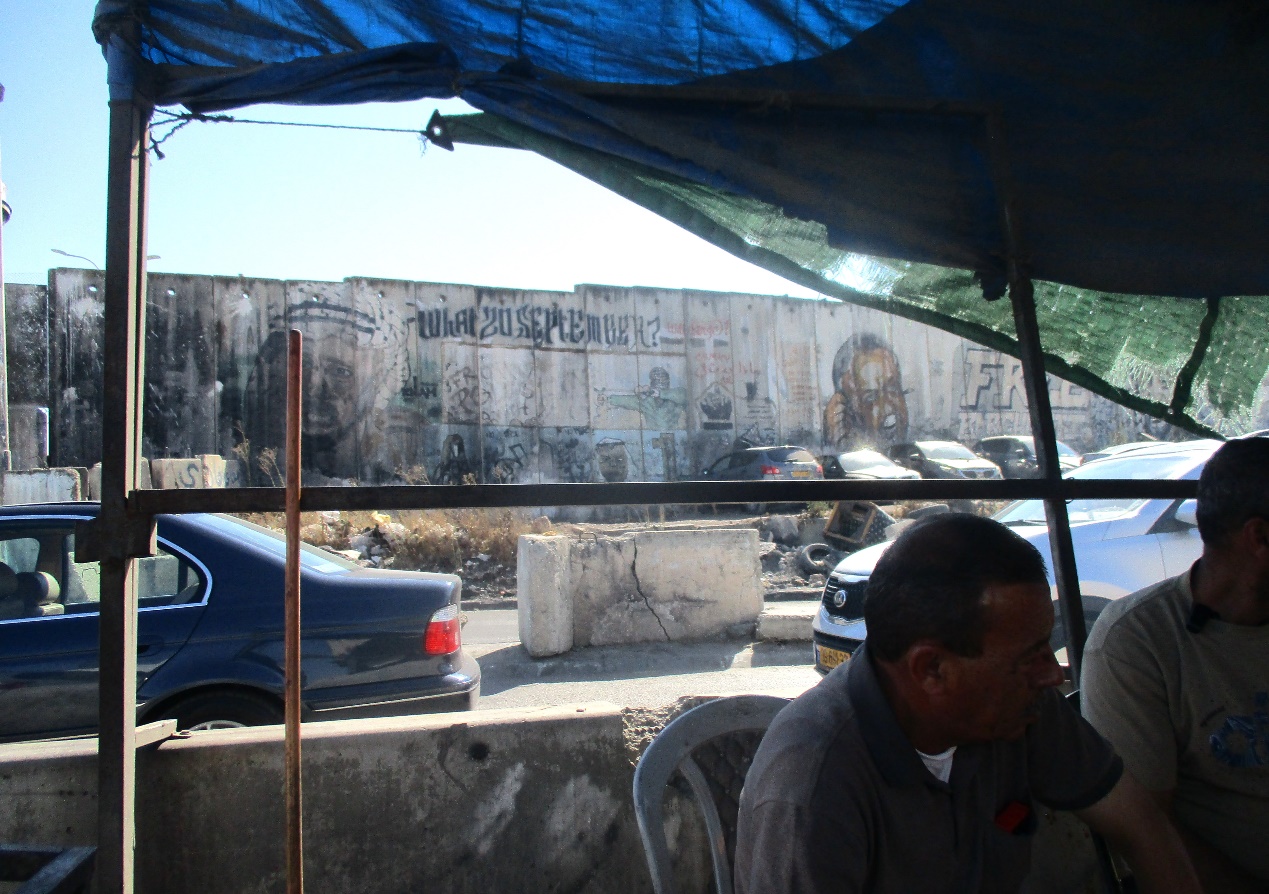 Tamar FleishmanJul-21-2026Qalandiya. Conversation in the shadow of the wall
-
