
Qalandiya
Translator: Charles K.
On cops and hunters

For five days the Qalandiya refugee camp had no electricity or water, said Mahmoud. “Just like you.” No, Mahmoud, I thought, not exactly like us – not exactly.
The remnants of the snow at the wall seemed to make Marwan Bargouti’s image – on the wall above them – paler. Perhaps because of the glare from the snow, or maybe I’m imagining it, but it seems that today, when Palestinian political prisoners will soon be released, the image of Marwan Bargouti, like Bargouti himself, who’s rotting in jail, a man who might have led the Palestinian people to independence, is fading from consciousness and perhaps also from history.

Menashe Hai’s hand – he’s a policeman – covered the camera lens when I pointed it at three Border Police soldiers, headhunters, at the entrance to the Qalandiya checkpoint. When I kept trying to take pictures he took me to the police station where I received a lecture from Ami, the checkpoint commander, the core of which were the regulations prohibiting photography throughout the checkpoint area. Ami demanded I promise to follow the rules. I refused. I know rules are rules, but the law is the law and it’s different from Ami’s rules. According to the law, photography is permitted wherever civilians are present, including the checkpoint area.
“If you won’t understand willingly, you’ll understand in another way,” Menasheh, the policeman, told me. I was detained. They issued a summons: “Failure to obey a policeman’s order.” Case No. 123, Menashe reported it by phone to somewhere, they ordered a squad car from somewhere to take me for interrogation and also threatened that the interrogator might decide to arrest me. I took that into consideration in deciding not to change my mind.
But the squad car didn’t arrive. Menashe called again, reminded them, requested. And the squad car still didn’t arrive.
I didn’t want to sit in the policemen’s room. I told them I’d rather not be in an unpleasant location. I stood outside the door. Passing soldiers looked at me, whispered among themselves as if I were on display in a zoo.
I thought about the hundreds of Palestinians I saw detained over the years. If they were, I could be also. But it’s not really the same thing – at least, not yet.
I knew, as did Menashe who was ordered to guard me, that according to the law a person can’t be detained for more than three hours. Toward the end of the three hours Menashe, whose shift was ending and whose wife had given him a shopping list over the phone, hurriedly filled out a detention form. I signed the paragraph confirming I hadn’t been beaten, nor had anything been taken from me. There wasn’t any place to write down the time stolen from me.
I was released. I’d been detained for eight minutes less than three hours. I went out into Qalandiya’s very cold night and saw the three Border Police soldiers still on duty; a man and a youth stood next to them, shivering in the cold.
Qalandiya Checkpoint / Atarot Pass (Jerusalem)
See all reports for this place-
Click here to watch a video from Qalandiya checkpoint up to mid 2019 Three kilometers south of Ramallah, in the heart of Palestinian population. Integrates into "Jerusalem Envelope" as part of Wall that separates between northern suburbs that were annexed to Jerusalem in 1967: Kafr Aqab, Semiramis and Qalandiya, and the villages of Ar-Ram and Bir Nabala, also north of Jerusalem, and the city itself. Some residents of Kafr Aqab, Semiramis and Qalandiya have Jerusalem ID cards. A terminal operated by Israel Police has functioned since early 2006. As of August 2006, northbound pedestrians are not checked. Southbound Palestinians must carry Jerusalem IDs; holders of Palestinian Authority IDs cannot pass without special permits. Vehicular traffic from Ramallah to other West Bank areas runs to the north of Qalandiya. In February 2019, the new facility of the checkpoint was inaugurated aiming to make it like a "border crossing". The bars and barbed wire fences were replaced with walls of perforated metal panels. The check is now performed at multiple stations for face recognition and the transfer of an e-card. The rate of passage has improved and its density has generally decreased, but lack of manpower and malfunctions cause periods of stress. The development and paving of the roads has not yet been completed, the traffic of cars and pedestrians is dangerous, and t the entire vicinity of the checkpoint is filthy. In 2020 a huge pedestrian bridge was built over the vehicle crossing with severe mobility restrictions (steep stairs, long and winding route). The pedestrian access from public transport to the checkpoint from the north (Ramallah direction) is unclear, and there have been cases of people, especially people with disabilities, who accidentally reached the vehicle crossing and were shot by the soldiers at the checkpoint. In the summer of 2021, work began on a new, sunken entrance road from Qalandiya that will lead directly to Road 443 towards Jerusalem and Tel Aviv. At the same time, the runways of the old Atarot airport were demolished and infrastructure was prepared for a large bus terminal. (updated October 2021)
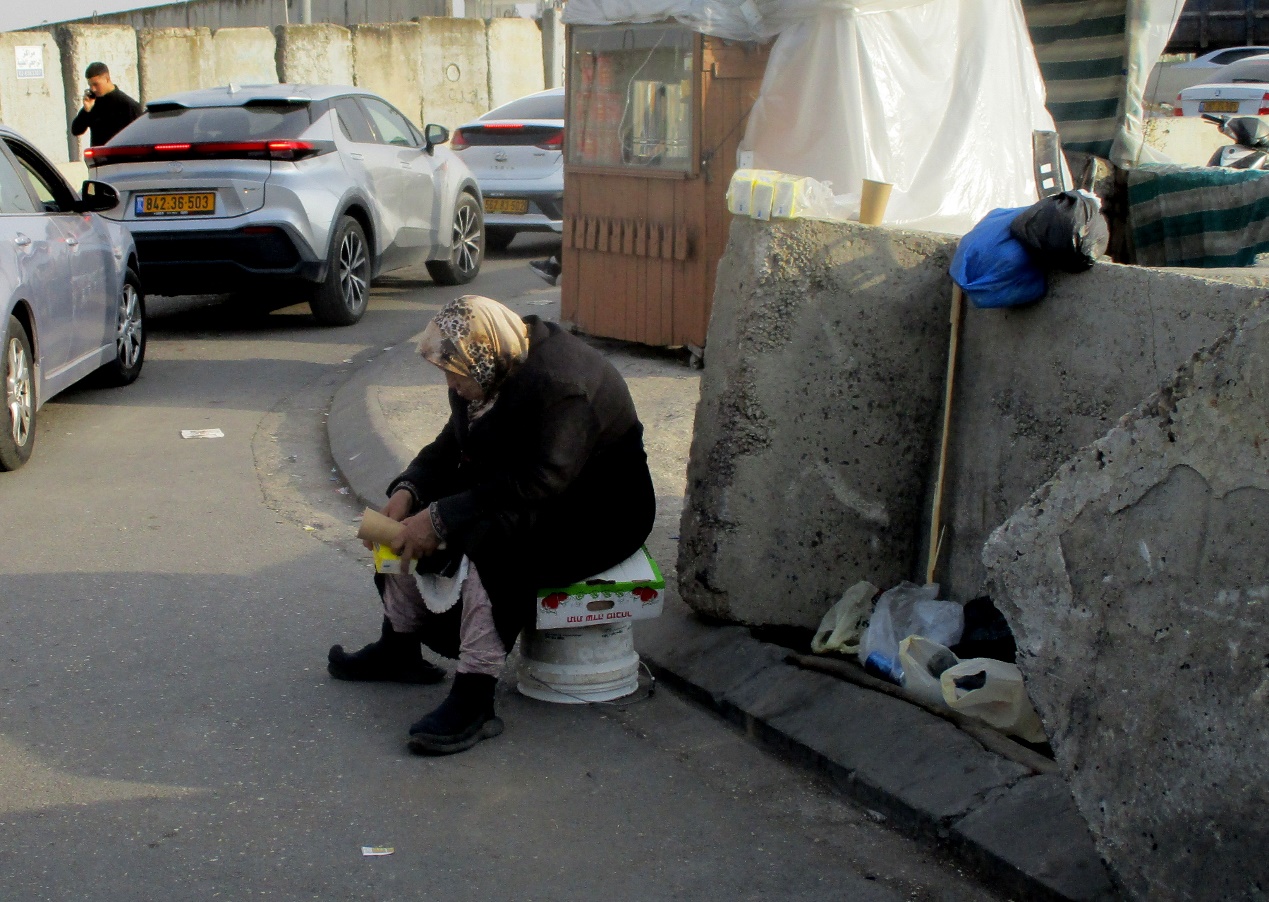 Tamar FleishmanOct-11-2026Qalandiya. Female Beggar
-
