
Qalandiya
After I prevailed over the interrogation by the soldier behind the bullet-proof glass window and refused to answer personal questions, and refused to give him my ID and he became angry, very angry, and imprisoned me for a few minutes in the concrete cell adjoining the emplacement, and spoke about me on the telephone – true, the redeemer didn’t come to Zion, but I was allowed to go through the checkpoint and managed to arrive on time to see two ambulances conduct the back-to-back procedure, how a young woman, a resident of Gaza, in her 23rd week of pregnancy, who was sent for treatment and observation to a hospital in Nablus because of a very large rise in her blood pressure which the physicians in Gaza weren’t able to stabilize, and who, to protect her health and that of her fetus, requires complete bed rest, has been harried since the morning among three ambulances and at least four stretchers.

Mohammad Abu-Latifa was murdered by soldiers’ bullets. He was 18.

The army’s version blames the victim.
An investigation by “Sihah Mekomit” reveals a different picture of the events leading to Mohammad’s death in the Qalandiya refugee camp on the morning of July 24 that contradicts that version:
And what I heard from one of Mohammad’s relatives:
“It’s said mountains don’t meet, but people do.
One day we’ll meet the soldier who killed Mohammad.”
Tomorrow, Monday, all the children will go to school.
Jibril (on the right) will go, Yazzen (above) will go, Muthasem (the youngest child, bottom) will also go and even ‘Abdullah (on the left) who didn’t go last year because his father had no money and wanted ‘Abdullah to work also in the morning, he’ll go to school tomorrow as well.
Muthasem asked me to come visit him in his school in Azariyya (a boarding school/orphanage). “When I get a chance,” I said.
And many, many more whom I know will go to school, and many, many more whom I don’t know will go to school. May they all, Jibril, Yazzen, Muthasem and Abdullah, and all the many others, be well.
May they live.

Qalandiya Checkpoint / Atarot Pass (Jerusalem)
See all reports for this place-
Click here to watch a video from Qalandiya checkpoint up to mid 2019 Three kilometers south of Ramallah, in the heart of Palestinian population. Integrates into "Jerusalem Envelope" as part of Wall that separates between northern suburbs that were annexed to Jerusalem in 1967: Kafr Aqab, Semiramis and Qalandiya, and the villages of Ar-Ram and Bir Nabala, also north of Jerusalem, and the city itself. Some residents of Kafr Aqab, Semiramis and Qalandiya have Jerusalem ID cards. A terminal operated by Israel Police has functioned since early 2006. As of August 2006, northbound pedestrians are not checked. Southbound Palestinians must carry Jerusalem IDs; holders of Palestinian Authority IDs cannot pass without special permits. Vehicular traffic from Ramallah to other West Bank areas runs to the north of Qalandiya. In February 2019, the new facility of the checkpoint was inaugurated aiming to make it like a "border crossing". The bars and barbed wire fences were replaced with walls of perforated metal panels. The check is now performed at multiple stations for face recognition and the transfer of an e-card. The rate of passage has improved and its density has generally decreased, but lack of manpower and malfunctions cause periods of stress. The development and paving of the roads has not yet been completed, the traffic of cars and pedestrians is dangerous, and t the entire vicinity of the checkpoint is filthy. In 2020 a huge pedestrian bridge was built over the vehicle crossing with severe mobility restrictions (steep stairs, long and winding route). The pedestrian access from public transport to the checkpoint from the north (Ramallah direction) is unclear, and there have been cases of people, especially people with disabilities, who accidentally reached the vehicle crossing and were shot by the soldiers at the checkpoint. In the summer of 2021, work began on a new, sunken entrance road from Qalandiya that will lead directly to Road 443 towards Jerusalem and Tel Aviv. At the same time, the runways of the old Atarot airport were demolished and infrastructure was prepared for a large bus terminal. (updated October 2021)
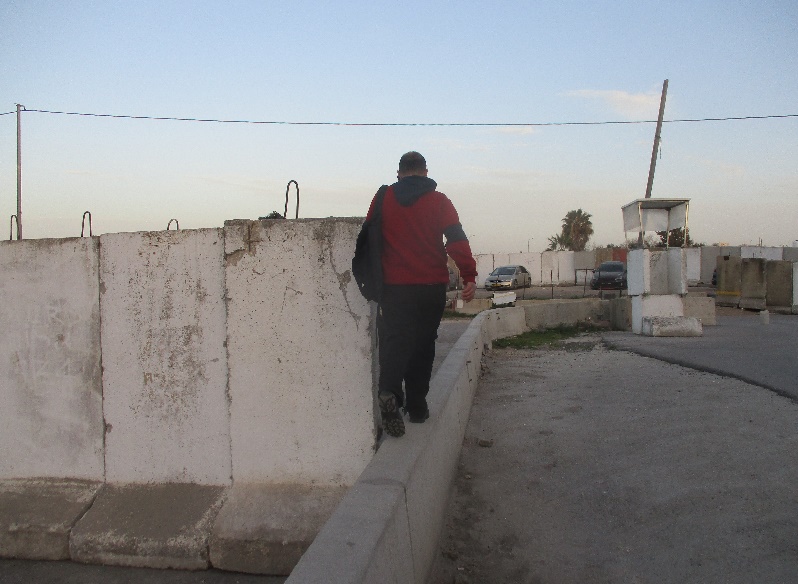 Tamar FleishmanFeb-16-2026Qalandiya CP: shortcut
-