
Qalandiya
Translator: Charles K.
They’re all smiles at Qalandiya this morning! That also happens sometimes.
05:20 It’s still dark when we arrive; there’s already a long line at the vehicle checkpoint. The parking lot isn’t full yet. Passengers descend from a bus, hurry to the pedestrian crossing. We follow them. The beigeleh seller has set up in the covered area this morning.
A surprise awaits us inside – there’s almost no line. Four inspection stations are open; when the revolving gate opened for people to enter, everyone waiting went through.
That continued throughout our stay there. People emerge from their rides, come running and are then surprised to discover there’s no line. An older man says to us: “What’s going on? There’s nobody here.” We saw many smiles, surprised gestures, occasional exclamations: “It’s as if there’s a closure,” or “Like on Saturday.”
A young man begins speaking with us, says he works for Soda Stream in Meshor Adumim. He’s waiting for transportation to work, which arrives at 6 AM. With our slight Arabic and his slight English we try to decipher the signs: free legal advice (re. municipal taxes, for example). No phone number, but there’s an address to which people may come on Saturdays.
People went through the revolving gates without waiting almost all the time we were there, and a few minutes later had gone through inspection. Usually the soldiers stop the revolving gates, people wait in the fenced corridors crowded together during rush hour, and when the gates stop they remain packed together like sardines. There was no sign of that today. A young man who’d come with his companions from one of the buses grins and motions as if to jump over the fenced corridors, as he’d doubtless done often in the past to get ahead on line. Today there’s no need.
Two officers arrived about 6 AM, followed a little later by a male and a female police officer. Since there were no lines, no one waited for them at the humanitarian crossing, nor did they have to open it. So the four of them disappeared into the cage where the soldiers sit, and left for the DCO about 06:15.
Occasionally there were announcements over the loudspeaker. We couldn’t understand what was said, but the tone was calm and everything seemed relaxed today. We don’t know the reason for the change; we’re glad, of course.
06:30 We left, in a good mood for a change. Today we were also smiling. The parking lot wasn’t completely full. The sun already shone through the clouds (photo attached).
The drive to the vehicle checkpoint was chaotic, as usual. Many vehicles crowd into the plaza on the way to the checkpoint, honking, the traffic laws viewed only as recommendations. But they went through the checkpoint itself smoothly, showing IDs and crossing quickly – we as well as others. Because it was early our drive back to the center of town was fast and smooth; we parted at Giv’at Ram a little after 7 AM.
Later I visited the Israel Museum, including the show of Gid’on Gechtman’s work. “The Line,” his 1988 installation (photo attached), reminded me of the on-line conversation of the past few days and I thought that perhaps – just before the Qalandiya crossing is dismantled and travel between Israel and Palestine will be like among countries in the European Union – the fenced corridors at Qalandiya will be replaced by the red velvet ropes of Gechtman’s work…
Qalandiya Checkpoint / Atarot Pass (Jerusalem)
See all reports for this place-
Click here to watch a video from Qalandiya checkpoint up to mid 2019 Three kilometers south of Ramallah, in the heart of Palestinian population. Integrates into "Jerusalem Envelope" as part of Wall that separates between northern suburbs that were annexed to Jerusalem in 1967: Kafr Aqab, Semiramis and Qalandiya, and the villages of Ar-Ram and Bir Nabala, also north of Jerusalem, and the city itself. Some residents of Kafr Aqab, Semiramis and Qalandiya have Jerusalem ID cards. A terminal operated by Israel Police has functioned since early 2006. As of August 2006, northbound pedestrians are not checked. Southbound Palestinians must carry Jerusalem IDs; holders of Palestinian Authority IDs cannot pass without special permits. Vehicular traffic from Ramallah to other West Bank areas runs to the north of Qalandiya. In February 2019, the new facility of the checkpoint was inaugurated aiming to make it like a "border crossing". The bars and barbed wire fences were replaced with walls of perforated metal panels. The check is now performed at multiple stations for face recognition and the transfer of an e-card. The rate of passage has improved and its density has generally decreased, but lack of manpower and malfunctions cause periods of stress. The development and paving of the roads has not yet been completed, the traffic of cars and pedestrians is dangerous, and t the entire vicinity of the checkpoint is filthy. In 2020 a huge pedestrian bridge was built over the vehicle crossing with severe mobility restrictions (steep stairs, long and winding route). The pedestrian access from public transport to the checkpoint from the north (Ramallah direction) is unclear, and there have been cases of people, especially people with disabilities, who accidentally reached the vehicle crossing and were shot by the soldiers at the checkpoint. In the summer of 2021, work began on a new, sunken entrance road from Qalandiya that will lead directly to Road 443 towards Jerusalem and Tel Aviv. At the same time, the runways of the old Atarot airport were demolished and infrastructure was prepared for a large bus terminal. (updated October 2021)
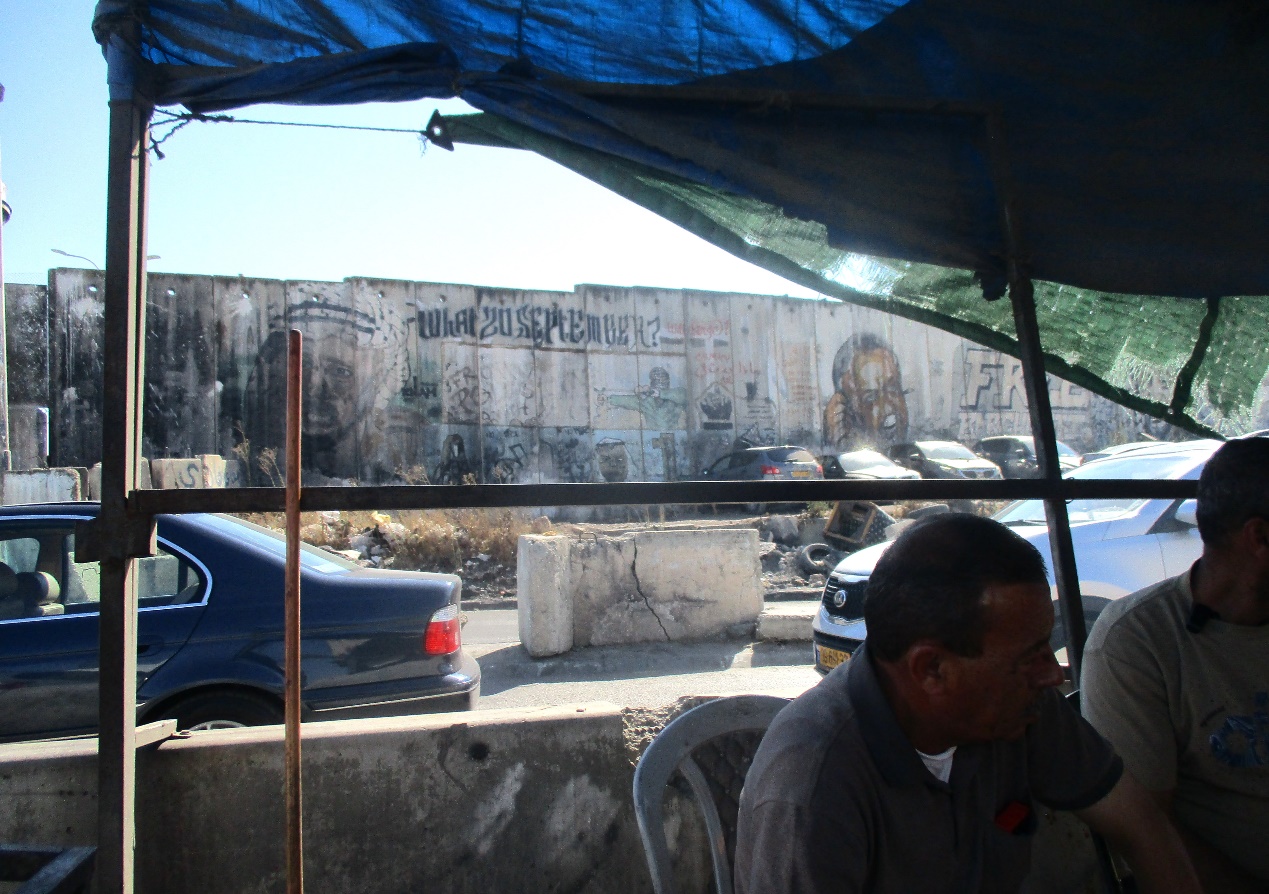 Tamar FleishmanJul-21-2026Qalandiya. Conversation in the shadow of the wall
-
