
Qalandiya
We met a group of 18 Germans hungry for information who had heard an erudite and impressive talk by Roniabout the occupation in general and the situation at Qalandiya in particular.
 Even if the sight of people whose weakness and humiliation as a result of the occupation has become all too routine at this evil place – we must not remain silent.
Those who see must show others; those who know must inform others, must document and report the humiliation daily suffered by people who lack rights.
Whoever grows accustomed to crime and injustice and remains silent becomes a collaborator who won’t be absolved.
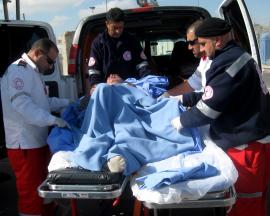
Because where the rights of individuals are trampled, and a person becomes no more than a passing shadow or is seen only as a security threat, the old man dying of brain cancer taken through the checkpoint as if he were but an object rather than someone with a tormented body and broken spirit becomes another example of the crimes committed in our name.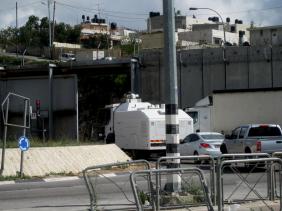
The 38th anniversary of Land Day had a low-key commemoration at Qalandiya. Apparently the leadership of both sides didn’t want to fan the flames. The soldiers as well as the youths throwing rocks behaved with relative moderation: the soldiers holed up in the smoke-blackened corner tower remained hidden from view while a few youths stood on the opposite hill trying not very successfully to stone the impregnable stronghold. The soldiers made no effort to provoke them but only responded sporadically with stun grenades and an occasional tear gas canister. A disappointed foreign photographer had to leave without a dramatic photo. “They’re playing a silly game…” he said, and wasn’t impressed by our explanation that what he viewed as a “game” is for many youths at Qalandiya the difference between life and death.
Across the way clouds of dense black smoke from burning tires rose above the walls and fences from the town of A-Ram whose buildings border the Qalandiya checkpoint. They proved, as the military armored vehicles and the terrifying “skunk liquid” cannon truck hurried to that location through the army’s gate in the wall, that Land Day is being commemorated properly and appropriately in A-Ram.
And an ambulance driver reported on Friday’s events at the Nablus Gate, telling us that a 50 year old man, who wasn’t one of the demonstrators but an innocent pedestrian had been hit in the face by a stun grenade, lost an eye and been rushed to the trauma unit at Hadassah Ein Karem, semi-conscious, with a broken nose.
Qalandiya Checkpoint / Atarot Pass (Jerusalem)
See all reports for this place-
Click here to watch a video from Qalandiya checkpoint up to mid 2019 Three kilometers south of Ramallah, in the heart of Palestinian population. Integrates into "Jerusalem Envelope" as part of Wall that separates between northern suburbs that were annexed to Jerusalem in 1967: Kafr Aqab, Semiramis and Qalandiya, and the villages of Ar-Ram and Bir Nabala, also north of Jerusalem, and the city itself. Some residents of Kafr Aqab, Semiramis and Qalandiya have Jerusalem ID cards. A terminal operated by Israel Police has functioned since early 2006. As of August 2006, northbound pedestrians are not checked. Southbound Palestinians must carry Jerusalem IDs; holders of Palestinian Authority IDs cannot pass without special permits. Vehicular traffic from Ramallah to other West Bank areas runs to the north of Qalandiya. In February 2019, the new facility of the checkpoint was inaugurated aiming to make it like a "border crossing". The bars and barbed wire fences were replaced with walls of perforated metal panels. The check is now performed at multiple stations for face recognition and the transfer of an e-card. The rate of passage has improved and its density has generally decreased, but lack of manpower and malfunctions cause periods of stress. The development and paving of the roads has not yet been completed, the traffic of cars and pedestrians is dangerous, and t the entire vicinity of the checkpoint is filthy. In 2020 a huge pedestrian bridge was built over the vehicle crossing with severe mobility restrictions (steep stairs, long and winding route). The pedestrian access from public transport to the checkpoint from the north (Ramallah direction) is unclear, and there have been cases of people, especially people with disabilities, who accidentally reached the vehicle crossing and were shot by the soldiers at the checkpoint. In the summer of 2021, work began on a new, sunken entrance road from Qalandiya that will lead directly to Road 443 towards Jerusalem and Tel Aviv. At the same time, the runways of the old Atarot airport were demolished and infrastructure was prepared for a large bus terminal. (updated October 2021)
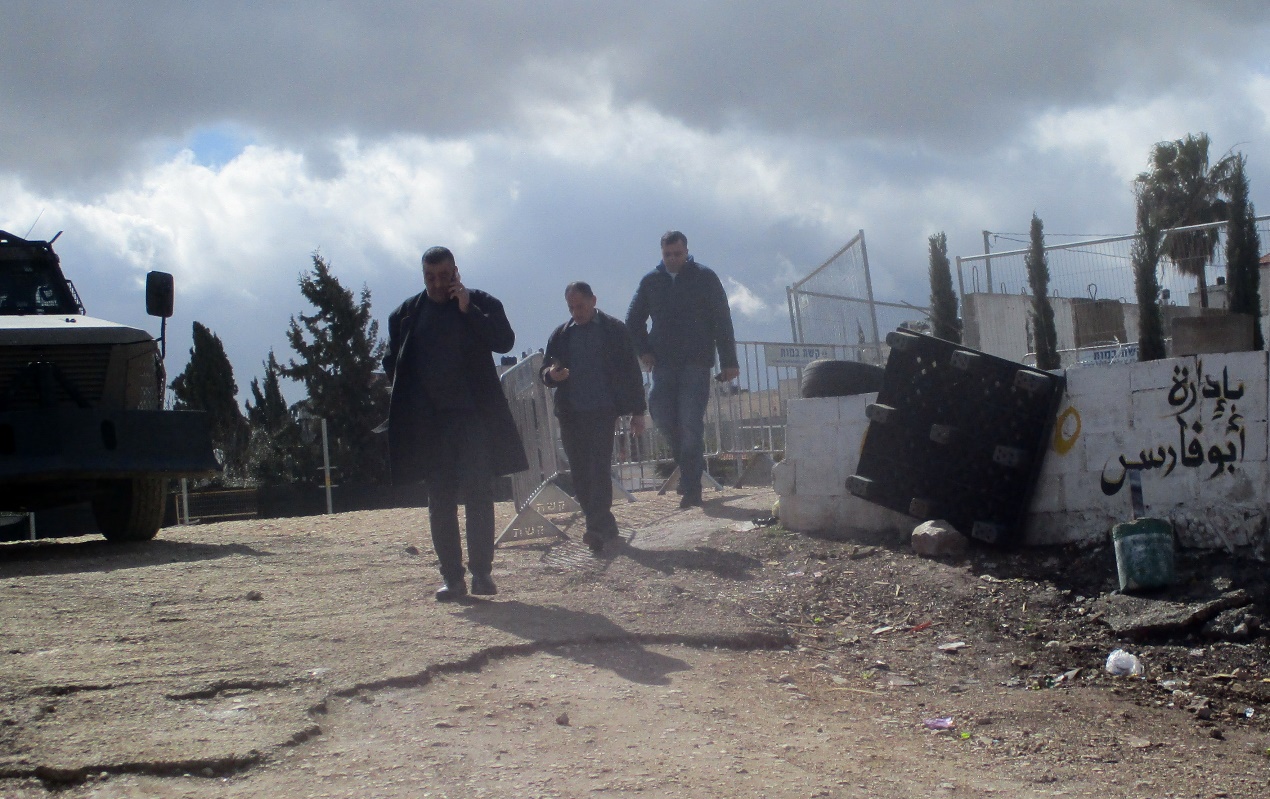 Tamar FleishmanFeb-27-2026Qalandiya: On the way to prayer
-