
Qalandiya
A quiet morning at Qalandiya checkpoint and an interesting conversation with a policeman
We arrived at about 5.20, parking as usual on the Israel side and walking to the Palestinian side. Inside the 5 checking stations were open. Queues extended beyond the hut, though the stations themselves were rather empty, but very soon the carousels opened and, as a result, the queues became much shorter. We greeted the beigel seller, and the ecumenical volunteer (one on the Israeli side, one on the Palestinian side). The few women who arrived were allowed by the men to enter the enclosed lanes from the side. We wondered if there were fewer people than usual or if the checkers were unusually efficient. Usually we come on Wednesdays – this was Thursday. Was it generally a calmer day?
Our acqaintance H. waved to us from the line – no time to chat as the line moved so fast. The kiosk did not open today. At about 5.45 two policeman arrived. The humanitarian gate did not open, but there was no need for it and no one waited next to it. When the policemen came they allowed more people into the area of the checking stations themselves, with the result that the lines in the hut became even shorter. Apparently the checking stations were working very efficiently today.
At about 6, when we thought to leave, one of the policemen came out of the booth (from which the carousels are controlled) and came to speak to us. He said he has been working here many years. He lives in the north near Rosh Hanikra, and travels to Jerusalem twice a week, 4 hours in each direction. According to him, they check the waiting times and generally achieve the times they are obliged to in terms laid down by the law courts. Compared with Ben Gurion Airport, they are much quicker. He says that some days are less busy, as some people work shifts and do not arrive every morning. He says that he regularly studies our reports and that they read what is written and check the situation reported, by means of the pictures they have filmed. We were happy to hear that he sees his role to be giving a service to the public passing through.
At 6.15 we joined the queue. Unfortunately at the particular checking station we chose, the computer broke down and was closed for a few minutes. While we waited, a man standing near us told us that the situation at Jib checkpoint has been very bad lately. Although very few people pass there, according to a fixed list of names, it takes hours! So he prefers to come to Qalandiya.
Meanwhile the station was working again. Altogether within 15 minutes we were outside and could reach the centre of town before the morning traffic jams.
Qalandiya Checkpoint / Atarot Pass (Jerusalem)
See all reports for this place-
Click here to watch a video from Qalandiya checkpoint up to mid 2019 Three kilometers south of Ramallah, in the heart of Palestinian population. Integrates into "Jerusalem Envelope" as part of Wall that separates between northern suburbs that were annexed to Jerusalem in 1967: Kafr Aqab, Semiramis and Qalandiya, and the villages of Ar-Ram and Bir Nabala, also north of Jerusalem, and the city itself. Some residents of Kafr Aqab, Semiramis and Qalandiya have Jerusalem ID cards. A terminal operated by Israel Police has functioned since early 2006. As of August 2006, northbound pedestrians are not checked. Southbound Palestinians must carry Jerusalem IDs; holders of Palestinian Authority IDs cannot pass without special permits. Vehicular traffic from Ramallah to other West Bank areas runs to the north of Qalandiya. In February 2019, the new facility of the checkpoint was inaugurated aiming to make it like a "border crossing". The bars and barbed wire fences were replaced with walls of perforated metal panels. The check is now performed at multiple stations for face recognition and the transfer of an e-card. The rate of passage has improved and its density has generally decreased, but lack of manpower and malfunctions cause periods of stress. The development and paving of the roads has not yet been completed, the traffic of cars and pedestrians is dangerous, and t the entire vicinity of the checkpoint is filthy. In 2020 a huge pedestrian bridge was built over the vehicle crossing with severe mobility restrictions (steep stairs, long and winding route). The pedestrian access from public transport to the checkpoint from the north (Ramallah direction) is unclear, and there have been cases of people, especially people with disabilities, who accidentally reached the vehicle crossing and were shot by the soldiers at the checkpoint. In the summer of 2021, work began on a new, sunken entrance road from Qalandiya that will lead directly to Road 443 towards Jerusalem and Tel Aviv. At the same time, the runways of the old Atarot airport were demolished and infrastructure was prepared for a large bus terminal. (updated October 2021)
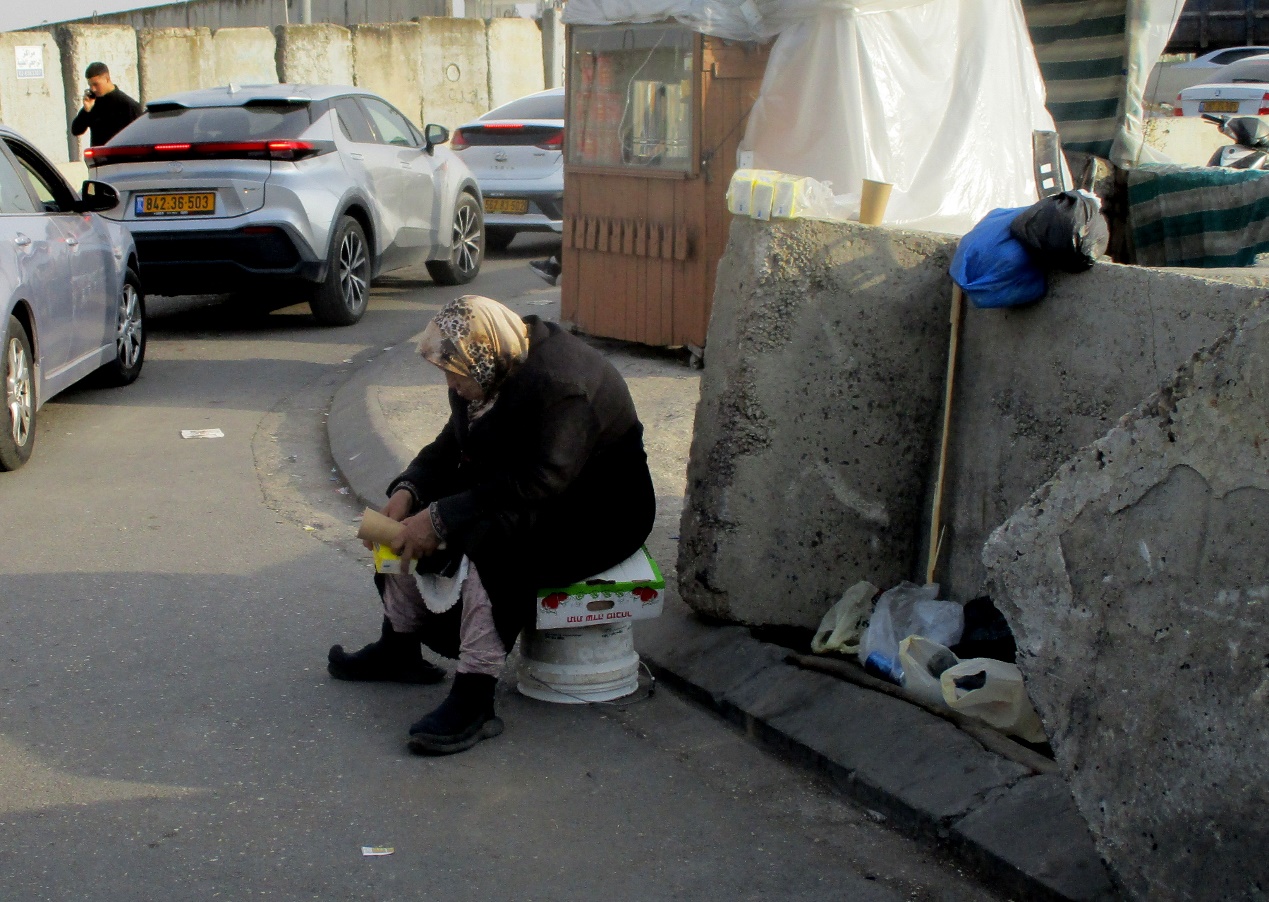 Tamar FleishmanOct-11-2026Qalandiya. Female Beggar
-
