
Qalandiya
“You can sense something bad in the air”, said Iman, the first and only Palestinian woman-ambulance-driver. But this badness was mainly on the ground, not in the air.
There’s always something bad in this place, but at these afternoon and evening hours this badness was worse than usual.
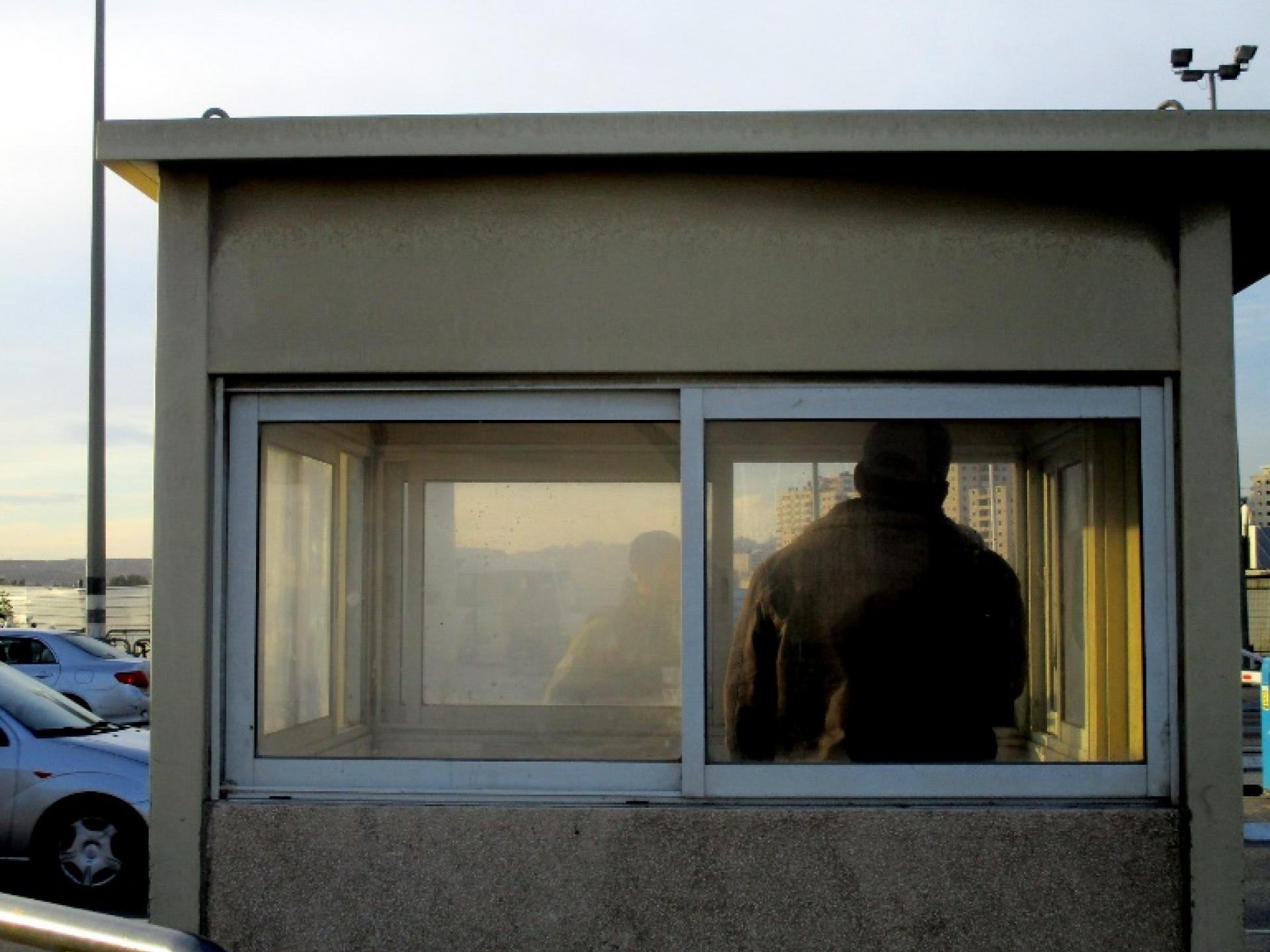
Policemen and security guards blocked anyone going back into the West Bank, regardless of age or gender. They inspected IDs and permits, some Palestinians underwent an actual body search. Others were forced to lift their shirt and expose their upper body. Quite a few were led into the closed inner compound of the checkpoint (arrests?). Others were detained at the side of the road for long minutes. There was a humiliation parade that included cursing and threats for a young man who responded to his inspectors with pursed lips. There was also a man caged in the small concrete cell, and anyone passing by could not help but see him through its windows.
Further on, Iman’s ambulance waited only half an hour plus some minutes until the ambulance from the West Bank arrived, carrying a dying man who was returning the East Jerusalem hospital of Augusta Victoria to his Nablus home.
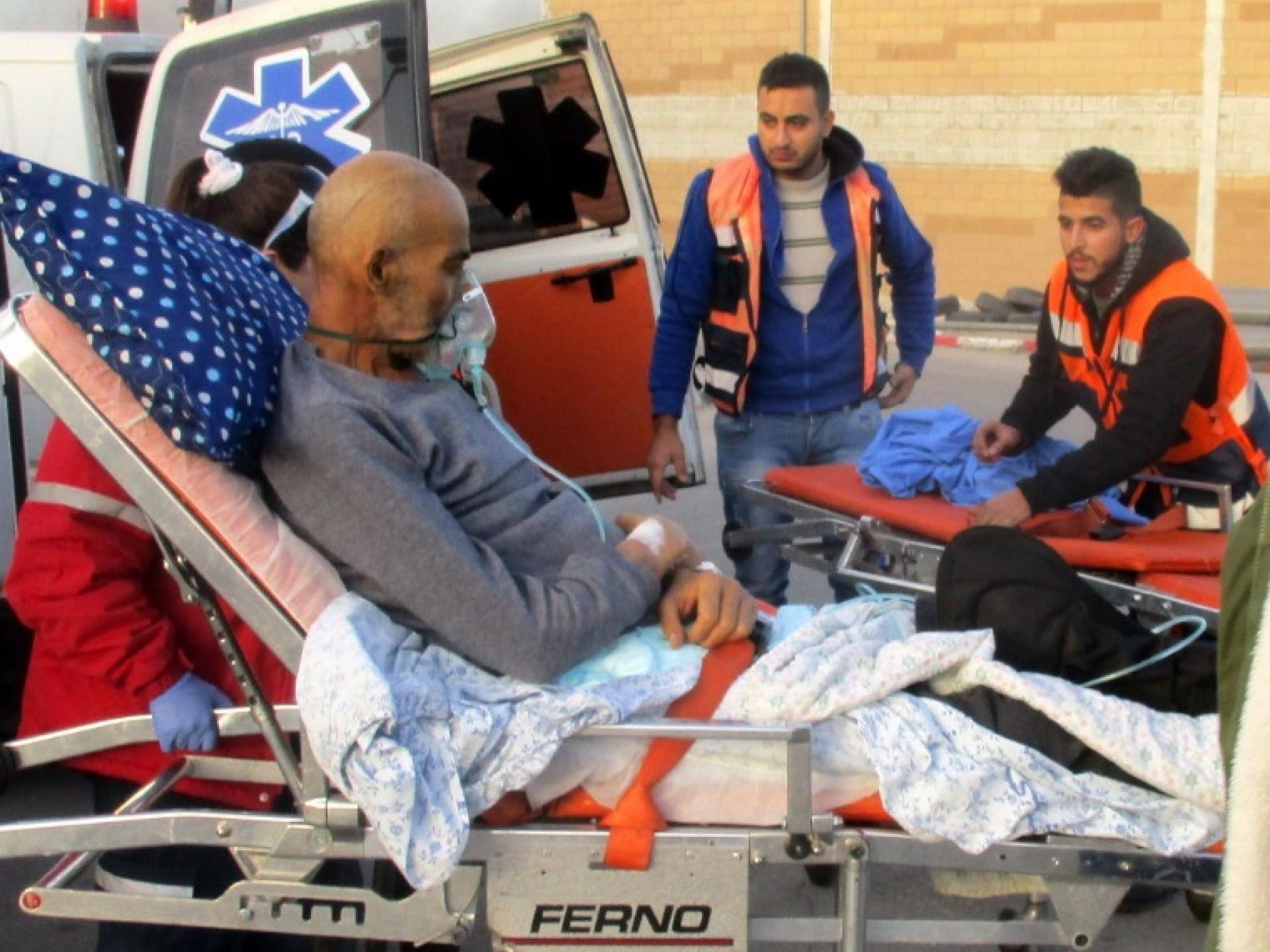
So for just half an hour plus some minutes this dying man lay waiting, only half an hour plus some minutes were robbed of the remaining time of this patient’s life, for the procedures forbid a Jerusalem ambulance to carry patients into the West Bank.
Riots, confrontations, violent protests and all the rest of those definitions depend on the media and its editors. What happened there in Qalandiya that afternoon was that children lit a bonfire up the hill, on the inner – Palestinian – side of the Separation Wall. One child holding a sling threw stones at the Wall’s other – Jerusalem – side and then climbed a ladder that reached only up to half the height of that wall.
Within a short while, the blue sky was striped with white as if a jet plane had whooshed by – stripes that crashed to the ground with thick teargas swallowing everything and everyone.
Time passed, dark falls early and with it arrived two armored cars loaded with Border Police, twelve in number, who disembarked, armed with rifles and grenades.
Their friend, a civilian security guard, approached the bunch, and leaving them – yelled “Fuck them!” – a sort of parting blessing. The armed men lined up and marched over to the other side of the checkpoint. There, facing the refugee camp, they took up positions, their rifles pointed at homes and people.
But the children were no longer on the hill. The bonfire had already died down and there was no one left to fuck.
So, at the order of their commanding officer, they lined up again and marched back to where they came from.

Qalandiya Checkpoint / Atarot Pass (Jerusalem)
See all reports for this place-
Click here to watch a video from Qalandiya checkpoint up to mid 2019 Three kilometers south of Ramallah, in the heart of Palestinian population. Integrates into "Jerusalem Envelope" as part of Wall that separates between northern suburbs that were annexed to Jerusalem in 1967: Kafr Aqab, Semiramis and Qalandiya, and the villages of Ar-Ram and Bir Nabala, also north of Jerusalem, and the city itself. Some residents of Kafr Aqab, Semiramis and Qalandiya have Jerusalem ID cards. A terminal operated by Israel Police has functioned since early 2006. As of August 2006, northbound pedestrians are not checked. Southbound Palestinians must carry Jerusalem IDs; holders of Palestinian Authority IDs cannot pass without special permits. Vehicular traffic from Ramallah to other West Bank areas runs to the north of Qalandiya. In February 2019, the new facility of the checkpoint was inaugurated aiming to make it like a "border crossing". The bars and barbed wire fences were replaced with walls of perforated metal panels. The check is now performed at multiple stations for face recognition and the transfer of an e-card. The rate of passage has improved and its density has generally decreased, but lack of manpower and malfunctions cause periods of stress. The development and paving of the roads has not yet been completed, the traffic of cars and pedestrians is dangerous, and t the entire vicinity of the checkpoint is filthy. In 2020 a huge pedestrian bridge was built over the vehicle crossing with severe mobility restrictions (steep stairs, long and winding route). The pedestrian access from public transport to the checkpoint from the north (Ramallah direction) is unclear, and there have been cases of people, especially people with disabilities, who accidentally reached the vehicle crossing and were shot by the soldiers at the checkpoint. In the summer of 2021, work began on a new, sunken entrance road from Qalandiya that will lead directly to Road 443 towards Jerusalem and Tel Aviv. At the same time, the runways of the old Atarot airport were demolished and infrastructure was prepared for a large bus terminal. (updated October 2021)
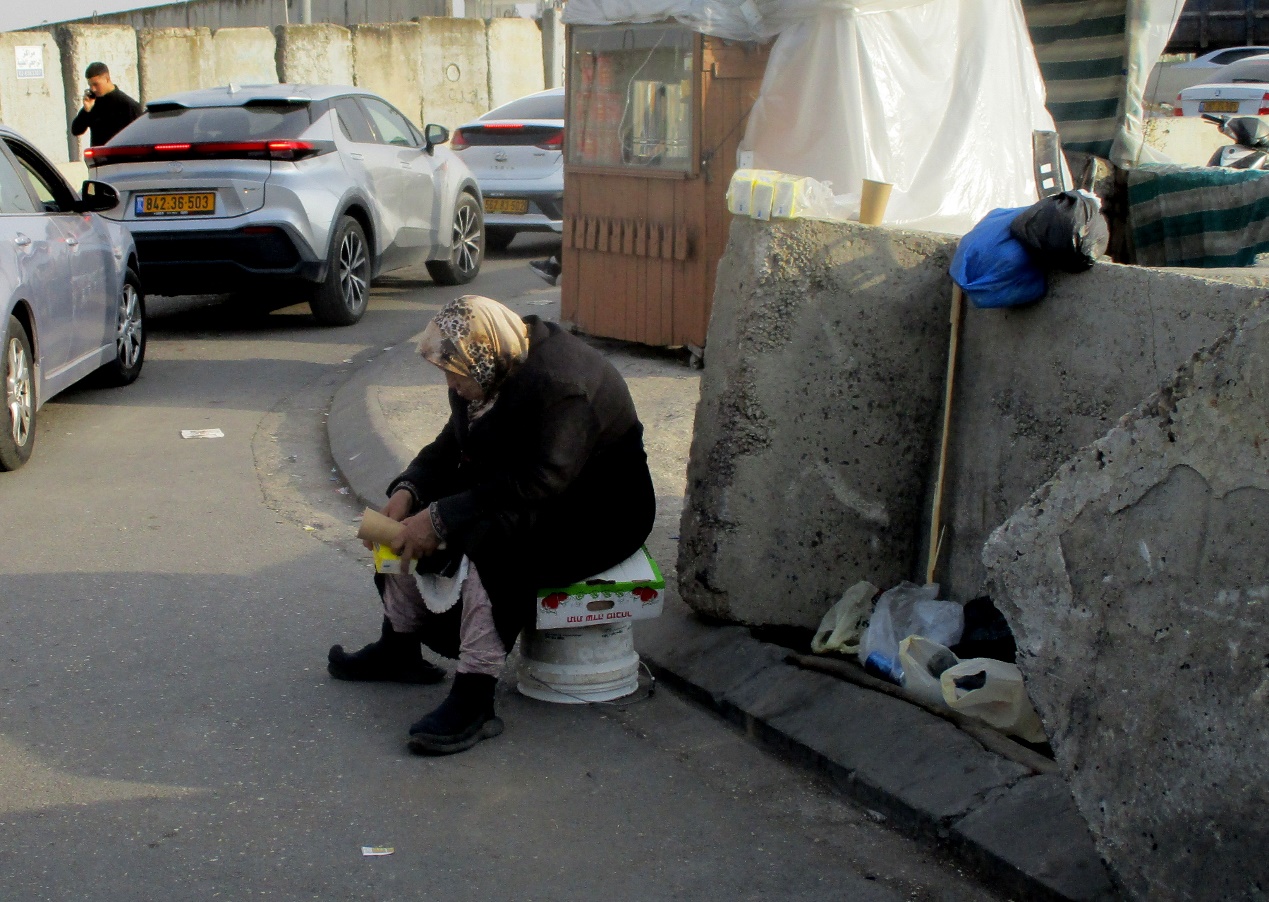 Tamar FleishmanOct-11-2026Qalandiya. Female Beggar
-
