
Qalandiya
The eve of the second holiday of Passover. Two days of closure. Two more days of closure.
Not many Palestinians come to the checkpoint during a closure.
A drowsy soldier, who’s probably bitter at having to spend the holiday at this lousy place, presses distractedly on the button that opens the gate, and closes it. Opens and closes it, opens and closes it again.
Minutes passed, people waited, time oozed by, the soldier doesn’t care. His minutes seem to creep by. Minutes, hours – they’re all the same to him; so are all the people. Some pass before him, others arrive. He presses and releases the button. He’s in no hurry.
He admits them three at a time. Three, then closes. And waits. And opens, and closes. And even when the rule of three separates a child from his mother – the child’s inside, the mother’s outside, both of them panicking, the soldier doesn’t hurry to reunite them.
“What can we do? – They have the button,” a man says, an experienced old-timer.
He’s right. They have that button and all the other buttons. The button that opens, the button that closes, the button that fires, the button that detains. Buttons and more buttons, and they have them all.
But the real truth is not so visible: the fact that the DCL offices where Palestinians obtain (or not) crossing permits are closed for four days in a row. When the days the offices are closed for the weekend follow immediately upon the days they’re closed for the holiday those needing their services stand helplessly before the locked doors and the insensitivity.
Nor is the sign, blue letters on a gray background, any help:
Weekends and holidays
Call the DCL at:
02-970-3762
Someone picks up, but has no answers.
One man learned that the hard way. His infant daughter, “who’ll be one month old in three days,” was scheduled for an operation at the St. John Ophthalmic Hospital in East Jerusalem; she was to have been admitted Monday, during the holiday. The father came to the Qalandiya checkpoint to obtain a crossing permit for his wife to stay with the infant in the hospital, take care of her, nurse her. But the offices are closed. Holiday eve. Closure. He called the phone number on the sign, called the health liason officer, called Physicians for Human Rights. “Go to the Zeitim checkpoint,” they told him. “They’ll give it to you.”
He went to the Zeitim checkpoint, but those offices are also shut because of the closure. He stood outside waiting, telephoned again to everyone he’d already called: “It’s being prepared,” they told him. Hours passed. He didn’t eat or drink, just “stood chain-smoking,” he said.
All the operators told him nothing’s standing in the way of the permit, it already appears in the computer, but they’re not the ones who print it out. The Palestinians know if they don’t have a piece of paper in hand – there’s no permit. He kept waiting.
And after trying again and more phone calls and more discussions they promised that everything was arranged, that he and his wife and baby should come tomorrow, during the holiday, and the soldiers would let them through even if he doesn’t have a piece of paper in hand. I promise, says the officer.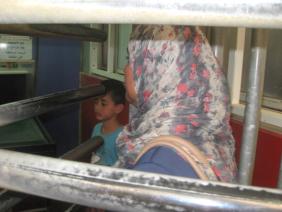
That night he was troubled by doubts.
And the next morning something incredible occurred – the soldiers at the checkpoint knew about it and let the mother and infant through without a piece of paper. What goes without saying in every normal human society seems like a small miracle under occupation.
We thank Husam Liftawi and Amal Zeida, of Physicians for Human Rights, who spared no effort to help open the way for one infant “who’ll be one month old in three days” and her mother.
Qalandiya Checkpoint / Atarot Pass (Jerusalem)
See all reports for this place-
Click here to watch a video from Qalandiya checkpoint up to mid 2019 Three kilometers south of Ramallah, in the heart of Palestinian population. Integrates into "Jerusalem Envelope" as part of Wall that separates between northern suburbs that were annexed to Jerusalem in 1967: Kafr Aqab, Semiramis and Qalandiya, and the villages of Ar-Ram and Bir Nabala, also north of Jerusalem, and the city itself. Some residents of Kafr Aqab, Semiramis and Qalandiya have Jerusalem ID cards. A terminal operated by Israel Police has functioned since early 2006. As of August 2006, northbound pedestrians are not checked. Southbound Palestinians must carry Jerusalem IDs; holders of Palestinian Authority IDs cannot pass without special permits. Vehicular traffic from Ramallah to other West Bank areas runs to the north of Qalandiya. In February 2019, the new facility of the checkpoint was inaugurated aiming to make it like a "border crossing". The bars and barbed wire fences were replaced with walls of perforated metal panels. The check is now performed at multiple stations for face recognition and the transfer of an e-card. The rate of passage has improved and its density has generally decreased, but lack of manpower and malfunctions cause periods of stress. The development and paving of the roads has not yet been completed, the traffic of cars and pedestrians is dangerous, and t the entire vicinity of the checkpoint is filthy. In 2020 a huge pedestrian bridge was built over the vehicle crossing with severe mobility restrictions (steep stairs, long and winding route). The pedestrian access from public transport to the checkpoint from the north (Ramallah direction) is unclear, and there have been cases of people, especially people with disabilities, who accidentally reached the vehicle crossing and were shot by the soldiers at the checkpoint. In the summer of 2021, work began on a new, sunken entrance road from Qalandiya that will lead directly to Road 443 towards Jerusalem and Tel Aviv. At the same time, the runways of the old Atarot airport were demolished and infrastructure was prepared for a large bus terminal. (updated October 2021)
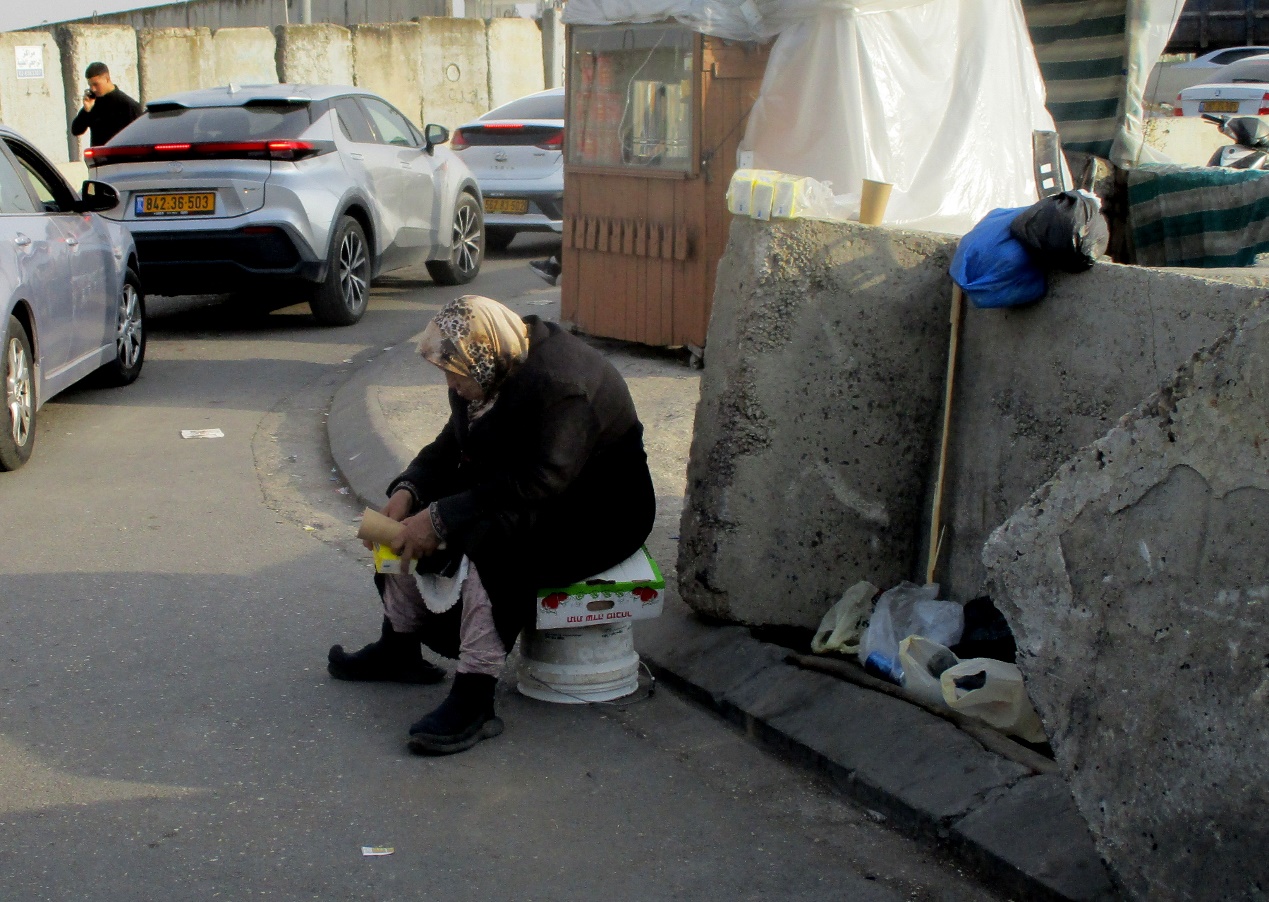 Tamar FleishmanOct-11-2026Qalandiya. Female Beggar
-
