
Qalandiya
Disclosure along with current events:
I do not take pictures of Palestinians who do not wish to be photographed.
I do take pictures of soldiers and policemen even if they do not wish me to do so, and I publish these photos.
These are both conscious choices. I choose about what and about whom to write, out of everything I see and hear. I also choose what and whom to photograph and publish in these reports.
From the many things I saw and heard and experienced and photographed in the more than two and a half hours I spent there, I choose to tell about Abu Suleiman.
He is an elderly man, whose black-dyed hair does not conceal his age, revealed by his furrowed face. He has been here for many years, a part of the local landscape
I don’t know how many years he has been here, perhaps as many as the checkpoint itself, maybe more, maybe less. Perhaps I’ll know one day.
Abu Suleiman sits on a stool at the entrance to the checkpoint compound next to the cart that is the source of his livelihood, a cart loaded with snacks and candy and other trivia. It’s a mobile cart, and next to it is a crate with bottles of soft drinks and water at 1 shekel a piece. He’s a friendly, warm-hearted man who never raises his voice, never tries to coddle customers. Just waits for them to come.
Abu Suleiman has a home of his own, in Hebron. He has a home and he is here, a home far away from home. A place to spend the night, a rented spot in A-Ram town. The need to earn a living has forced him there.
All week he is here with his wife. They return there, to their family, on weekends and holidays.
All hours of the day Abu Suleiman sits alone by his cart. The child-vendors whom he likes keep him company. He spoils them and smiles at them as if they were his grandchildren. At evening time he is joined by his wife and together they push the heavy cart along all the way to A-Ram.
Why do I tell you about Abu Suleiman ? Because he is no longer at his usual spot. One day before Ramadan month began, on Wednesday – he told me – they came, the Israeli authorities, took the cart and all its content, and warned/promised that if he ever come back here as a vendor they would come back too and take again everything he has.
So now the same man and the same stool are at a different spot, with another cart and other goods.
Now Abu Suleiman sits at the side of the road in the scathing summer sun, for what can he do? One does need to earn a living, how would he? Where else could he go?
And I wonder what will happen with old Abu Suleiman when the summer is over and the days of wind and cold and rain will be here?
It is important to tell about Abu Suleiman because beyond his personal tragedy and beyond the mutual acquaintance and affection, this is the story and fate of thousands of migrant-workers inside Palestine.
Qalandiya Checkpoint / Atarot Pass (Jerusalem)
See all reports for this place-
Click here to watch a video from Qalandiya checkpoint up to mid 2019 Three kilometers south of Ramallah, in the heart of Palestinian population. Integrates into "Jerusalem Envelope" as part of Wall that separates between northern suburbs that were annexed to Jerusalem in 1967: Kafr Aqab, Semiramis and Qalandiya, and the villages of Ar-Ram and Bir Nabala, also north of Jerusalem, and the city itself. Some residents of Kafr Aqab, Semiramis and Qalandiya have Jerusalem ID cards. A terminal operated by Israel Police has functioned since early 2006. As of August 2006, northbound pedestrians are not checked. Southbound Palestinians must carry Jerusalem IDs; holders of Palestinian Authority IDs cannot pass without special permits. Vehicular traffic from Ramallah to other West Bank areas runs to the north of Qalandiya. In February 2019, the new facility of the checkpoint was inaugurated aiming to make it like a "border crossing". The bars and barbed wire fences were replaced with walls of perforated metal panels. The check is now performed at multiple stations for face recognition and the transfer of an e-card. The rate of passage has improved and its density has generally decreased, but lack of manpower and malfunctions cause periods of stress. The development and paving of the roads has not yet been completed, the traffic of cars and pedestrians is dangerous, and t the entire vicinity of the checkpoint is filthy. In 2020 a huge pedestrian bridge was built over the vehicle crossing with severe mobility restrictions (steep stairs, long and winding route). The pedestrian access from public transport to the checkpoint from the north (Ramallah direction) is unclear, and there have been cases of people, especially people with disabilities, who accidentally reached the vehicle crossing and were shot by the soldiers at the checkpoint. In the summer of 2021, work began on a new, sunken entrance road from Qalandiya that will lead directly to Road 443 towards Jerusalem and Tel Aviv. At the same time, the runways of the old Atarot airport were demolished and infrastructure was prepared for a large bus terminal. (updated October 2021)
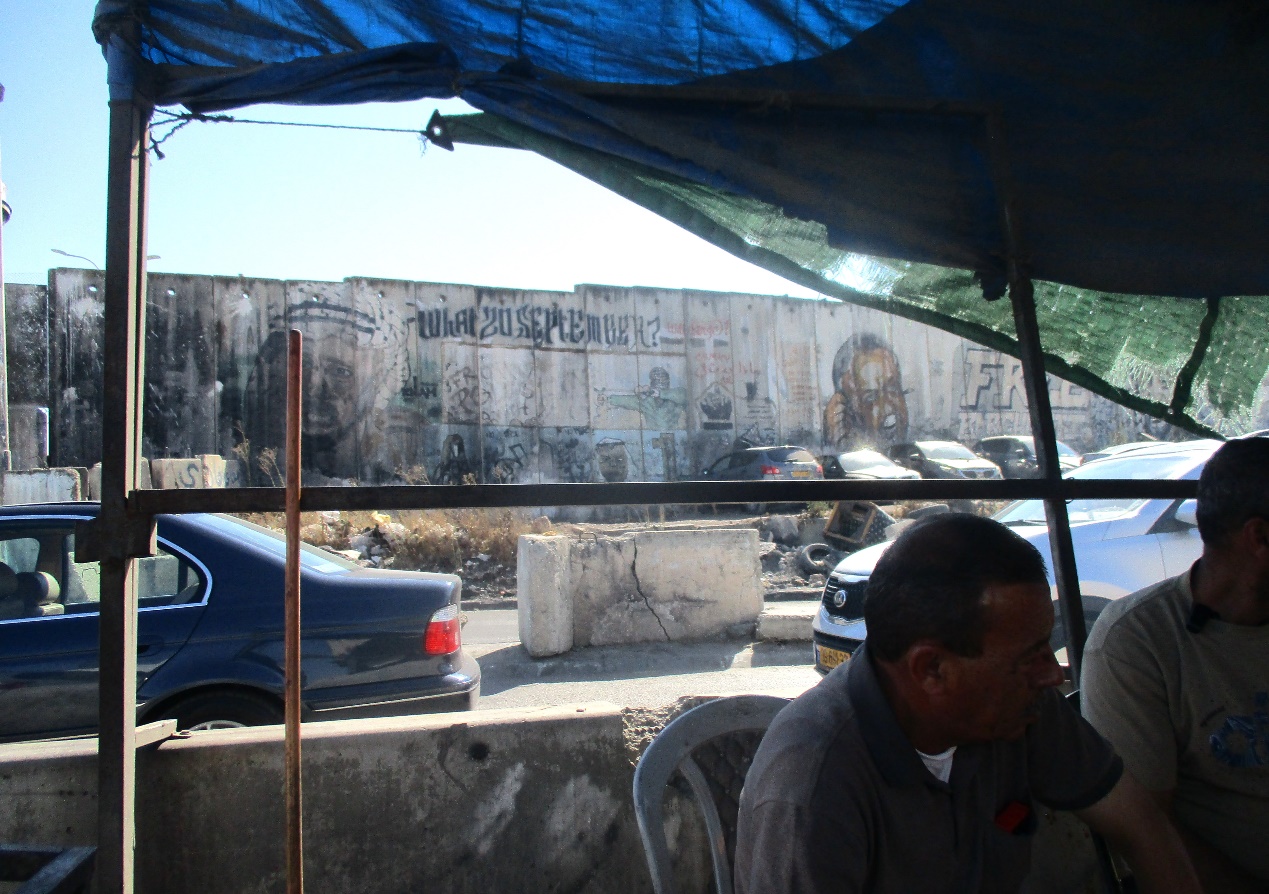 Tamar FleishmanJul-21-2026Qalandiya. Conversation in the shadow of the wall
-
