
Qalandiya
An ambulance driver carried a 9-year old boy across between ambulances. He told me the boy had a problem in his respiratory system and was sent for treatment at Muqassad Hospital (East Jerusalem). I photographed.
-You’re not allowed to take pictures! Yelled the soldiers. This is a military zone, and you’re also invading privacy.
-Privacy? Really? And this does not apply to you? Everything is photographed around here.
-Ah, those are security measures.
I wondered why pictures of the young man murdered on Yom Kippur Eve at the entrance to the Old City of Jerusalem were not posted as usual on walls and pillars, and in answer I heard something I never knew: “No picture before we get the body”.
What I didn’t know then and still don’t know is why the hell his body was not returned to his family.
“Imagine what his mother must be feeling”, said a resident of the refugee camp.
As I crossed the checkpoint and reached the soldiers’ checking post again I heard the old songs about not being allowed into Ramallah, and that as a Jew I am forbidden to cross over to the Palestinian side of the checkpoint and so forth.
Speak to my lawyer, I retorted and pointed to Attorney Tayel Dudin who stood behind me in line. When they were done with me they addressed Tayel: “It’s dangerous for a Jewish woman to be there”, and heard from him that it’s true, it might be dangerous for a Jew, but his client (me) chose to be there and it’s not forbidden by law, it’s a matter of personal choice.
What I didn’t yet know and found out while crossing the checkpoint is that a man holding a blue (Israeli) ID could at any given time block his green-Id-holding wife’s permit that meets the definition of family unification. This is what happened to a woman at odds with her husband, and only as she reached the soldiers was she informed that her permit was no longer valid. What about the children at home? That’s the man’s worry.
A bit further stood a white vehicle with flashing police lights, and inside it were two army lieutenants. It blocked the vehicular lane of traffic exiting Palestine and caused a traffic jam the end of which was out of sight.
Why do you block the road? I asked. Someone important is about to arrive, they answered. Who? I wondered.
A shout pierced the air: Don’t answer her! Policeman Menashe Chai arrived on the scene. The officers, although above him in the official hierarchy, obeyed.
After not sparing Menashe my opinion of him I mentioned to the officers that even if that important person expected to cross is so important, still whoever is lying in the ambulance in back is more important.
Something in what I said must have touched them, and they made way for the ambulance and everyone else.
Not long afterwards a kind of VIP convoy arrived, including a military vehicle with a high-ranking officer inside, followed by a civilian white vehicle with darkened windows and several human shadows inside.
Qalandiya Checkpoint / Atarot Pass (Jerusalem)
See all reports for this place-
Click here to watch a video from Qalandiya checkpoint up to mid 2019 Three kilometers south of Ramallah, in the heart of Palestinian population. Integrates into "Jerusalem Envelope" as part of Wall that separates between northern suburbs that were annexed to Jerusalem in 1967: Kafr Aqab, Semiramis and Qalandiya, and the villages of Ar-Ram and Bir Nabala, also north of Jerusalem, and the city itself. Some residents of Kafr Aqab, Semiramis and Qalandiya have Jerusalem ID cards. A terminal operated by Israel Police has functioned since early 2006. As of August 2006, northbound pedestrians are not checked. Southbound Palestinians must carry Jerusalem IDs; holders of Palestinian Authority IDs cannot pass without special permits. Vehicular traffic from Ramallah to other West Bank areas runs to the north of Qalandiya. In February 2019, the new facility of the checkpoint was inaugurated aiming to make it like a "border crossing". The bars and barbed wire fences were replaced with walls of perforated metal panels. The check is now performed at multiple stations for face recognition and the transfer of an e-card. The rate of passage has improved and its density has generally decreased, but lack of manpower and malfunctions cause periods of stress. The development and paving of the roads has not yet been completed, the traffic of cars and pedestrians is dangerous, and t the entire vicinity of the checkpoint is filthy. In 2020 a huge pedestrian bridge was built over the vehicle crossing with severe mobility restrictions (steep stairs, long and winding route). The pedestrian access from public transport to the checkpoint from the north (Ramallah direction) is unclear, and there have been cases of people, especially people with disabilities, who accidentally reached the vehicle crossing and were shot by the soldiers at the checkpoint. In the summer of 2021, work began on a new, sunken entrance road from Qalandiya that will lead directly to Road 443 towards Jerusalem and Tel Aviv. At the same time, the runways of the old Atarot airport were demolished and infrastructure was prepared for a large bus terminal. (updated October 2021)
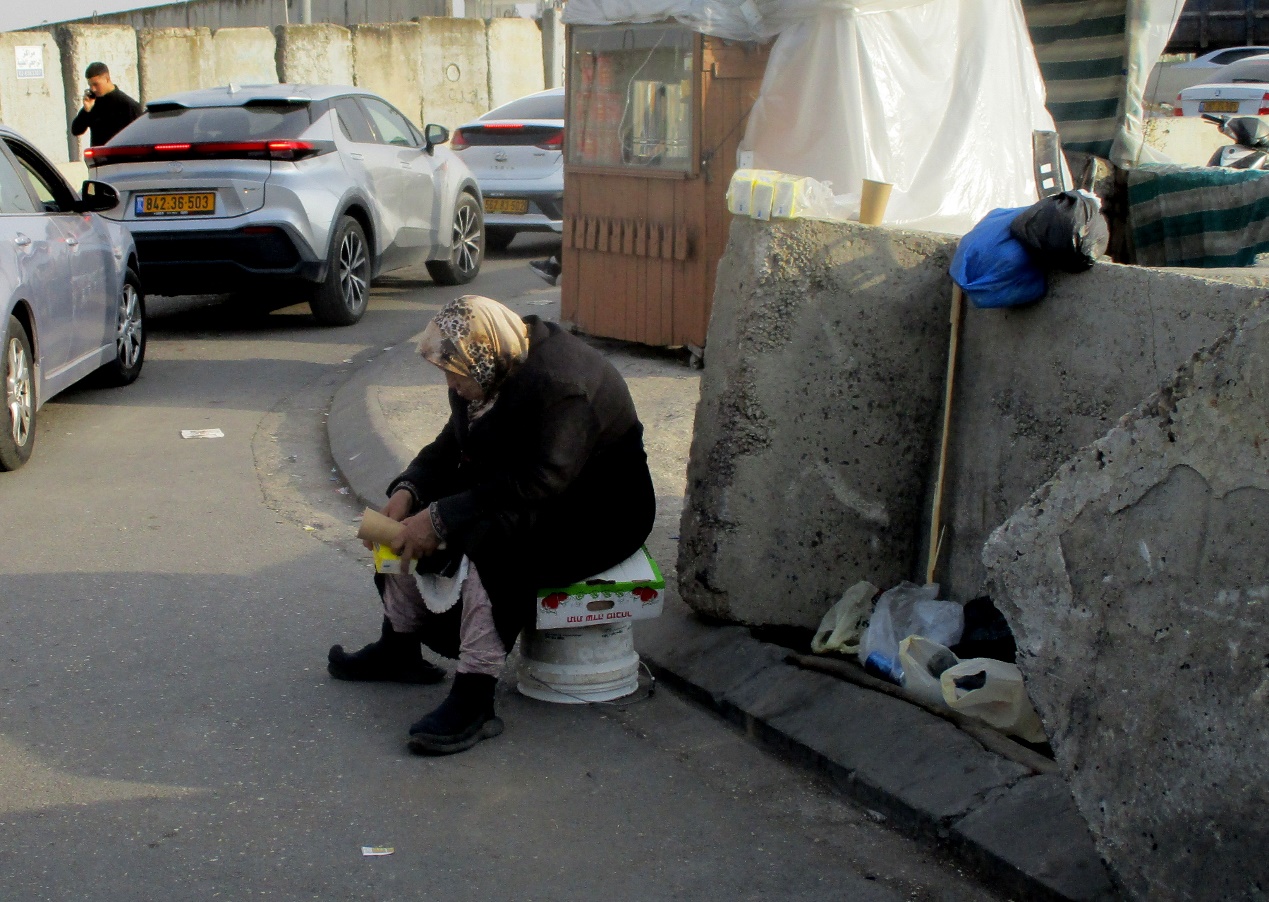 Tamar FleishmanOct-11-2026Qalandiya. Female Beggar
-
