
Qalandiya
Slowly and warily those who were released from hospital that morning emerged from the checkpoint compound, most of them women, and continued towards the transport platform from where their designated vehicle would drive them home to Gaza.
Last was a woman, pale, dragging her feet. A few days ago she underwent surgery in a Nablus hospital, replacing her knee, and she yet to recover. The doctors had recommended/ordered total rest for ten days, but the instructions of the Occupation’s experts take precedence over medical ones.
The woman reached the van leaning on her walker and could not tackle the two steps in the front of the vehicle, letting three men take her very gently up and inside.
Like others, she also came there at 9 a.m., and like others, all very unhealthy, waited for six hours to get going.
Until a few months ago, the DCO had a wheelchair for sparing cases like hers extra suffering. No longer.
And one cannot help but ask again:
- Is it not right and considerate and proper for someone in her condition, suffering as she does, to travel home from hospital directly rather than be harassed between offices and headquarters and transport vehicles?
- How is this woman going to cross the Erez Crossing into the Gaza Strip and get home from there?
Earlier, next to the vehicle checkpoint, an Arabic-speaking officer of the Israeli army spokesperson’s office gave a flattering explanation about the wonders of the renovated checkpoint and another officer stood facing him, documenting the speech.
“I spoke about the renovations in this crossing” he told me, as I disturbed the two and broke the idyll claiming that there is a different between a crossing – where people cross – and a checkpoint that checks and blocks passage.
Away from there, in front of the refugee camp, the inner wall that surrounds the checkpoint area showed a picture of the latest martyr from the camp, Majd Jamal Mutir who was shot to death by an Israeli Border Police unit on December 13, 2018, on Hagai Street in the Old City of Jerusalem.
Israeli media reports: “Two Border Police combatants were wounded lightly in a stabbing in the Old City of Jerusalem, the terrorist was exterminated.”
Again, a nameless person was exterminated, a man who was as good as nonexistent except for some scratch he caused two Border Policemen.
Qalandiya Checkpoint / Atarot Pass (Jerusalem)
See all reports for this place-
Click here to watch a video from Qalandiya checkpoint up to mid 2019 Three kilometers south of Ramallah, in the heart of Palestinian population. Integrates into "Jerusalem Envelope" as part of Wall that separates between northern suburbs that were annexed to Jerusalem in 1967: Kafr Aqab, Semiramis and Qalandiya, and the villages of Ar-Ram and Bir Nabala, also north of Jerusalem, and the city itself. Some residents of Kafr Aqab, Semiramis and Qalandiya have Jerusalem ID cards. A terminal operated by Israel Police has functioned since early 2006. As of August 2006, northbound pedestrians are not checked. Southbound Palestinians must carry Jerusalem IDs; holders of Palestinian Authority IDs cannot pass without special permits. Vehicular traffic from Ramallah to other West Bank areas runs to the north of Qalandiya. In February 2019, the new facility of the checkpoint was inaugurated aiming to make it like a "border crossing". The bars and barbed wire fences were replaced with walls of perforated metal panels. The check is now performed at multiple stations for face recognition and the transfer of an e-card. The rate of passage has improved and its density has generally decreased, but lack of manpower and malfunctions cause periods of stress. The development and paving of the roads has not yet been completed, the traffic of cars and pedestrians is dangerous, and t the entire vicinity of the checkpoint is filthy. In 2020 a huge pedestrian bridge was built over the vehicle crossing with severe mobility restrictions (steep stairs, long and winding route). The pedestrian access from public transport to the checkpoint from the north (Ramallah direction) is unclear, and there have been cases of people, especially people with disabilities, who accidentally reached the vehicle crossing and were shot by the soldiers at the checkpoint. In the summer of 2021, work began on a new, sunken entrance road from Qalandiya that will lead directly to Road 443 towards Jerusalem and Tel Aviv. At the same time, the runways of the old Atarot airport were demolished and infrastructure was prepared for a large bus terminal. (updated October 2021)
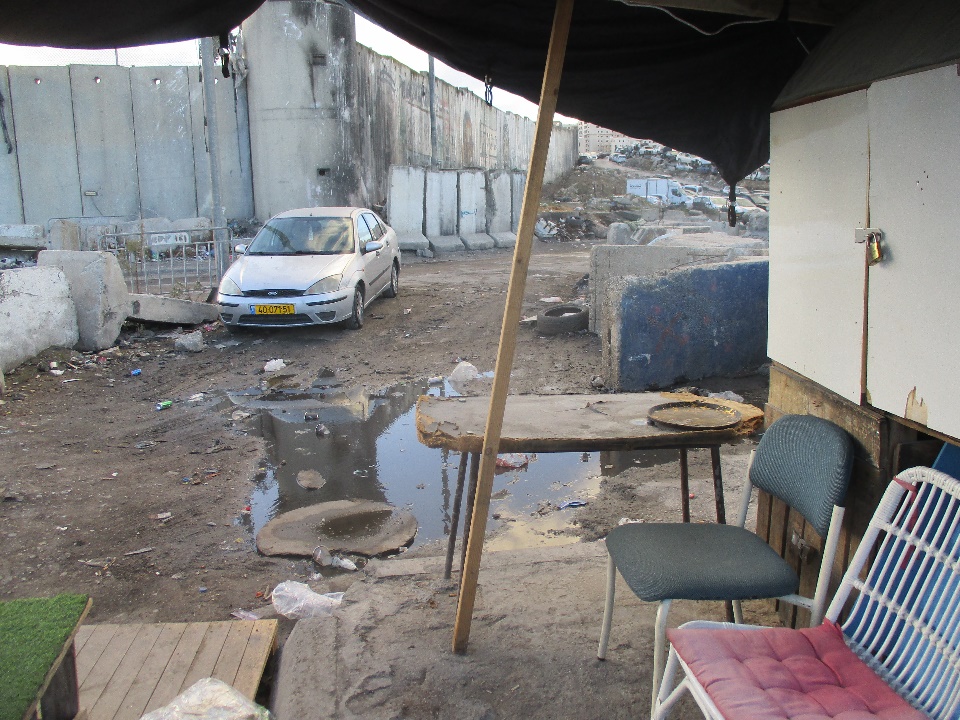 Tamar FleishmanNov-30-2025Qalandiya: Puddles and dirt after the rain
-