
Qalandiya
A calm morning in Qalandiya and a meeting with an old acquaintance.
We continue to park on the Palestinian side because due to the works on the Israeli side, there is no place to park there. We arrived at a quarter to six. When we approached from the Israeli side in the dark, we saw that the pedestrian bridge was still covered in Christmas lights. For the first time, we saw that the vehicle crossing to the Palestinian side is closed. The crossing to the Israeli side went as in the past. We approached slowly and asked the security guard who was close to us what was going on. He said he was opening and let us move on. A moment later, he remembered to ask who we actually were, but the answer “Machsomwatch” put his mind at rest. He signaled us to continue and indeed the checkpoint opened and remained open. It is not clear why they closed before. After we parked, our first stop is at our friend Abu Ramzi, the pretzel seller. Today the grandson came with him to help, and later he will go to school. Abu Ramzi reports that the situation at the pedestrian checkpoint is normal. Near him, there is a falafel and another food stand that operates as usual, and, opposite, the kiosk. We’ll get to them on our way back. The cake seller has been stationed for some time under the shed, near one of the entrances to the checkpoint building. The stand for selling tickets for mobile phones (Palestinians usually use a phone with a prepaid card) and for charging RavKav, which we already saw on our previous shift, has moved from the eastern side to the western side. Next to the gate at the western end, the woman we met before was waiting with a sick baby in a stroller. Today she was waiting with her (presumably) husband. We wished her good morning, but immediately after that a security guard came and opened the gate for her. Her escort then left and she moved with the toddler in the stroller.

From the direction of the Qalandiya refugee camp flashes an electronic advertising sign, which is a striking contrast to the rest of the “setting” around.
Many young people still climb the fence surrounding the checkpoint complex on the side adjacent to the Qalandiya camp, to save themselves the usual detour to enter from the east. And we still wonder why they don’t open the gate that is there in the fence and make it easier for the public. An electronic advertising sign flashes above a building in the Qalandiya camp and young people who climbed the fence are coming from this direction.
The situation at the checkpoint was very calm. Everyone who arrives enters immediately. One of the turnstiles is very creaky. We also noticed this last time we were here, but now it’s really jarring. The squeak is heard all the time. Is it really that hard to oil the carousel??? Suddenly someone approaches us with a big smile on his face. How happy we were to see him. He used to work at the pita bakery in the Mahane Yehuda market and we would meet him every shift. He speaks fluent Hebrew and we used to talk every now and then. A little before the opening of the new checkpoint he stopped working there, then the Coronavirus came and we hadn’t seen him since. He says that he is now working in Atarot and is satisfied.
Around a quarter to seven, we approached the turnstile at the middle entrance and peeked in to see what the situation was. We saw that there were really short queues for the baggage check positions. They all seemed to be open and there were no delays. We decided to give up the passing to the Israeli side this time. On the way back to the car, we photographed, now in daylight, the upgraded falafel stand. Now it is inside some kind of building. The sellers and the frying station are raised, and below is the table on which all the salads and other types of food are placed, while on top there is a roof. It is certainly more comfortable that way on rainy days. Today is not rainy, only the Jerusalem cold penetrates the bones. The sellers are happy to have us taking pictures and offer us falafel. For us it’s a little early for fried food, so we politely acknowledged and said our goodbyes. At the upgraded falafel stand we are offered to treat ourselves.

We drove back to Jerusalem via A-Ram. The temporary Jib checkpoint is not manned this morning (perhaps because we passed just before seven in the morning). In the Hizmeh area, there is slight traffic congestion and from there within Jerusalem, there is reasonable traffic congestion for this hour.
Qalandiya Checkpoint / Atarot Pass (Jerusalem)
See all reports for this place-
Click here to watch a video from Qalandiya checkpoint up to mid 2019 Three kilometers south of Ramallah, in the heart of Palestinian population. Integrates into "Jerusalem Envelope" as part of Wall that separates between northern suburbs that were annexed to Jerusalem in 1967: Kafr Aqab, Semiramis and Qalandiya, and the villages of Ar-Ram and Bir Nabala, also north of Jerusalem, and the city itself. Some residents of Kafr Aqab, Semiramis and Qalandiya have Jerusalem ID cards. A terminal operated by Israel Police has functioned since early 2006. As of August 2006, northbound pedestrians are not checked. Southbound Palestinians must carry Jerusalem IDs; holders of Palestinian Authority IDs cannot pass without special permits. Vehicular traffic from Ramallah to other West Bank areas runs to the north of Qalandiya. In February 2019, the new facility of the checkpoint was inaugurated aiming to make it like a "border crossing". The bars and barbed wire fences were replaced with walls of perforated metal panels. The check is now performed at multiple stations for face recognition and the transfer of an e-card. The rate of passage has improved and its density has generally decreased, but lack of manpower and malfunctions cause periods of stress. The development and paving of the roads has not yet been completed, the traffic of cars and pedestrians is dangerous, and t the entire vicinity of the checkpoint is filthy. In 2020 a huge pedestrian bridge was built over the vehicle crossing with severe mobility restrictions (steep stairs, long and winding route). The pedestrian access from public transport to the checkpoint from the north (Ramallah direction) is unclear, and there have been cases of people, especially people with disabilities, who accidentally reached the vehicle crossing and were shot by the soldiers at the checkpoint. In the summer of 2021, work began on a new, sunken entrance road from Qalandiya that will lead directly to Road 443 towards Jerusalem and Tel Aviv. At the same time, the runways of the old Atarot airport were demolished and infrastructure was prepared for a large bus terminal. (updated October 2021)
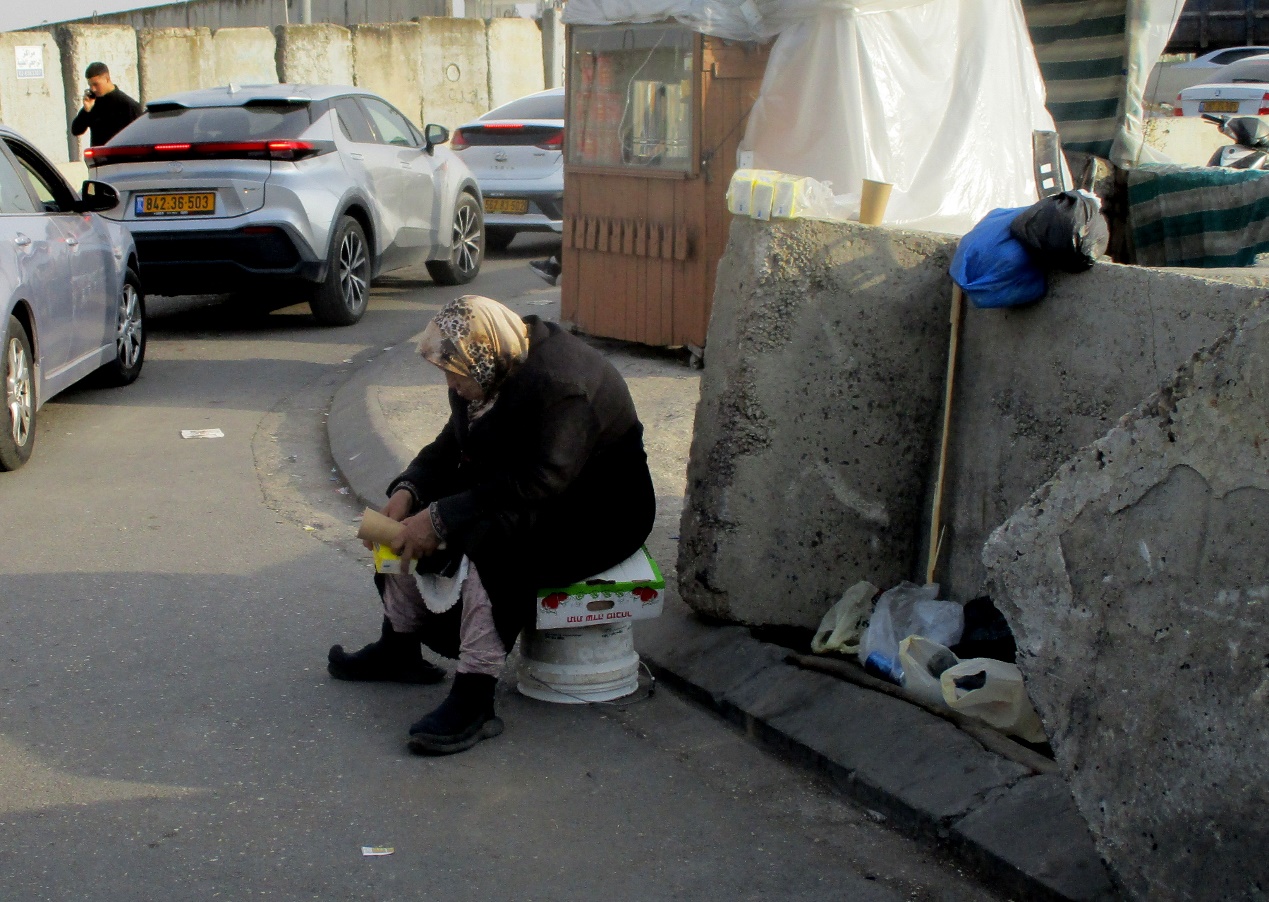 Tamar FleishmanOct-11-2026Qalandiya. Female Beggar
-
