Qalandiya
Qalandiya
The day after the attack in Jerusalem, and the day before the Yom Kippur closure. At 5 there were only a few people, and over a period of time, transits arrived with more people. It was quiet in the hall and looked very tired. The soldier in the enclosure opened the door and spoke with us. He said that he read our reports; when we asked if they were interesting, he answered positively. He opened the turnstyle frequently and toward the end of our shift, it seemed as though about 1000 people had passed through. We met a young man who spoke with us in English, from Louisiana, USA. HIs family had been there for 11 years already and always return for visits in the village. During this period, he was working at Atarot and experiencing the life style of his family from close up. He’s glad that he is returning to the US in a few days.
People were explaining how important it is to them to work on the land no matter what. We met a young man who was sent back from the inspection window. He said that he didn’t receive any explanation why. We took down all his particulars so we could help him clarify the problem. He also went back to the DCO at 9 and they told him to come at 10 and then they finally explained that he was refused by the GSS. Of course, he doesn’t understand why he was refused and the only explanation is that it frequently happens that someone is refused without any reason, especially as a reponse to attacks. We will continue to deal with the case and hope that we can cancel this kind of ruling.
The Humanitarian Gate opened with a short delay and people said that sometimes it is even further delayed. The officer and the policeman checked the people and also send back to the long line people who aren’t 60 yet and therefore should not be in this gate. It is always difficult to see the small ugly gate as a “humanitarian” gate. On the other hand, there are always DCO officers there, police and guards and there is a chance that one of them can understand and speak Arabic. This happened again this time, to an elderly man, who wanted to cross there despite that fact that elderly people can cross into Jerusalem only after 8:00 if it is not for the purpose of employment.
Shuafat refugee camp
The Shuafat refugee camp is an example of another interesting aspect of the deprivation of freedom of movement. It is a case of people who are “Jerusalem residents” who work in the city, travel to Eilat for holidays, shop in the city’s shopping malls, send their kids to the Hebrew University, are hospitalized at Hadassah hospital – but can only get to all these places through the humiliating checkpoint and the fences at the border of their neighborhood.
The humiliation, the oppression and the poverty brought this neighborhood and others surrounding it to become neglected areas, violent and ruled over by drug dealers. When we visited the municipal school for boys, we met the art teachers who was trying with immense effort to bring some beauty to the 800 students studying in the school. It is nno wonder that the budget of the school is tiny, much smaller than the Jewish schools in the city. We will try to help the teacher get paint and other supplies which would help him in painting the separation wall which opposite the entrance to the shcool.
We also met a young man who wasn’t going to give up or give in and is active with the youth in the neighborhood. It is always difficult to see how “Jerusalem which is sewn together” actually looks.
Qalandiya Checkpoint / Atarot Pass (Jerusalem)
See all reports for this place-
Click here to watch a video from Qalandiya checkpoint up to mid 2019 Three kilometers south of Ramallah, in the heart of Palestinian population. Integrates into "Jerusalem Envelope" as part of Wall that separates between northern suburbs that were annexed to Jerusalem in 1967: Kafr Aqab, Semiramis and Qalandiya, and the villages of Ar-Ram and Bir Nabala, also north of Jerusalem, and the city itself. Some residents of Kafr Aqab, Semiramis and Qalandiya have Jerusalem ID cards. A terminal operated by Israel Police has functioned since early 2006. As of August 2006, northbound pedestrians are not checked. Southbound Palestinians must carry Jerusalem IDs; holders of Palestinian Authority IDs cannot pass without special permits. Vehicular traffic from Ramallah to other West Bank areas runs to the north of Qalandiya. In February 2019, the new facility of the checkpoint was inaugurated aiming to make it like a "border crossing". The bars and barbed wire fences were replaced with walls of perforated metal panels. The check is now performed at multiple stations for face recognition and the transfer of an e-card. The rate of passage has improved and its density has generally decreased, but lack of manpower and malfunctions cause periods of stress. The development and paving of the roads has not yet been completed, the traffic of cars and pedestrians is dangerous, and t the entire vicinity of the checkpoint is filthy. In 2020 a huge pedestrian bridge was built over the vehicle crossing with severe mobility restrictions (steep stairs, long and winding route). The pedestrian access from public transport to the checkpoint from the north (Ramallah direction) is unclear, and there have been cases of people, especially people with disabilities, who accidentally reached the vehicle crossing and were shot by the soldiers at the checkpoint. In the summer of 2021, work began on a new, sunken entrance road from Qalandiya that will lead directly to Road 443 towards Jerusalem and Tel Aviv. At the same time, the runways of the old Atarot airport were demolished and infrastructure was prepared for a large bus terminal. (updated October 2021)
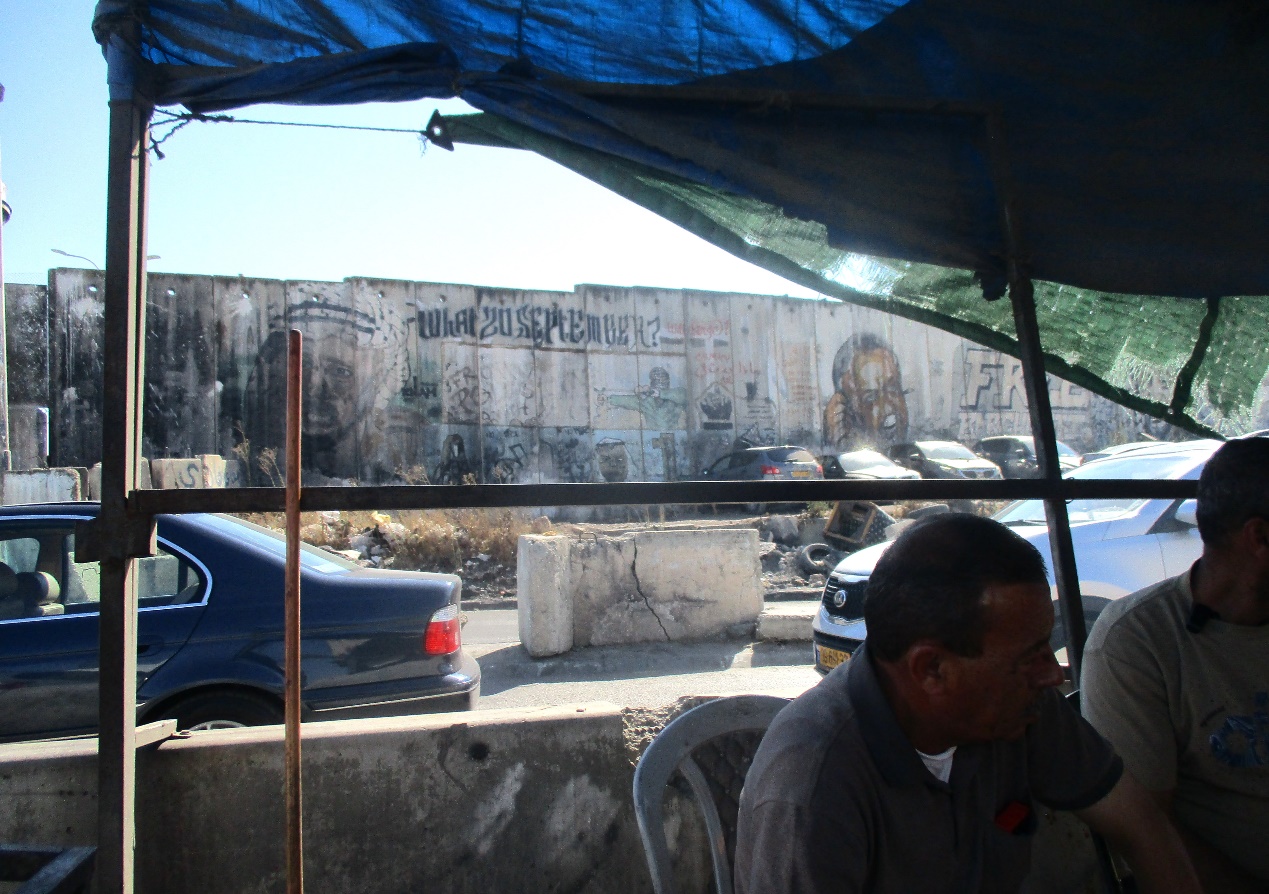 Tamar FleishmanJul-21-2026Qalandiya. Conversation in the shadow of the wall
-