
Qalandiya
Qalandiya
Their Ramadan means nothing to me
Preparation for Ramadan, and innovations
05:15 We parked before reaching the checkpoint and crossed on foot to the Palestinian side. Long lines greet us. Five inspection booths are already open and there aren’t many people waiting at them. Only when the female soldier in the aquarium opened the turnstiles at the end of the fenced areas and people began coming in did we notice an innovation: curved railings have been added between the turnstiles and the inspection booths so people must wind their way toward the booths. Younger men jump over the railings to avoid the winding route.
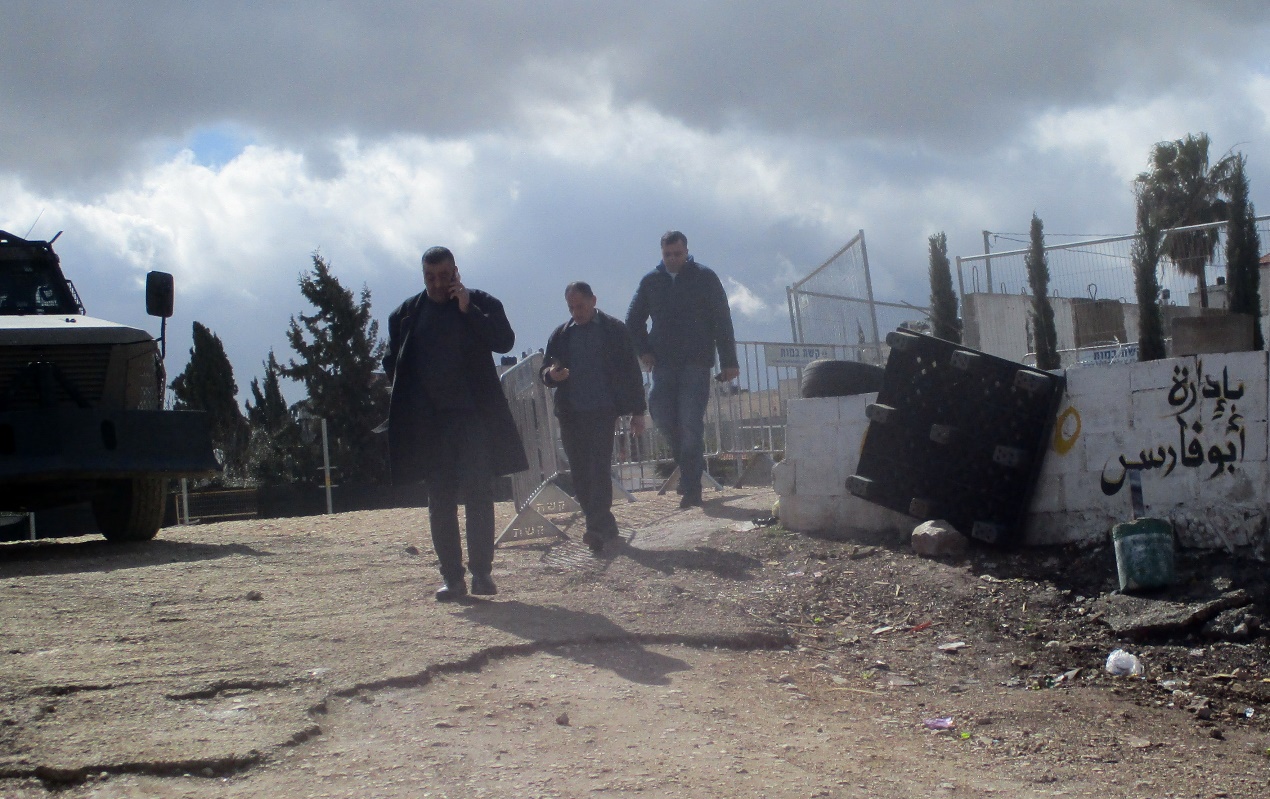
The lines grew a bit shorter and we exited to see preparations for the Friday of Ramadan. The parking lot is closed – concrete barriers block the entrance. To the left of the checkpoint the road to the parking lot has been newly paved, and there are three lanes bounded by concrete barriers, culminating in what seem to be three inspection sheds. A turnstile leads to the checkpoint at the left of the canopied area. Is it new? Or has it always been there? Will they use it on Friday so people won’t have to circumnavigate the area? Usually people enter the canopied area on the right and wait on lines to enter the fenced areas (the lines often stretch beyond the canopied area).
The kiosk is closed because of the Ramadan fast, and the beigel and cake sellers aren’t here. People don’t smoke; the place is slightly cleaner than usual. Many come without food containers. That helps when the loudspeaker later announces that people with no bags can go through booth 2 (apparently the scanner isn’t working).
A policeman arrives, comes out to prevent people from jumping over the new railings. He catches someone, confiscates his permit and will return it only at 07:00. The man turns to us. He says it’s the first time he’s crossed here and isn’t familiar with the procedure. At first we thought his permit was for a later hour and didn’t understand that he’d been punished. The DCO noncom, who today arrived on time (about 06:00), explains his error to him in Arabic. He apologizes and tells her also that he’s new here. The policeman wants him to wait, and to speak Hebrew. But the man doesn’t know Hebrew.
The humanitarian gate first opens at 06:09, and then intermittently for people permitted to go through it. The policeman continued hunting people jumping over the railings and confiscated their permits. The female soldier returned the first permits at 06:35. The policeman made do with a warning to the others that the next time their permits would be confiscated permanently.
More and more forces arrived while we were there. One of the three additional guards ate demonstratively outside and when his colleagues told him people were fasting responded, “Their Ramadan means nothing to me.” Another policewoman arrived and then a policeman, briefly. At one point nine people in uniform were present but later most left. The DCO noncom left at 06:45, even though there were still long lines.
At 07:00 we got on line. It took us 35 minutes to cross, much longer than usual (we usually get on line after the congestion has eased, when the lines are short). It doesn’t look as though the new slalom does any good…
We saw that the sidewalks and area outside had been cleaned. Garbage had been collected in large white sacks belonging to the municipality and waited on the side to be picked up.
Qalandiya Checkpoint / Atarot Pass (Jerusalem)
See all reports for this place-
Click here to watch a video from Qalandiya checkpoint up to mid 2019 Three kilometers south of Ramallah, in the heart of Palestinian population. Integrates into "Jerusalem Envelope" as part of Wall that separates between northern suburbs that were annexed to Jerusalem in 1967: Kafr Aqab, Semiramis and Qalandiya, and the villages of Ar-Ram and Bir Nabala, also north of Jerusalem, and the city itself. Some residents of Kafr Aqab, Semiramis and Qalandiya have Jerusalem ID cards. A terminal operated by Israel Police has functioned since early 2006. As of August 2006, northbound pedestrians are not checked. Southbound Palestinians must carry Jerusalem IDs; holders of Palestinian Authority IDs cannot pass without special permits. Vehicular traffic from Ramallah to other West Bank areas runs to the north of Qalandiya. In February 2019, the new facility of the checkpoint was inaugurated aiming to make it like a "border crossing". The bars and barbed wire fences were replaced with walls of perforated metal panels. The check is now performed at multiple stations for face recognition and the transfer of an e-card. The rate of passage has improved and its density has generally decreased, but lack of manpower and malfunctions cause periods of stress. The development and paving of the roads has not yet been completed, the traffic of cars and pedestrians is dangerous, and t the entire vicinity of the checkpoint is filthy. In 2020 a huge pedestrian bridge was built over the vehicle crossing with severe mobility restrictions (steep stairs, long and winding route). The pedestrian access from public transport to the checkpoint from the north (Ramallah direction) is unclear, and there have been cases of people, especially people with disabilities, who accidentally reached the vehicle crossing and were shot by the soldiers at the checkpoint. In the summer of 2021, work began on a new, sunken entrance road from Qalandiya that will lead directly to Road 443 towards Jerusalem and Tel Aviv. At the same time, the runways of the old Atarot airport were demolished and infrastructure was prepared for a large bus terminal. (updated October 2021)
 Tamar FleishmanFeb-27-2026Qalandiya: On the way to prayer
-