
Qalandiya - a routine of abuse
“A Palestinian drew a knife facing soldiers in Kiryat Arba (settler-colony adjacent to Hebron) and was shot to death”, thus ran the Haaretz headline onTuesday.
A similar event happened at noon on Sunday, at Qalandiya Checkpoint. Similar and different.
Different because rather than ending with a dead body, there was an arrested woman, and perhaps no dead body means no headline.
What I heard from two Palestinians who witnessed this scene, one inside the checkpoint and the other outside, was that a young woman walked into the vehicle checkpoint which is strictly out of bounds for pedestrians. One said she had a knife, the other claimed there was no knife. Either way, what happened was that the guards yelled at her to stop and she didn’t but rather went on walking. Guards came towards her, spraying her face with teargas, she fainted and fell, they stood around her and waited until police came and took her away.
*
An 18-day old baby born with respiratory difficulties was hurried by ambulance and accompanied by a doctor who respirated him, to Maqassed Hospital in East Jerusalem.
“If he is left for two minutes without oxygen, he will die” said the ambulance driver.
The baby, the mother, the oxygen tank and the doctor all crossed into Jerusalem. But the ambulance that may have avoided hardship and delay remained beyond the fence, waiting for the doctor to return.
Why? Because there are laws and regulations (that are not really lawful) and such. The Palestinian ambulance team sat for a long time inside the ambulance, waiting. After an hour I still saw the waiting ambulance lights from a distance.
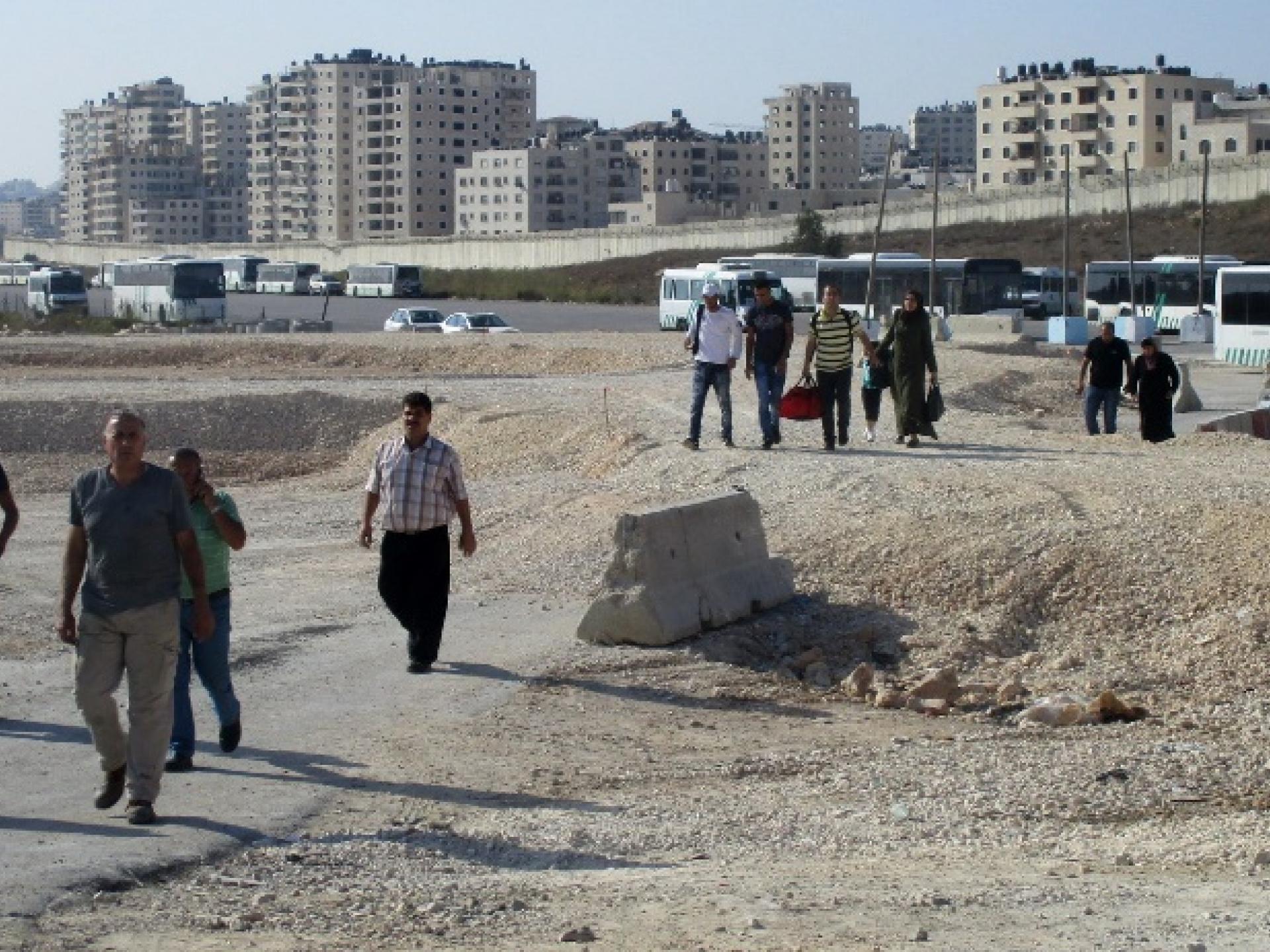
The asphalt area which used to be the bus terminal to and from the West Bank has now been cleared by order of the sovereign.
No questions asked, no consultations, no objections, neither of the bus company owners nor the drivers not the many thousands for whom these buses were their only means of vital transport.
The new location of this central transportation hub has been moved further away, in back of the vehicle checkpoint.
What used to comprise a walking of distance of about 10 meters from the checkpoint exit to the bus is now about half a kilometer, and although for many months construction works have been done, building and demolishing, and paving and moving, the new location has not a single water faucet and the ride coordinator must lug water in jerry-cans to and fro.
So true, this trek is no easy feat and the way from here to there is not really paved or smooth, and it’s very very hot these days, and there’s no water, and no latrines and the rainy season is just around the corner, but hey, at least they have founds some use for the end of the takeoff tarmac of the (former) Atarot air field…
Qalandiya Checkpoint / Atarot Pass (Jerusalem)
See all reports for this place-
Click here to watch a video from Qalandiya checkpoint up to mid 2019 Three kilometers south of Ramallah, in the heart of Palestinian population. Integrates into "Jerusalem Envelope" as part of Wall that separates between northern suburbs that were annexed to Jerusalem in 1967: Kafr Aqab, Semiramis and Qalandiya, and the villages of Ar-Ram and Bir Nabala, also north of Jerusalem, and the city itself. Some residents of Kafr Aqab, Semiramis and Qalandiya have Jerusalem ID cards. A terminal operated by Israel Police has functioned since early 2006. As of August 2006, northbound pedestrians are not checked. Southbound Palestinians must carry Jerusalem IDs; holders of Palestinian Authority IDs cannot pass without special permits. Vehicular traffic from Ramallah to other West Bank areas runs to the north of Qalandiya. In February 2019, the new facility of the checkpoint was inaugurated aiming to make it like a "border crossing". The bars and barbed wire fences were replaced with walls of perforated metal panels. The check is now performed at multiple stations for face recognition and the transfer of an e-card. The rate of passage has improved and its density has generally decreased, but lack of manpower and malfunctions cause periods of stress. The development and paving of the roads has not yet been completed, the traffic of cars and pedestrians is dangerous, and t the entire vicinity of the checkpoint is filthy. In 2020 a huge pedestrian bridge was built over the vehicle crossing with severe mobility restrictions (steep stairs, long and winding route). The pedestrian access from public transport to the checkpoint from the north (Ramallah direction) is unclear, and there have been cases of people, especially people with disabilities, who accidentally reached the vehicle crossing and were shot by the soldiers at the checkpoint. In the summer of 2021, work began on a new, sunken entrance road from Qalandiya that will lead directly to Road 443 towards Jerusalem and Tel Aviv. At the same time, the runways of the old Atarot airport were demolished and infrastructure was prepared for a large bus terminal. (updated October 2021)
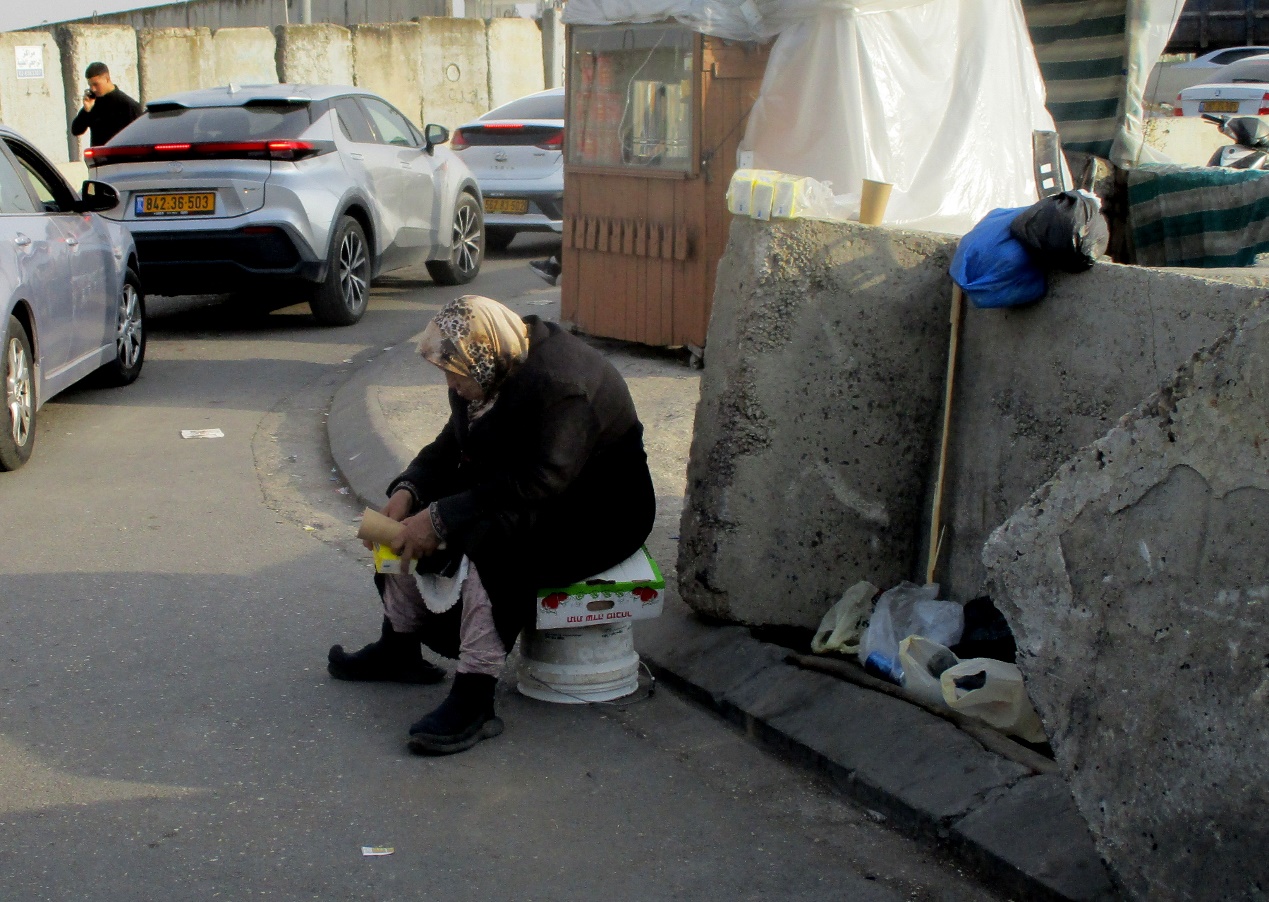 Tamar FleishmanOct-11-2026Qalandiya. Female Beggar
-
