
Qalandiya, Dura alQara’
Translator: Charles K.
Her heart is already burnt.
Calling the settlers’ crimes against Palestinians “Tag Mechir” is misleading.
“Terror” is the only appropriate word to describe the crimes of settlers from Beit El against the residents of the Palestinian neighborhood on whose border the intruders established their fortified locality.
Terror – physical, psychological, racist.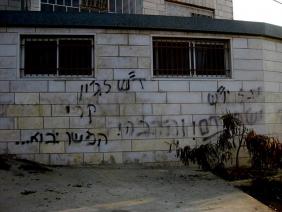
(Wikipedia: “Terror” – a form of violent conflict aimed primarily at civilians in order to achieve political goals.)
This isn’t only writing on the wall, or on cars set on fire in the middle of the night – it’s the terror and helplessness felt by those who, along with their property, are powerless in the face of the malicious behavior of criminals.
“My heart has already been burned,” said Ayesha, describing the settlers’ repeated harassment, saying she no longer has anywhere to go. “Not to America, not Russia, not China,” because in her old age she, who was born in Al-Abasiyya (on whose ruins Yahud was established), from which she’d been expelled during the nakba, and had grown up here, in Dura al-Qara, as a refugee, gave birth to and raised her ten children here, is seeing her world collapse because she and her family are in danger of being expelled again. But she, Ayesha, isn’t going anywhere, nor does anywhere await this old woman whose heart is already burnt.
And Jamal, a soft-spoken man, told us about his children’s nightmares since they were awaked by that huge fire; he doesn’t know how to calm their fears, how to cure their nightmares. All he can do is add more layers of protection to his home and property, to prepare for the coming pogroms.
But neither Ayesha nor Jamal believe this was the final attack; they know the rioters won’t be brought to justice this time, as they weren’t before, and certainly won’t be in the future. Ayesha and Jamal, as well as all their compatriots, know their property and even their physical selves are unprotected, at everyone’s mercy, worthless in the eyes of the army and the police and the law who treat people differently according to the nature of the blood flowing in their veins.
The burning cars:
https://www.youtube.com/watch?feature=player_embedded&v=G1g2H-0S1l4#t=0
Filmed by Ayyad Haddad
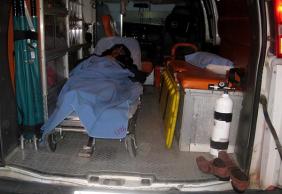
On our way back through the Qalandiya checkpoint in the cold evening we saw a dying man being transferred from one stretcher to another, from the ambulance that brought him from Jenin, where he lives, to an ambulance that came from Jerusalem. Because those are the rules of occupation. And rules must be obeyed, even if they violate humane dictates. Only his shoes lying at the ambulance door, bereft of feet, could say something about the man, the path he chose, which path chose him, how far he got.
Qalandiya Checkpoint / Atarot Pass (Jerusalem)
See all reports for this place-
Click here to watch a video from Qalandiya checkpoint up to mid 2019 Three kilometers south of Ramallah, in the heart of Palestinian population. Integrates into "Jerusalem Envelope" as part of Wall that separates between northern suburbs that were annexed to Jerusalem in 1967: Kafr Aqab, Semiramis and Qalandiya, and the villages of Ar-Ram and Bir Nabala, also north of Jerusalem, and the city itself. Some residents of Kafr Aqab, Semiramis and Qalandiya have Jerusalem ID cards. A terminal operated by Israel Police has functioned since early 2006. As of August 2006, northbound pedestrians are not checked. Southbound Palestinians must carry Jerusalem IDs; holders of Palestinian Authority IDs cannot pass without special permits. Vehicular traffic from Ramallah to other West Bank areas runs to the north of Qalandiya. In February 2019, the new facility of the checkpoint was inaugurated aiming to make it like a "border crossing". The bars and barbed wire fences were replaced with walls of perforated metal panels. The check is now performed at multiple stations for face recognition and the transfer of an e-card. The rate of passage has improved and its density has generally decreased, but lack of manpower and malfunctions cause periods of stress. The development and paving of the roads has not yet been completed, the traffic of cars and pedestrians is dangerous, and t the entire vicinity of the checkpoint is filthy. In 2020 a huge pedestrian bridge was built over the vehicle crossing with severe mobility restrictions (steep stairs, long and winding route). The pedestrian access from public transport to the checkpoint from the north (Ramallah direction) is unclear, and there have been cases of people, especially people with disabilities, who accidentally reached the vehicle crossing and were shot by the soldiers at the checkpoint. In the summer of 2021, work began on a new, sunken entrance road from Qalandiya that will lead directly to Road 443 towards Jerusalem and Tel Aviv. At the same time, the runways of the old Atarot airport were demolished and infrastructure was prepared for a large bus terminal. (updated October 2021)
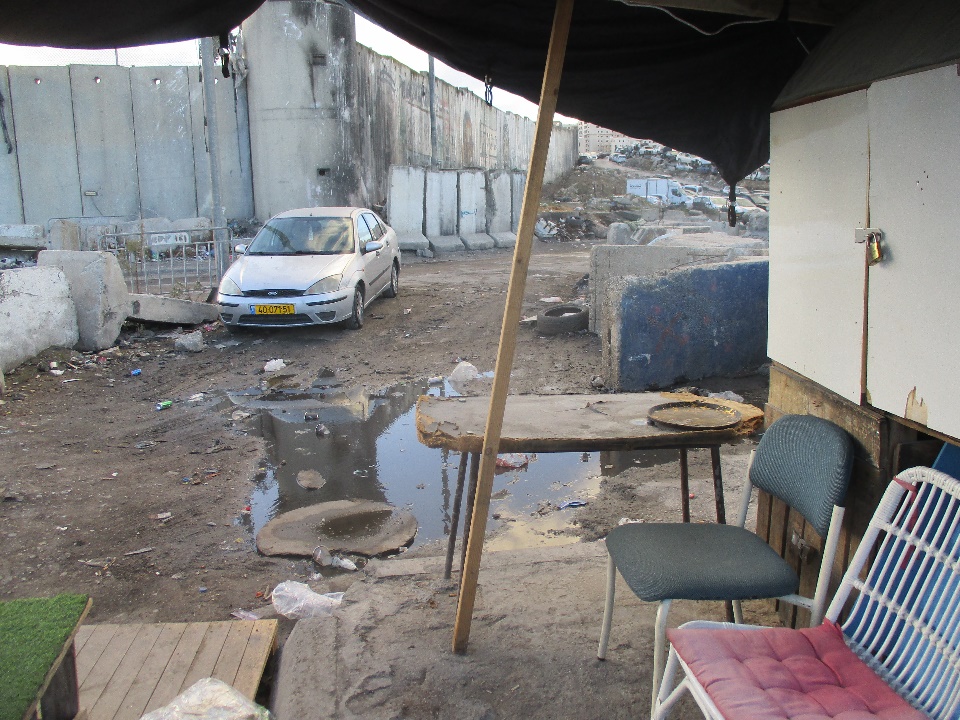 Tamar FleishmanNov-30-2025Qalandiya: Puddles and dirt after the rain
-