
Qalandiya - Everyone who arrives at the checkpoint enters immediately. No delays.
A quiet morning at Qalandiya.
We arrived at 6.20, after collecting our visitor, a student from Germany, studying for a Masters degree in International Law at Hebrew University. We drove along the Wall, not as we usually do along Begin and route 443, so that she could see how the wall separates Palestinians from Israeli Palestinians.
The Jerusalem side of the checkpoint was humming. Many people were waiting for their transport to work, some of them sitting on the low wall next to the major Wall. The public transport area at the foot of the pedestrian bridge was busy. The bridge itself gives a good view of both the Israel and West Bank sides of the checkpoint, and so helps to explain the situation to our visitor.
Many people pass us on the bridge. The West Bank side of the checkpoint is quiet. At least one of the entrances is open and everyone who arrives enters quickly. There are still two big notices: one about the RavKav system and the other, old one about Corona. There is no mention of the renewed rule about wearing masks, but everyone seems to be aware of it
We were happy to meet Abu Ramzi, the beigel-seller, after not seeing him for a long time. He had a grandson with him. When we asked about vaccinations he said that there weren’t any – only workers in Israel were vaccinated. He enjoyed practicing his limited English with our visitor.
A bit lower down from Abu Ramzi was a stall selling food, filling the air with the smell of fried falafel. The tea kiosk is back, in its recently established spot, in its commercial vehicle. It was too hot for us to think of drinking tea. We described to our visitor how in the afternoons the place fills up with stalls selling fruit, vegetables and assorted things. One could see signs of this activity all around. We also explained how sometimes city inspectors come and destroy stalls and write police reports.
We walked along the long fence surrounding the locked parking lot to the Qalandiya entrance and showed her the wall pictures and graffiti on the Wall – Arafat and Barghouti (whom she wasn’t aware of) – and other things. These are all largely obscured by now by fires and smoke bombs. We showed her a point from which one couldn’t approach the vehicle checkpoint on foot. Only recently a woman who passed it was shot. Our visitor had heard of this incident.
We returned to the checkpoint building, showing our visitor the locked gate at the Qalandiya entrance to the parking lot which in the past was the quick way for people to reach the checkpoint. We saw the one place where the space between bars was a bit wider and which thin little children use to squeeze through.
It was now about 7 o’clock. All was quiet, and we decided to go through the checkpoint. Inside, too, all was quiet. There were few electronic positions working, but this was enough as there was no pressure at this hour. We passed through in a couple of minutes without questions, even to our visitor, by the woman soldier doing the checking. Of course, we explained to our visitor how the system works inside, and described the changes over the years. It is hard for a newcomer to imagine those chaotic conditions. [Such a streamlined occupation! We did explain to her that those coming through this speedy process are permit holders. We rarely see here in the early morning people with permit restrictions.]
On the way back to our car, we noticed that the area had apparently been recently cleaned – a spotless sidewalk, and even the area behind the low wall where people sit and throw their empty coffee cups was clean.
On the way, we met Y., who we wrote about in our report of 27.5.2021. The date is soon approaching when he will be able again to submit a request to cancel his restriction, and we spoke about the letter he must bring from an employer for this. If at long last the restriction is canceled, we hope that the authorities will stop harassing him all the time.
Qalandiya Checkpoint / Atarot Pass (Jerusalem)
See all reports for this place-
Click here to watch a video from Qalandiya checkpoint up to mid 2019 Three kilometers south of Ramallah, in the heart of Palestinian population. Integrates into "Jerusalem Envelope" as part of Wall that separates between northern suburbs that were annexed to Jerusalem in 1967: Kafr Aqab, Semiramis and Qalandiya, and the villages of Ar-Ram and Bir Nabala, also north of Jerusalem, and the city itself. Some residents of Kafr Aqab, Semiramis and Qalandiya have Jerusalem ID cards. A terminal operated by Israel Police has functioned since early 2006. As of August 2006, northbound pedestrians are not checked. Southbound Palestinians must carry Jerusalem IDs; holders of Palestinian Authority IDs cannot pass without special permits. Vehicular traffic from Ramallah to other West Bank areas runs to the north of Qalandiya. In February 2019, the new facility of the checkpoint was inaugurated aiming to make it like a "border crossing". The bars and barbed wire fences were replaced with walls of perforated metal panels. The check is now performed at multiple stations for face recognition and the transfer of an e-card. The rate of passage has improved and its density has generally decreased, but lack of manpower and malfunctions cause periods of stress. The development and paving of the roads has not yet been completed, the traffic of cars and pedestrians is dangerous, and t the entire vicinity of the checkpoint is filthy. In 2020 a huge pedestrian bridge was built over the vehicle crossing with severe mobility restrictions (steep stairs, long and winding route). The pedestrian access from public transport to the checkpoint from the north (Ramallah direction) is unclear, and there have been cases of people, especially people with disabilities, who accidentally reached the vehicle crossing and were shot by the soldiers at the checkpoint. In the summer of 2021, work began on a new, sunken entrance road from Qalandiya that will lead directly to Road 443 towards Jerusalem and Tel Aviv. At the same time, the runways of the old Atarot airport were demolished and infrastructure was prepared for a large bus terminal. (updated October 2021)
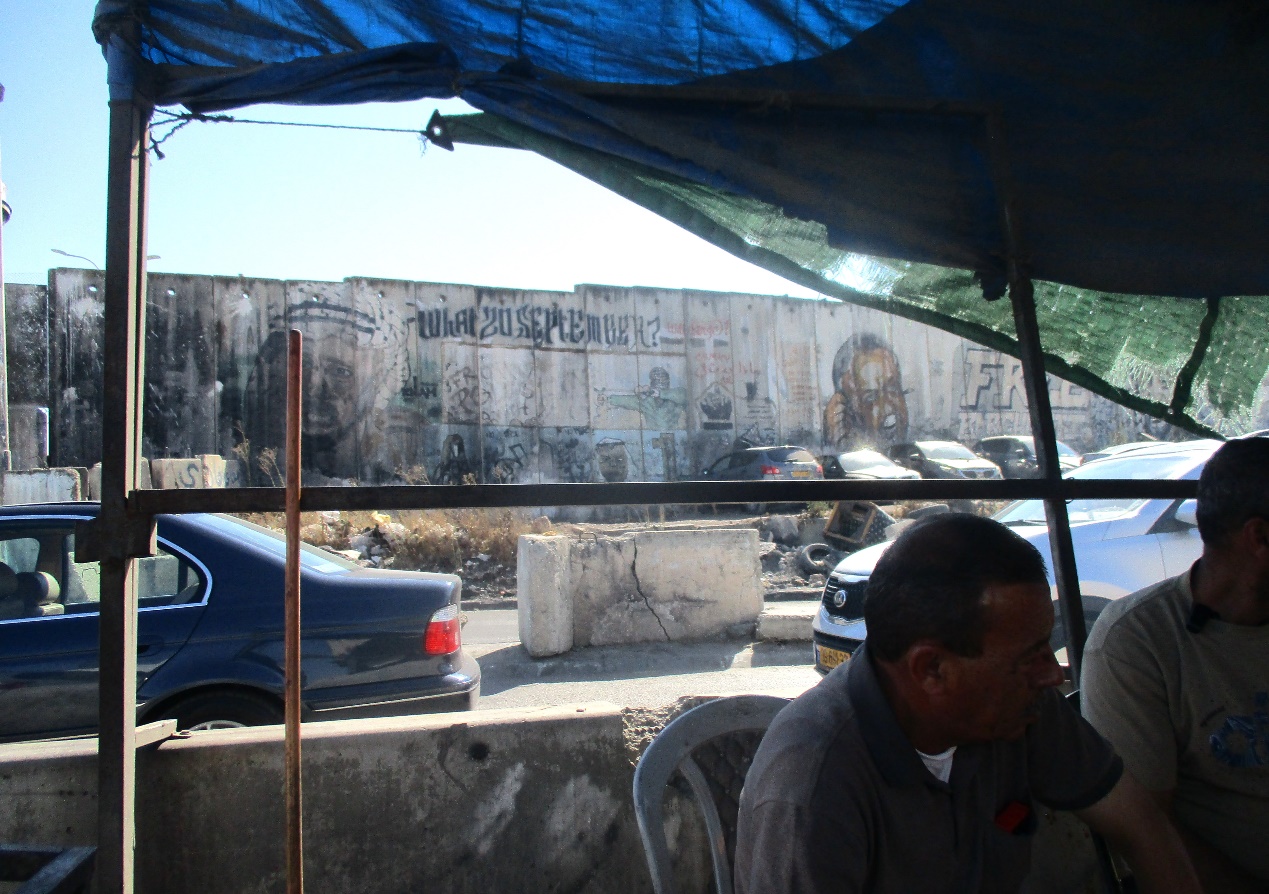 Tamar FleishmanJul-21-2026Qalandiya. Conversation in the shadow of the wall
-
