
Qalandiya, Fri 12.7.13, Morning
Translator: Charles K.
First Friday of Ramadan
A DCO officer (S.N.) at the men’s crossing explains the procedures to representatives of foreign human rights groups 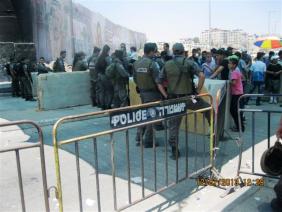
A. Men older than 40 and children under 12 pass freely through the first screening point.
They’re screened according to how old they seem and what appears in their ID.
We saw that the first selection is, as usual, by means of a “fishnet” – Palestinian police working jointly with IDF officers.
Whoever was rejected was sent back via a side path.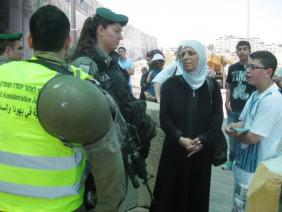
B. Second screening: at the entry to the facility. Then Palestinians older than 40 can go around the facility without inspection.
C. Palestinians younger than 40 proceed to a third screening for inspection at the revolving gates.
11:30 At the third screening:
Three “cages” are open, people released to the revolving gates at five-minute intervals, approximately. 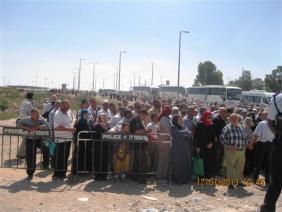
Five fenced corridors are open.
Five men who were turned back put their belts back on; they’d removed them for the inspection.
All the women, and children under 12, went through the women’s crossing.
A Swiss volunteer who’d arrived at 04:00 said that masses of worshippers came at 05:00.
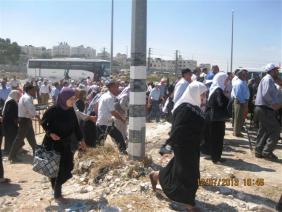
The lines of women, men and children merged at the checkpoint exit and together had a long walk to the buses.
Two minibus drivers reported that a police officer on a motor scooter blocks the buses driving to Jerusalem and demands NIS 50 from each driver. “No, he doesn’t give receipts,” they replied to our question and added that he keeps the money. They estimated that the sum amounts to hundreds of thousands of shekels a day.
The “sterile” area has been subdivided into a number of “sterile” areas. When I stood photographing next to the women’s entrance, Rafi Peretz, a Border Police officer, told me to move back. I insisted on remaining where I was. “I’ll arrest you,” he threatened and grabbed my arm. I demanded he not touch me. He called Yana, a female Border Police soldier, who grabbed my arm hard and dragged me back. Only when I yelled to Annelien to take photos did they quickly release me. (Apparently they’d screwed up enough this week with regard to arrests). Uri Mendescame over a few minutes later. “Why are you doing this? You’re here to see that everything’s ok…” he said. So, Uri Mendes and you other officers, that’s certainly not why I’m/we’re here. Because “ok,” or what you consider “ok,” I consider disgraceful.
An agitated Palestinian (M.A.) from Qalandiya said that when he wanted to go through the first screening a policeman cursed him, saying “Fuck you.” He described the policeman in detail. He complained to the policeman’s superior.
The eased restrictions for Ramadan ended at 12:25. Anyone who hadn’t managed to cross was turned back. Why? “Because the officer said so,” replied the Palestinians who wanted to pray and begged to be allowed through.
Qalandiya Checkpoint / Atarot Pass (Jerusalem)
See all reports for this place-
Click here to watch a video from Qalandiya checkpoint up to mid 2019 Three kilometers south of Ramallah, in the heart of Palestinian population. Integrates into "Jerusalem Envelope" as part of Wall that separates between northern suburbs that were annexed to Jerusalem in 1967: Kafr Aqab, Semiramis and Qalandiya, and the villages of Ar-Ram and Bir Nabala, also north of Jerusalem, and the city itself. Some residents of Kafr Aqab, Semiramis and Qalandiya have Jerusalem ID cards. A terminal operated by Israel Police has functioned since early 2006. As of August 2006, northbound pedestrians are not checked. Southbound Palestinians must carry Jerusalem IDs; holders of Palestinian Authority IDs cannot pass without special permits. Vehicular traffic from Ramallah to other West Bank areas runs to the north of Qalandiya. In February 2019, the new facility of the checkpoint was inaugurated aiming to make it like a "border crossing". The bars and barbed wire fences were replaced with walls of perforated metal panels. The check is now performed at multiple stations for face recognition and the transfer of an e-card. The rate of passage has improved and its density has generally decreased, but lack of manpower and malfunctions cause periods of stress. The development and paving of the roads has not yet been completed, the traffic of cars and pedestrians is dangerous, and t the entire vicinity of the checkpoint is filthy. In 2020 a huge pedestrian bridge was built over the vehicle crossing with severe mobility restrictions (steep stairs, long and winding route). The pedestrian access from public transport to the checkpoint from the north (Ramallah direction) is unclear, and there have been cases of people, especially people with disabilities, who accidentally reached the vehicle crossing and were shot by the soldiers at the checkpoint. In the summer of 2021, work began on a new, sunken entrance road from Qalandiya that will lead directly to Road 443 towards Jerusalem and Tel Aviv. At the same time, the runways of the old Atarot airport were demolished and infrastructure was prepared for a large bus terminal. (updated October 2021)
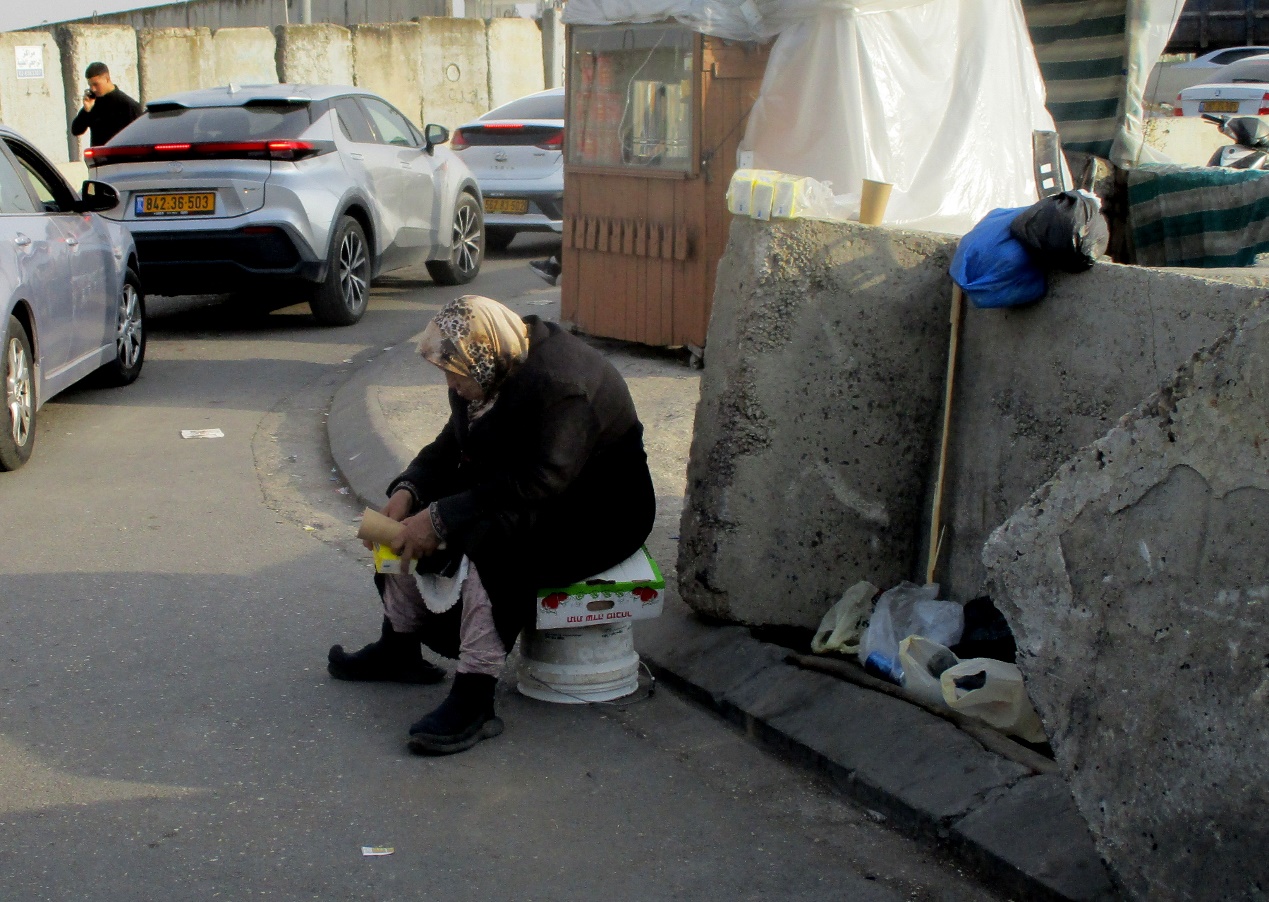 Tamar FleishmanOct-11-2026Qalandiya. Female Beggar
-
