
Qalandiya, Fri 26.8.11, Afternoon
Translation: Ruth Fleishman
fourth Friday of the Ramadan
Why is it that a partial realization of fundamental (Palestinian) human rights is regarded as alleviation and gesture of good will?
The beginning of the "Olive Revolution"
"They took the goat out of the house", our friend Tami described accurately the situation in face of the media's publications regarding the alleviations in the passage for the Friday prayer. There were no alleviations. The same old and familiar regulations were once again implemented.
IDs inspections were performed in hast and urgency, the likes of which we had never before seen. The military forces had been preparing from the early morning hours to greet the people of the "Olive Revolution" and prevent the masses from joining it .
.
The Palestinians, whose bodies and pride had been crushed after tens of year of humiliation, quickly obeyed the orders.
Only a few raised their voices, attempted, begged, urged the uniformed man who was holding their IDs and checking to see their date of birth. In spite of the rapidity and speediness there seemed to be no place of gestures of good will, and when a father escorted by his sons, one of eleven years and other of thirteen, he was force to decide whether it would be best to head back with them both, or continue the journey and leave the eldest behind, a person from the administration patronizingly gave him some advice: "what's the big deal, give him some money and he'll go back home in a cab…".
The age barrier once again separated women from their husbands, children from their parents and prevented from the young and healthy to support their handicapped parents or grandparents.
As the hour of the prayer was approaching the pressure at the men's passage grew higher and people in the crowed started to complain. A BP officer rebuked them: "We've been letting you pass all week, and this is how you pay us back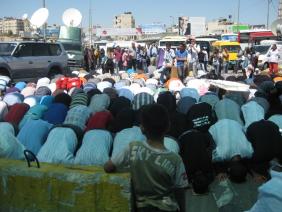 ?…"
?…"
The signal for the beginning of the "Olive Revolution" was given when Ashraf Abu-Rahma, whose brother and sister had died while participating in the non-violent protest against the building of the separation wall in Bil'in, climbed on top of the part of the wall that was closest to the site, waved Palestinian flags and handed them to the people surrounding him. "Arrest him!", the order was head. Hands armed with weapons pulled and tipped Ashraf over. The struggle began. Ashraf was outflanked and he and his friend were dragged away. Ashraf was taken away but kept resisting, while his friend, held by the hand by a BP man, walked aside his capturer with his head high up. The two were arrested and taken to the inner zone.
Rows on top of rows of men and women faced the soldiers and concrete walls. A religious Muslim dressed in white blessed the believers and held a prayer. Tens of people kneeled on the filthy ground and raised the voices to their god.
Once the prayer had ended, Palestine flags and purple flags (the symbol of the revolution) were raised, and standing in front of the blockages, walls and soldiers the protesters sang songs of freedom and shouted slogans expressing hope for peace, emancipation and independence.
The protest lasted an hour. When the announcer thanked those who came, declared that the protest had ended for that day and promised that the attendants and many other would continue to protest and knock on Jerusalem doors, the officers ordered the soldiers to disperse the protest and gas grenades were thrown at the crowd. As though it were all part of a ritual, the young man responded by throwing stones, ambulances arrived, the injured were taken care of as some were transferred to hospitals, the peddlers promoted their merchandise while those retuning from the Friday prayers at Al- Aqsa were streaming from the other side of the checkpoint back to their home, at Palestine.
-Until the upcoming Ramadan-the next protest- the upcoming revolution? Until the outburst of the September events?
The flowing link is to a video of the protest and it's dispersing.
Qalandiya Checkpoint / Atarot Pass (Jerusalem)
See all reports for this place-
Click here to watch a video from Qalandiya checkpoint up to mid 2019 Three kilometers south of Ramallah, in the heart of Palestinian population. Integrates into "Jerusalem Envelope" as part of Wall that separates between northern suburbs that were annexed to Jerusalem in 1967: Kafr Aqab, Semiramis and Qalandiya, and the villages of Ar-Ram and Bir Nabala, also north of Jerusalem, and the city itself. Some residents of Kafr Aqab, Semiramis and Qalandiya have Jerusalem ID cards. A terminal operated by Israel Police has functioned since early 2006. As of August 2006, northbound pedestrians are not checked. Southbound Palestinians must carry Jerusalem IDs; holders of Palestinian Authority IDs cannot pass without special permits. Vehicular traffic from Ramallah to other West Bank areas runs to the north of Qalandiya. In February 2019, the new facility of the checkpoint was inaugurated aiming to make it like a "border crossing". The bars and barbed wire fences were replaced with walls of perforated metal panels. The check is now performed at multiple stations for face recognition and the transfer of an e-card. The rate of passage has improved and its density has generally decreased, but lack of manpower and malfunctions cause periods of stress. The development and paving of the roads has not yet been completed, the traffic of cars and pedestrians is dangerous, and t the entire vicinity of the checkpoint is filthy. In 2020 a huge pedestrian bridge was built over the vehicle crossing with severe mobility restrictions (steep stairs, long and winding route). The pedestrian access from public transport to the checkpoint from the north (Ramallah direction) is unclear, and there have been cases of people, especially people with disabilities, who accidentally reached the vehicle crossing and were shot by the soldiers at the checkpoint. In the summer of 2021, work began on a new, sunken entrance road from Qalandiya that will lead directly to Road 443 towards Jerusalem and Tel Aviv. At the same time, the runways of the old Atarot airport were demolished and infrastructure was prepared for a large bus terminal. (updated October 2021)
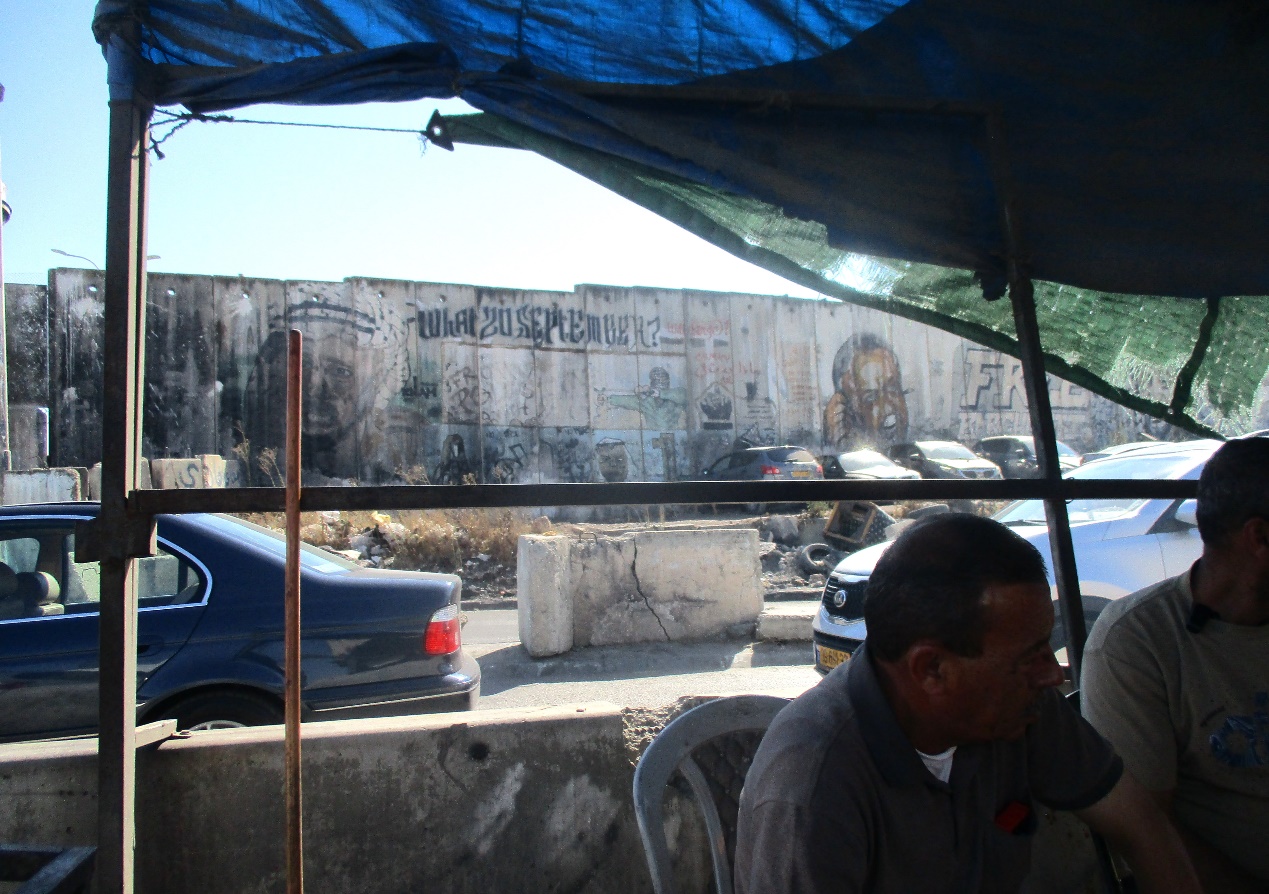 Tamar FleishmanJul-21-2026Qalandiya. Conversation in the shadow of the wall
-
