
Qalandiya, Fri 3.8.12, Afternoon

Translating: Ruth Fleishman
Third Friday of the Ramadan
"We work only according toorders. Nothing can be done!" said an officer.
There really was nothing that could be done.

No, to the disabled woman who entered from the direction of the area designated for women and tottered towards the other side of the building- which was designated for men. There, behind the fences, between the huddles of men who had yet to turn forty, stood her son. The woman went from a soldier, to a BP man and then to an officer, she begged that her son be permitted to join her, she said that without him she would be lost…, "Does he have a permit?" They asked, "No, he doesn't, but…", "it's impossible!" was the verdict.
After all they work only according to orders.
No, also to the young man who led his two festively dressed daughters. He managed to break through the first line of soldiers and was caught at the next inspection post- in consistence with the fishing net method.  He tried his luck and stood at the humanitarian line which is designated for elder men (over forty) and was sent back, and he tried at the checkpoint where the special prayer permits held by young men are inspected but his request was once again denied, and he went over to the women's passage and was thrown out in shame, and he walked back and forth at the so called sterile zone. "My girls wanted to go to Jerusalem", he told me, "and their mother had already passed earlier, she arrived at the ancient city, I called her and she came back to take the girls".
  The man whose home is in Ar-Ram, wanted to pray, but knew that if he requested a permit he wouldn't receive it, because a year ago he was caught working illegally in Israel, and after spending a month in prison he is now on probation and registered at the GSS as "prevented passage".
Once again- in accordance with the orders.

And no to many others, young men or teenagers that didn't qualify according to the standards of the cold hearted policy makers. Women passed quickly and had their belongings inspected, men, however, were defined dangerous between the ages of 12 to 40 and not a month less. And documents were inspected thoroughly, and the children had to have their original Kushan (birth certificate) and one of their parents. Those accompanying their uncle or a friend were sent away.
Once again- everything is in accordance with the orders.
And regulations were changed according to the orders at noon: the metal partitions were dragged away and a line of soldiers was placed instead, separating the crowd from the path leading to the checkpoint. And then a thin and red headed man stood on one of the concrete blocks, he was the prayer leader. He held a sermon before the hundreds that weren't permitted to pass and once he finished prayer-matts were placed on the ground and the people stood in line behind the sermonizer and held a prayer with great intention, they raised their hands pleading to their god and knelt on the filthy ground between the barbed wires and the men in uniform.
Among the thousands of men and women who flowed to the checkpoint like streams of human beings, one could see the portrait of those who had been murdered hanging from the inside walls, one of them was Ali Khalifa whom I had met, I had taken his photo and wrote about him:
http://palestinechronicle.com/view_article_details.php?id=17099
There was a pleasurable moment in that filth when an old women support by a cane got out from among the group of men and proceeded determinately to walk towards the soldiers, this is what they call "a checkpoint break-in". She did not adhere to regulations, norm or orders, and didn't present her ID nor did she arrive from the zone designated for her sex. Despite her slow pace it seemed as though she was dashing forward, vigorously and enthusiastically, and she passed right by them while looking towards her destination.
And they, who couldn't stop her and her spirit, looked away, pretending not to see.
Qalandiya Checkpoint / Atarot Pass (Jerusalem)
See all reports for this place-
Click here to watch a video from Qalandiya checkpoint up to mid 2019 Three kilometers south of Ramallah, in the heart of Palestinian population. Integrates into "Jerusalem Envelope" as part of Wall that separates between northern suburbs that were annexed to Jerusalem in 1967: Kafr Aqab, Semiramis and Qalandiya, and the villages of Ar-Ram and Bir Nabala, also north of Jerusalem, and the city itself. Some residents of Kafr Aqab, Semiramis and Qalandiya have Jerusalem ID cards. A terminal operated by Israel Police has functioned since early 2006. As of August 2006, northbound pedestrians are not checked. Southbound Palestinians must carry Jerusalem IDs; holders of Palestinian Authority IDs cannot pass without special permits. Vehicular traffic from Ramallah to other West Bank areas runs to the north of Qalandiya. In February 2019, the new facility of the checkpoint was inaugurated aiming to make it like a "border crossing". The bars and barbed wire fences were replaced with walls of perforated metal panels. The check is now performed at multiple stations for face recognition and the transfer of an e-card. The rate of passage has improved and its density has generally decreased, but lack of manpower and malfunctions cause periods of stress. The development and paving of the roads has not yet been completed, the traffic of cars and pedestrians is dangerous, and t the entire vicinity of the checkpoint is filthy. In 2020 a huge pedestrian bridge was built over the vehicle crossing with severe mobility restrictions (steep stairs, long and winding route). The pedestrian access from public transport to the checkpoint from the north (Ramallah direction) is unclear, and there have been cases of people, especially people with disabilities, who accidentally reached the vehicle crossing and were shot by the soldiers at the checkpoint. In the summer of 2021, work began on a new, sunken entrance road from Qalandiya that will lead directly to Road 443 towards Jerusalem and Tel Aviv. At the same time, the runways of the old Atarot airport were demolished and infrastructure was prepared for a large bus terminal. (updated October 2021)
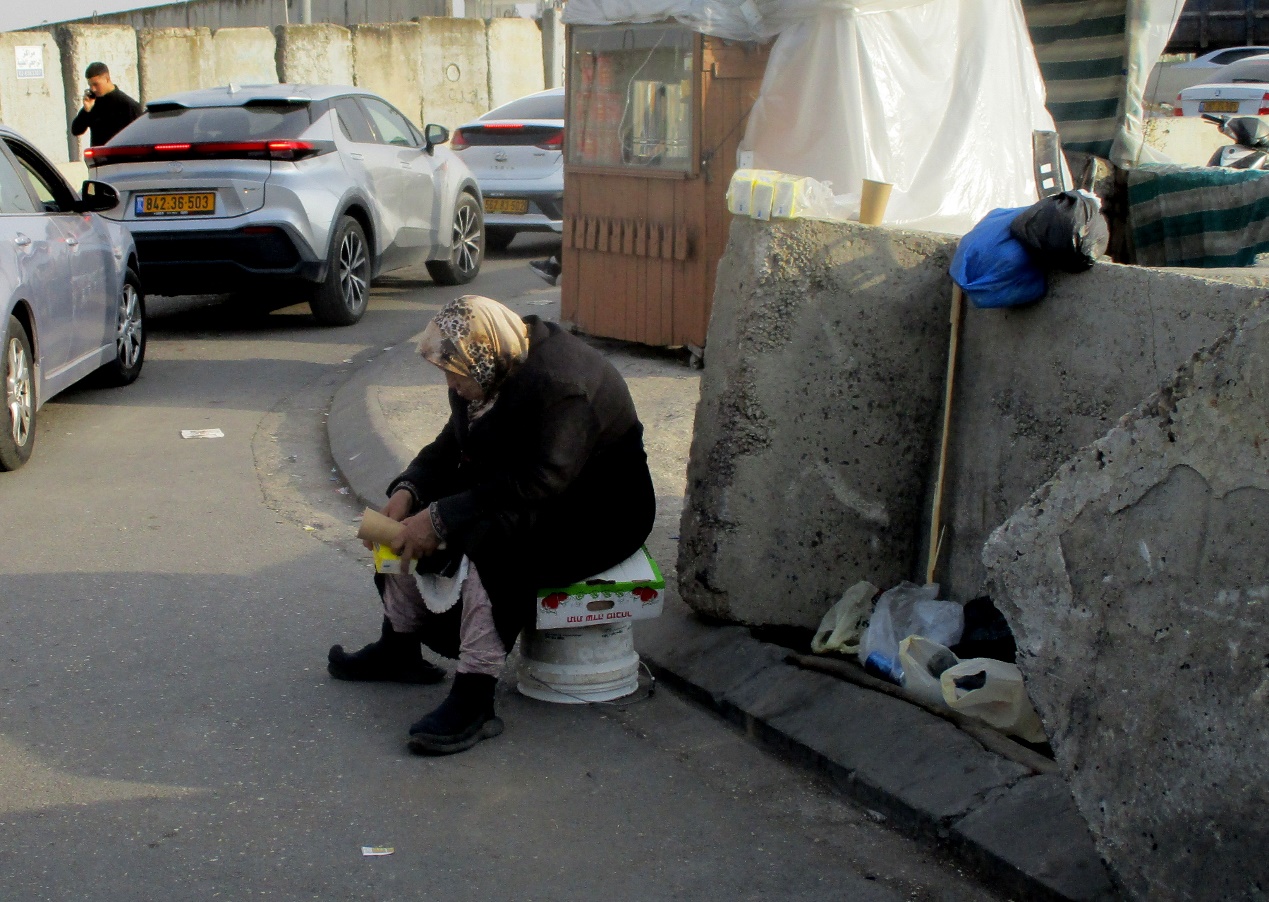 Tamar FleishmanOct-11-2026Qalandiya. Female Beggar
-
