
Qalandiya - God is in the small details
God is in the minor details.
God is in the space between the permitted and the forbidden, the ever-growing fences, in cracks that close, in breaches that are sealed, in laws that limit and in rifles that kill.
The more heavily armed the ruler becomes, the more he closes himself in among his defenses, and the suffering of his victim grows accordingly.
The architecture of the checkpoint is no chance occurrence. It has an ideology and a purpose. It must strengthen its hold on the controlled population and intensify the might of the controlling power.

No one coming or going to and from Palestine can evade the mighty bridge.
He/she must climb and walk hundreds of meters to cross a distance that in fact measures only a few meters.
An acquaintance living in the refugee camp spoke about the hardship and difficulties facing the elderly, disabled persons seated in wheelchairs, women carrying toddlers or pushing prams, and finished by asking, rhetorically: “What would it have cost them to arrange for an elevator, even just one?” And asserted: “It’s because the Zionists don’t care about people”.
The man continued, telling me about a destruction prophecy that has been making the rounds, according to which Israel will be erased from the face of the earth in two months’ time. “So, we don’t have to do anything. Just wait. And you? -You are one of us. You’ll come live with us.”
Although this was a compliment of sorts in the face of helplessness and despair, it was mainly an expression of sorrow.

Crossing over from the checkpoint to the bridge – which until lately had been a narrow corridor flanked on both sides by concrete – used to be the youngsters’ chance to lift themselves over the concrete and jump into the track from there, saving time. This chance no longer exists. Above the concrete a metal railing up to the ceiling has been erected and the person walking this corridor now feels like someone proceeding in a corral-like cage.

Furthermore, the breach which Palestinians had created in the fence surrounding the checkpoint has now been blocked with planks and metal. It used to be an opening that anyone bending down (myself included) could pass under and save themselves a long walk.
But the human spirit aspiring resistance cannot be blocked by planks nor metal rods. Even after this blocking and railings, some brave ones still manage to squirm their way in and jump over, even when they know that everything – literally everything – is photographed and to be reckoned with.
What do they care about a hole in the fence? Why should they care that people working hard in construction all day would have less of a walk home?” – asked or claimed a man standing next to me facing the fence.
The point is that they do care. He knows, I know, and they certainly know – but no doubt Leonard Cohen was right, singing that
There is a crack in everything
That’s how the light gets in.

Qalandiya Checkpoint / Atarot Pass (Jerusalem)
See all reports for this place-
Click here to watch a video from Qalandiya checkpoint up to mid 2019 Three kilometers south of Ramallah, in the heart of Palestinian population. Integrates into "Jerusalem Envelope" as part of Wall that separates between northern suburbs that were annexed to Jerusalem in 1967: Kafr Aqab, Semiramis and Qalandiya, and the villages of Ar-Ram and Bir Nabala, also north of Jerusalem, and the city itself. Some residents of Kafr Aqab, Semiramis and Qalandiya have Jerusalem ID cards. A terminal operated by Israel Police has functioned since early 2006. As of August 2006, northbound pedestrians are not checked. Southbound Palestinians must carry Jerusalem IDs; holders of Palestinian Authority IDs cannot pass without special permits. Vehicular traffic from Ramallah to other West Bank areas runs to the north of Qalandiya. In February 2019, the new facility of the checkpoint was inaugurated aiming to make it like a "border crossing". The bars and barbed wire fences were replaced with walls of perforated metal panels. The check is now performed at multiple stations for face recognition and the transfer of an e-card. The rate of passage has improved and its density has generally decreased, but lack of manpower and malfunctions cause periods of stress. The development and paving of the roads has not yet been completed, the traffic of cars and pedestrians is dangerous, and t the entire vicinity of the checkpoint is filthy. In 2020 a huge pedestrian bridge was built over the vehicle crossing with severe mobility restrictions (steep stairs, long and winding route). The pedestrian access from public transport to the checkpoint from the north (Ramallah direction) is unclear, and there have been cases of people, especially people with disabilities, who accidentally reached the vehicle crossing and were shot by the soldiers at the checkpoint. In the summer of 2021, work began on a new, sunken entrance road from Qalandiya that will lead directly to Road 443 towards Jerusalem and Tel Aviv. At the same time, the runways of the old Atarot airport were demolished and infrastructure was prepared for a large bus terminal. (updated October 2021)
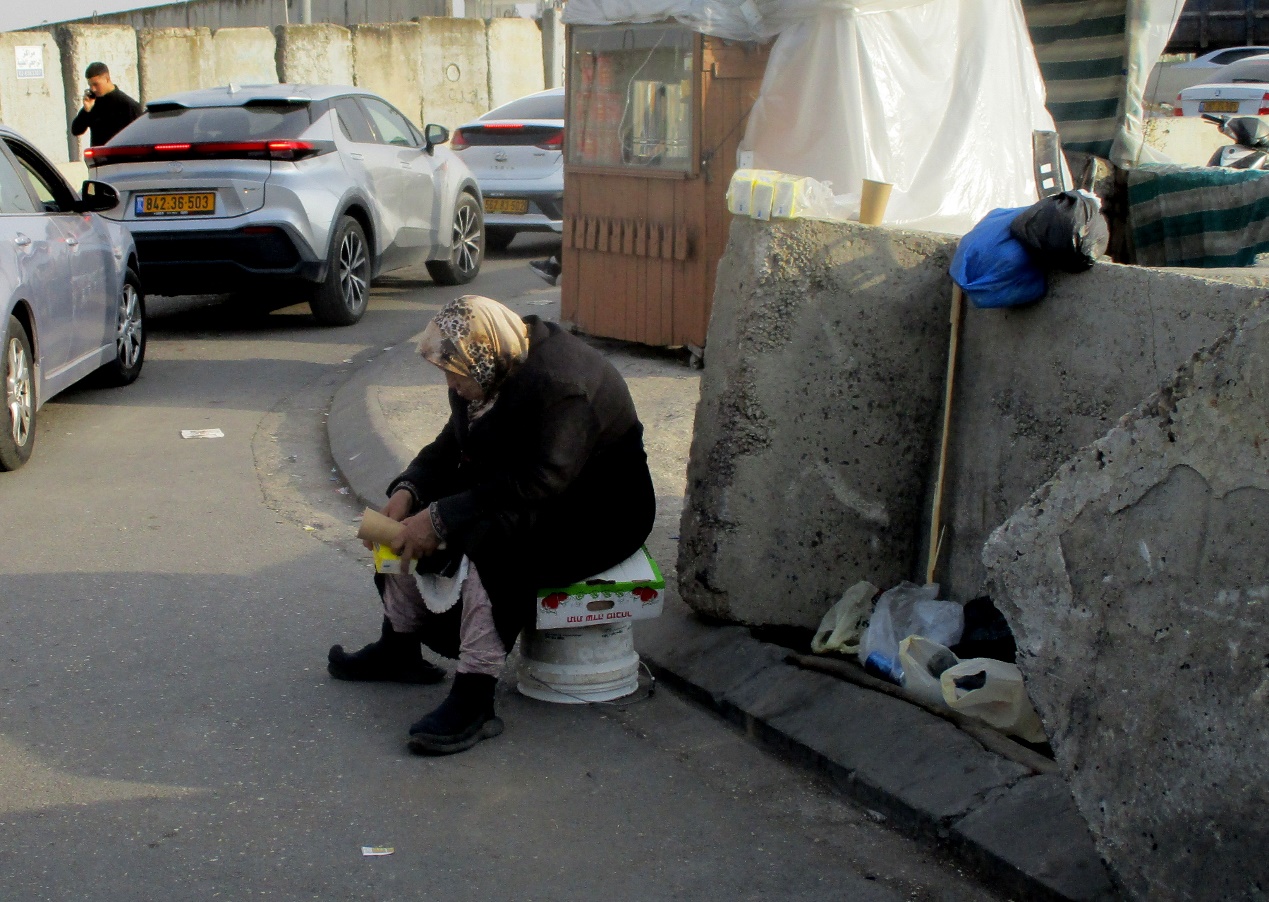 Tamar FleishmanOct-11-2026Qalandiya. Female Beggar
-
