
Qalandiya - “If you were an Arab, they’d shoot you”
“If you were an Arab, they’d shoot you”.
Everywhere and from everyone comes the same moaning:
No customers, no clients, no work, no money to bring home.
And as in any time of despair and distress, what is left for man is the faith in powers that not those of nature, and God is the one who grows in power.
On the main road, in front of the refugee camp, an army armored car sped along with a Palestinian license plate from Ramallah, eastward. I have never seen one like it.
Some minutes later, a young man – panting, running into a shop I was standing in – bought a mask and said he was caught by Palestinian police when crossing a checkpoint at the entry to Ramallah for not wearing a mask, the policemen took his ID from him, and when noticing that it was a blue one (as a resident of Aqab village, he has a Jerusalem-resident ID) that the relevant sovereign is Israel, notified him that the ID would be passed along to the Israeli secret services (Shabak) and returned to him with notice of fine, at the Binyamin police station (West Bank). Only the man does not know where this is and how to get there.
I let him go and he ran on, looking for transport to his destination.
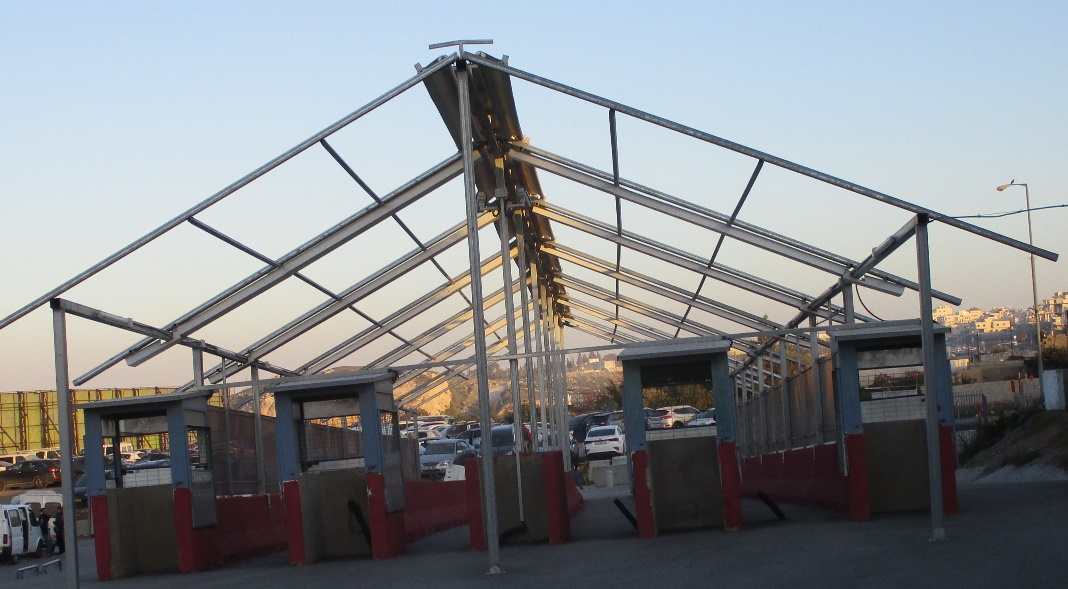
On the way to the checkpoint, new corrals await Ramadan that will be with us in 2 months’ time.
On the Jerusalem side of the checkpoint, a Red Cross ambulance stood waiting for a West bank one, to take back home a cancer patient that had been treated at Augusta Victoria Hospital in East Jerusalem.
After a considerable while, the ambulances met, the woman was taken out on a stretcher, the medical team acted skillfully, the procedure fulfilled all laws and instructions from above and God forbid not by logic or heart, as if it were right to delay ambulances and transfer aching patients from one stretcher to another, in full view of pointed guns, and not through direct travel from one hospital to the patient’s home.
The woman groaned with pain, but even as she was lifted by the medical teams and a scream of pain filled the air and the heart, not a word was said against this would-be axiom that this is how things run, by law.

True, the story of the cancer patient is the center of it all, but since every person knows herself, I shall also related a mini-drama that took place on the outside of things:
When I approached, an armed security guard chased me, and on the back side of his cap he had a skull sticker – some kind of Nazi insignia. The man claimed this was a security zone and demanded, yelling and cursing, that I bugger off.
I insisted on staying.
The guard went away and returned with a soldier who ordered the ambulance to park in the far-off corner, telling me that if I get close to it, I’ll be shot.
I crawled after the ambulance.
The soldier went and returned with a good-natured policeman who half said-half asked: “I understand you want to cross over to the other side of the checkpoint and don’t know how?” I answered that no, I was here to watch a back-to-back procedure. “Oh,” said the policeman, “no problem”, and left.
A Palestinian who heard the exchange had this to say: “If you were an Arab, they’d shoot you.”
Qalandiya Checkpoint / Atarot Pass (Jerusalem)
See all reports for this place-
Click here to watch a video from Qalandiya checkpoint up to mid 2019 Three kilometers south of Ramallah, in the heart of Palestinian population. Integrates into "Jerusalem Envelope" as part of Wall that separates between northern suburbs that were annexed to Jerusalem in 1967: Kafr Aqab, Semiramis and Qalandiya, and the villages of Ar-Ram and Bir Nabala, also north of Jerusalem, and the city itself. Some residents of Kafr Aqab, Semiramis and Qalandiya have Jerusalem ID cards. A terminal operated by Israel Police has functioned since early 2006. As of August 2006, northbound pedestrians are not checked. Southbound Palestinians must carry Jerusalem IDs; holders of Palestinian Authority IDs cannot pass without special permits. Vehicular traffic from Ramallah to other West Bank areas runs to the north of Qalandiya. In February 2019, the new facility of the checkpoint was inaugurated aiming to make it like a "border crossing". The bars and barbed wire fences were replaced with walls of perforated metal panels. The check is now performed at multiple stations for face recognition and the transfer of an e-card. The rate of passage has improved and its density has generally decreased, but lack of manpower and malfunctions cause periods of stress. The development and paving of the roads has not yet been completed, the traffic of cars and pedestrians is dangerous, and t the entire vicinity of the checkpoint is filthy. In 2020 a huge pedestrian bridge was built over the vehicle crossing with severe mobility restrictions (steep stairs, long and winding route). The pedestrian access from public transport to the checkpoint from the north (Ramallah direction) is unclear, and there have been cases of people, especially people with disabilities, who accidentally reached the vehicle crossing and were shot by the soldiers at the checkpoint. In the summer of 2021, work began on a new, sunken entrance road from Qalandiya that will lead directly to Road 443 towards Jerusalem and Tel Aviv. At the same time, the runways of the old Atarot airport were demolished and infrastructure was prepared for a large bus terminal. (updated October 2021)
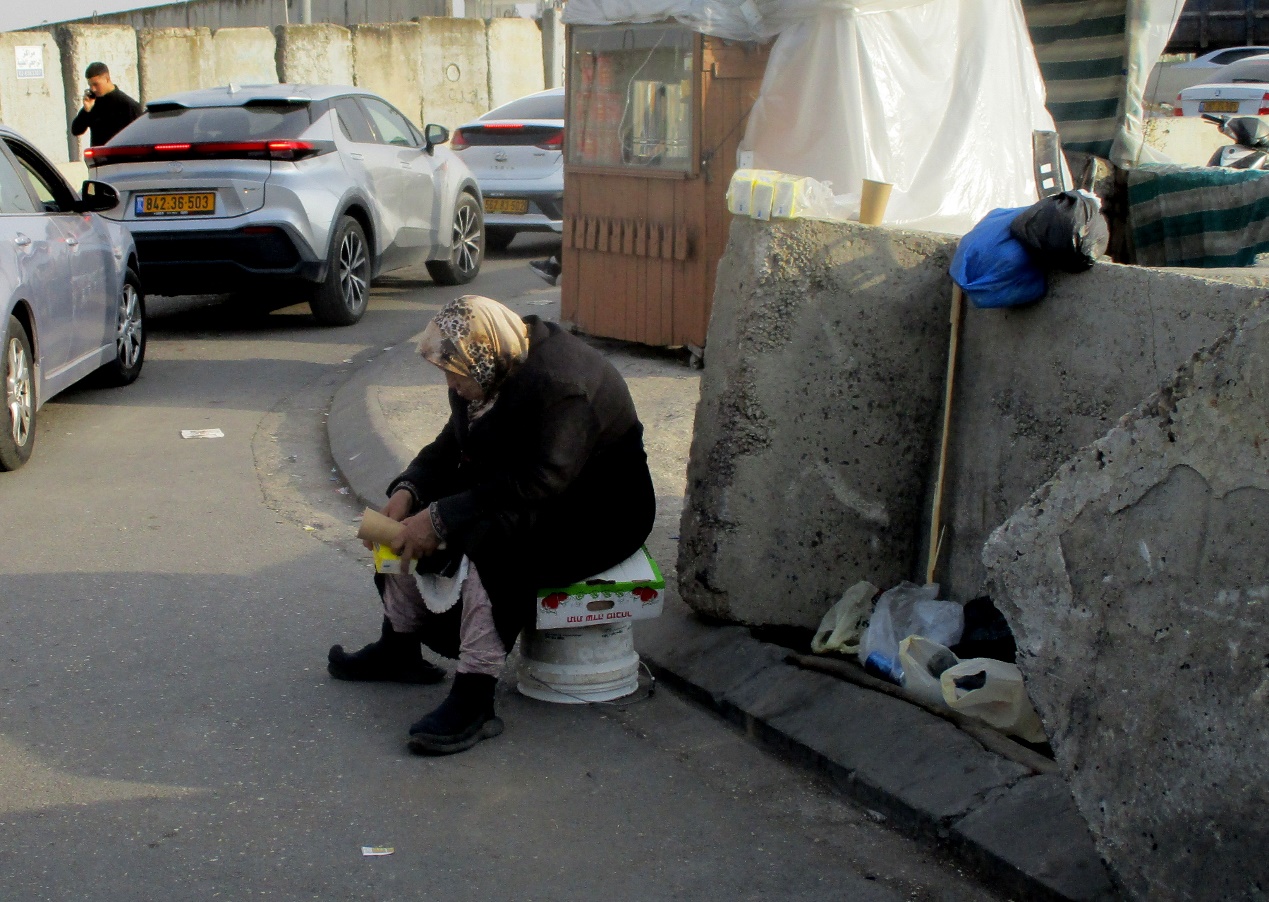 Tamar FleishmanOct-11-2026Qalandiya. Female Beggar
-
