
Qalandiya - lively trade in fruits, vegetables and other products
A reasonable morning in Qalandiya. We continue to park on the Palestinian side because due to the works on the Israeli side there is no place to park there. Even as we approached from the Israeli side in the dark, we saw that the horrible pedestrian bridge was covered in sparkling lights for Christmas. The contrast between the sparkling lights and what is happening here screams to the sky…
We arrived at a quarter to six. Our first stop is at our friend Abu Ramzi, the beigel seller. He is fine, but his mood has been low since his wife’s death. It’s hard to live without a wife, he says.
Near him, there is a falafel (and other food) stand that operates as usual, and opposite him, the kiosk. The cake seller was located today under the shed, near one of the entrances to the checkpoint building. At the edge of the shed stands a new booth inside a kind of trailer. He sells cards for mobile phones (Palestinians usually use a phone with a prepaid card) and he has the clientele. He also has a loudspeaker that announces his wares. I wonder how he is allowed to settle here and whether the municipality will boycott him, destroy and write reports from time to time. If he’s still here on our next shift we’ll try to talk to him.


Our guests have visited the checkpoint before, but that was in the days of the old checkpoint. As usual, when we have guests we make a tour with them and explain what is happening. The relatively new mural, along the road where the cars drag on the way to the car barrier, is very impressive and stands in stark contrast to the ugliness and dirt all around. Everywhere there are cartons and evidence of the lively trade in fruits and vegetables and other products that takes place here later in the day. The murals on the section of the wall facing the Qalandiya camp are already mostly covered in soot, and it is difficult to distinguish the portrait of Barghouti and the inscription calling for his release, as well as one of the portraits of Arafat.
Between the shed of the vehicle barrier and the fence of the pedestrian barrier complex (and in the background the wall that fences off the neighborhood next to the barrier), we were able to photograph a section of the decoration on the bridge. Dawn has already begun to rise, so the lights are less prominent. When fully light the illuminations went out.
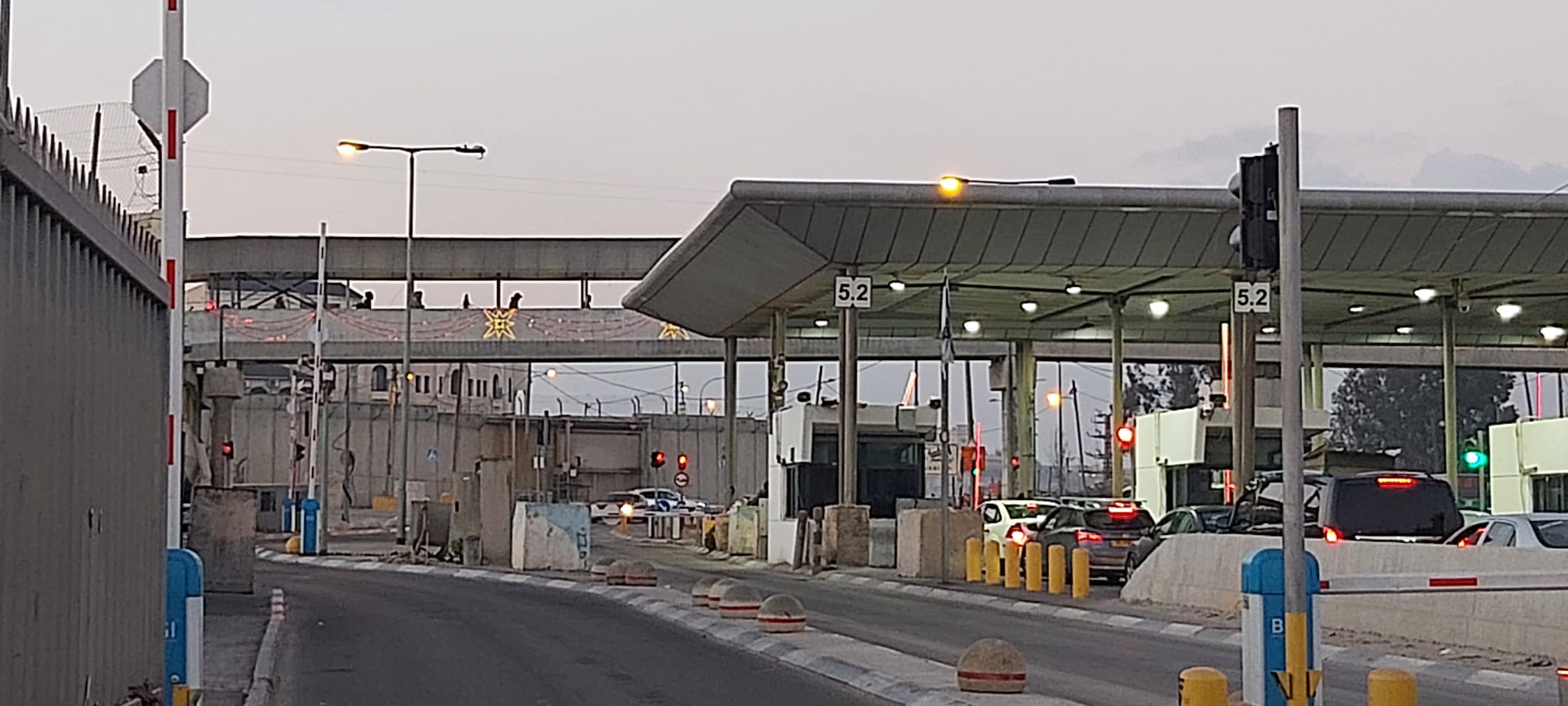
In the checkpoint complex itself, there were no queues under the shed and outside it during our entire stay. The three entrances were open all the time and the many people who arrived entered immediately without delay. At a quarter to seven, I passed the checkpoint with our guests. The transition took less than 10 minutes, including checking the guests’ passports. All 6 positions for checking objects were open. There were no special delays. Our guests got to see how the Palestinians pass with the magnetic card in the automatic machines with the camera. And also how children go to school and show the official birth certificate (“Khushan”) to the female soldier at the certificate checking station. Our guests fully understood that the technological improvements are also a sign of planned permanence. They understand, too, that at this early hour we hardly ever meet Palestinians who are refused permits, because these are workers who have already acquired them.
On the Israeli side, we went up on the dreadful pedestrian bridge and watched the work on the underpass, as well as the bus terminal that was built on the other side of the bridge and in the area where there is a plan to build a Jewish residential neighborhood. In the current political situation, this may still come true. This time we also went downstairs and approached to see if the shiny new toilet structure that was placed there was actually in use. It has an entrance for men, an entrance for women and in the middle for the disabled. But surprise (?!), all the doors were locked…


On the way back, we noticed that the traffic queue toward the checkpoint is relatively short. We drove through A-Ram. The Jabba temporary checkpoint was not manned this time. We arrived quite quickly at the Hizmeh checkpoint, which we passed without being checked. Since the schools were on Hanukkah vacation, the traffic situation even after the Hizmeh checkpoint was reasonable, and we arrived in the city center in a short time.
Qalandiya Checkpoint / Atarot Pass (Jerusalem)
See all reports for this place-
Click here to watch a video from Qalandiya checkpoint up to mid 2019 Three kilometers south of Ramallah, in the heart of Palestinian population. Integrates into "Jerusalem Envelope" as part of Wall that separates between northern suburbs that were annexed to Jerusalem in 1967: Kafr Aqab, Semiramis and Qalandiya, and the villages of Ar-Ram and Bir Nabala, also north of Jerusalem, and the city itself. Some residents of Kafr Aqab, Semiramis and Qalandiya have Jerusalem ID cards. A terminal operated by Israel Police has functioned since early 2006. As of August 2006, northbound pedestrians are not checked. Southbound Palestinians must carry Jerusalem IDs; holders of Palestinian Authority IDs cannot pass without special permits. Vehicular traffic from Ramallah to other West Bank areas runs to the north of Qalandiya. In February 2019, the new facility of the checkpoint was inaugurated aiming to make it like a "border crossing". The bars and barbed wire fences were replaced with walls of perforated metal panels. The check is now performed at multiple stations for face recognition and the transfer of an e-card. The rate of passage has improved and its density has generally decreased, but lack of manpower and malfunctions cause periods of stress. The development and paving of the roads has not yet been completed, the traffic of cars and pedestrians is dangerous, and t the entire vicinity of the checkpoint is filthy. In 2020 a huge pedestrian bridge was built over the vehicle crossing with severe mobility restrictions (steep stairs, long and winding route). The pedestrian access from public transport to the checkpoint from the north (Ramallah direction) is unclear, and there have been cases of people, especially people with disabilities, who accidentally reached the vehicle crossing and were shot by the soldiers at the checkpoint. In the summer of 2021, work began on a new, sunken entrance road from Qalandiya that will lead directly to Road 443 towards Jerusalem and Tel Aviv. At the same time, the runways of the old Atarot airport were demolished and infrastructure was prepared for a large bus terminal. (updated October 2021)
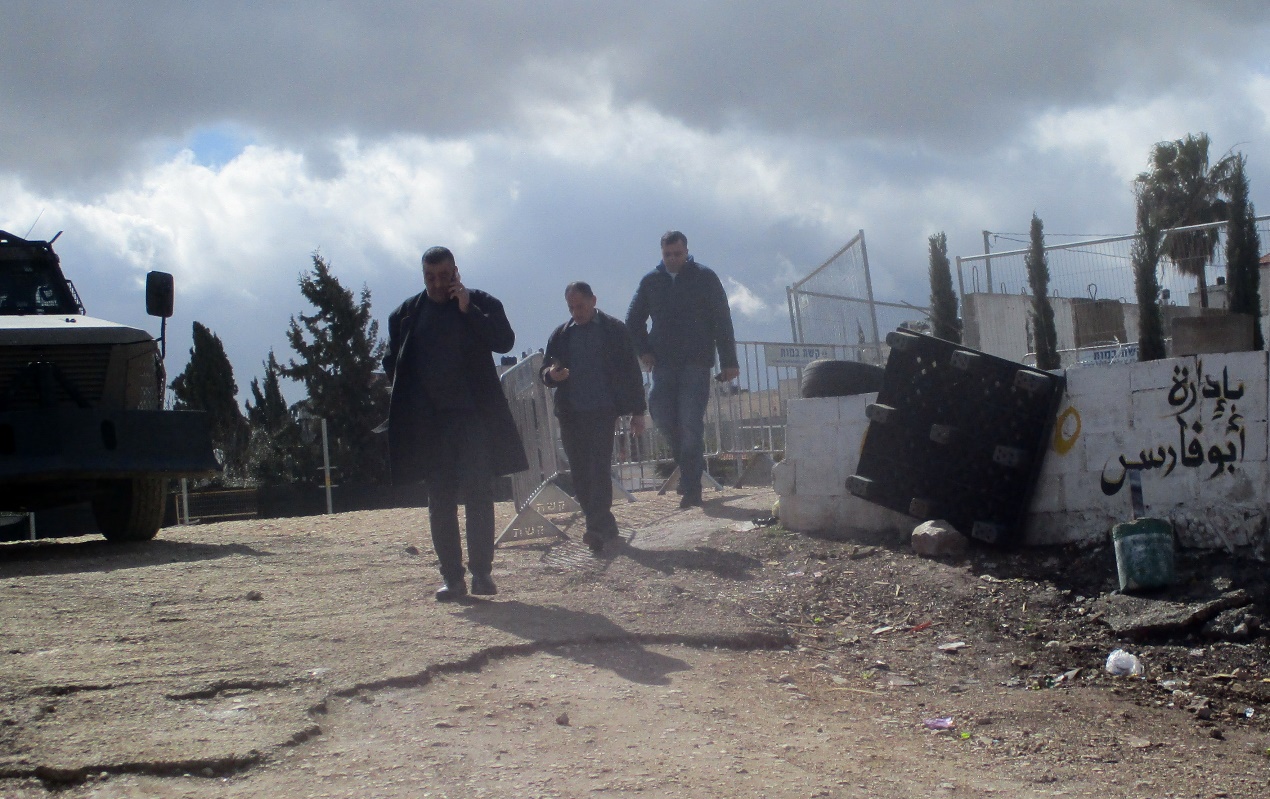 Tamar FleishmanFeb-27-2026Qalandiya: On the way to prayer
-